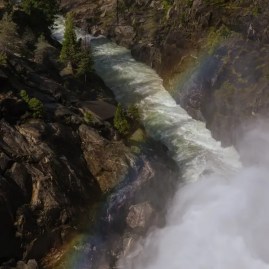
Water released from Hetch Hetchy Reservoir’s O’Shaughnessy Dam flows into the Tuolumne River. The reservoir currently supplies drinking water to 2.7 million San Francisco Bay Area residents. Photograph by Aubrey Trinnaman
We are gratified to know of such a place as a snow lab, and that their scientists share their knowledge in language we can all understand:
California’s Snow Is Melting, and It’s a Beautiful Thing
By Andrew Schwartz.
Dr. Schwartz is the lead scientist and station manager at the University of California, Berkeley, Central Sierra Snow Lab.
Photograph by Aubrey Trinnaman
SODA SPRINGS, Calif. — My fellow Californians often remark that the weather in this state seems it has been reduced to two seasons, both defined by natural disasters: In summer and fall, huge, intense wildfires rip their way across dry land, and winter and early spring bring intense atmospheric rivers with heavy rainfall, floods and landslides, along with winds that take down trees.
The weather extremes here are so common and climate change is so in your face that many people now just expect to jump from one natural disaster to the next. And this pessimism means it’s hard to enjoy it when — for once — nature deals us a good hand. But after several brutal years of fighting drought, we finally got the water that we have so sorely needed for so long. We damn well better enjoy it.
In late December, a deluge of rain began falling around the state. It eventually changed to snow that blanketed the mountains. That initial deluge turned into a relentless onslaught of snow and rain over the next four months that broke precipitation records in many places around the state.
At my lab in the Sierra Nevada, we saw the second snowiest year since the facility opened in 1946, with a total of 754 inches, or nearly 63 feet, of snowfall. Statewide, the snowpack was 232 percent of average at the annual April 1 measurement, the most important assessment of the year. It was the very thing that many of us in the water world have been dreaming about during years, even decades, of dry conditions.
The snow and rain were not without their challenges. In the mountains, ski resorts — which usually live or die by their snowfall — actually had to close at times because the snow was falling faster than they could clear it from their infrastructure. Residents and businesses were frantically calculating the weight of the snow on their roofs, lest they cave in, and travel ground to a halt on the highways and interstates.
On the coast, the storms’ wind pushed the sea to surge onto the land, eroding fragile beaches and triggering landslides that closed roads. Farther inland, the intense rainfall and snowmelt led to breaks in levees along rivers, floods and the re-emergence of Tulare Lake, a basin in the San Joaquin Valley that had gone dry because the rivers and streams that fed it were diverted by farmers. In the middle of the endless snow shoveling and wet days, it was easy to wonder if the precipitation was already too much of a good thing…
Read the whole article here.
 Organikos