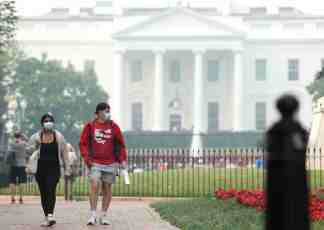
There’s been no enormous hurry in Washington to do much about the greatest threat that humans have ever faced. Photograph by Kevin Dietsch / Getty
Thanks, as always, to Bill McKibben for a perspective on otherwise difficult-to-make-sense-of events:
Looking at the White House Through Wildfire Smoke
This week, elected officials can see for themselves why they must get serious about climate change.
I’m sitting on a rocking chair just outside the White House fence on Thursday afternoon, and I can more or less make out the seat of American executive power through the haze. In the morning, the local government announced that the air-quality index for the District of Columbia had reached Code Purple (“very unhealthy”), because of the level of particulate pollution, which has never happened before. News came that some outlying areas had stepped up even further to Code Maroon (“hazardous”); Wednesday had been bad in D.C., but was only Code Red (“unhealthy”). (Someone may need to work on the alert color scheme; somehow “maroon” doesn’t quite conjure up the necessary adrenaline.) Basically, you can chew the air; it’s Code Grim.
There is, of course, no mystery about why everyone is breaking out their face masks again. (This is clearly going to be remembered as the N95 era.) It got very dry and very hot in Canada this spring; up near the tar sands in Alberta, fire forced the evacuation of Fort Chipewyan. But the trouble wasn’t just in the Canadian west: a forest fire turned Halifax, Nova Scotia, smoky last week, and fires soon broke out across Quebec. This is the new normal: big fires around the far north, from Siberia to Alaska to Canada.
And then the jet stream started carrying that smoke south. The jet stream has turned funky in recent years, potentially as a result of the melting Arctic, but it’s too soon to know if that played a role here—and it doesn’t really matter. What does matter is that arguably the two most important power centers in the world—New York and Washington, D.C.—are getting a taste of what climate change and fossil fuels have been doing to the rest of the world. Those cities have not been immune—Hurricane Sandy, in 2012, for instance, turned lower Manhattan into a powerless island, and prompted BusinessWeek to run the cover line “It’s Global Warming, Stupid.” But, in contrast with many other places, the Northeast has done less badly: no heat waves quite comparable to the ones that killed thousands in Europe, no forest fires like California’s, no wild droughts like those in much of Africa.
Perhaps partly as a result, there’s been no enormous hurry in Washington to do much about the greatest threat that humans have ever faced. Today, though, the people who have done the most to cause the crisis are feeling the tightness in the lungs that is the daily burden of much poorer people in much less guilty places. Which brings me to the rocking chair…
Read the whole comment here.
 Organikos