 What? We never posted on this book or its economist author before? We correct that now with Hettie O’Brien’s article in the Guardian :
The planet’s economist: has Kate Raworth found a model for sustainable living?
Her hit book Doughnut Economics laid out a path to a greener, more equal society. But can she turn her ideas into meaningful change?
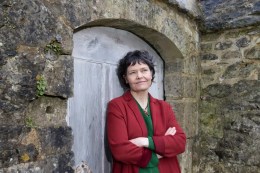
Raworth in Oxford. Photograph: Graeme Robertson/The Guardian
Consider the electric car. Sleek and nearly silent, it is a good example of how far the world has progressed in fighting the climate crisis. Its carbon footprint is around three times smaller than its petrol equivalent, and unlike a regular car, it emits none of the greenhouse gases that warm the planet or noxious fumes that pollute the air. That’s the good news. Then consider that the battery of an electric car uses 8kg of lithium, likely extracted from briny pools on South America’s salt flats, a process that has been blamed for shrinking pasturelands and causing desertification.
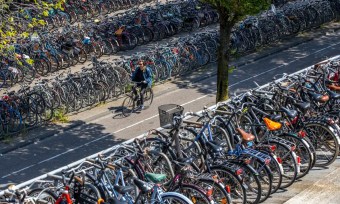
A bike park in Amsterdam which offers free parking for more than 2,500 bicycles. Photograph: Jochen Tack/Alamy
The 14kg of cobalt that prevent the car’s battery from overheating have probably come from the Democratic Republic of the Congo, where cobalt mines have contaminated water supplies and soil. As the demand for electric vehicles grows, the mining and refining of their components will intensify, further damaging natural ecosystems. By 2040, according to the International Energy Agency, the global demand for lithium will have increased more than fortyfold.
Electric cars improve on the status quo without transforming its rapacious use of resources. Subsidised by governments and promoted by the automotive industry, they fit smoothly with the economic ideas that guide how policymakers think about reducing carbon emissions. According to the idea of “green growth”, whose adherents include the World Bank and the White House, so long as the right policies are in place, societies will be able to enjoy endless growth while reducing their carbon footprint. Growth, the process by which a country increases the amount of goods and services it produces, is supposed to raise people’s wages and provide governments with an income that can be invested into public services such as schools and hospitals. To proponents of green growth, new innovations such as electric cars will help “decouple” growth from carbon emissions and allow humans to live a life of plenty within the limits of the planet.
That’s the theory, at least. But there is little evidence that this will be possible on the timescale required. Global carbon emissions have risen to their highest levels in history. Recently, researchers have warned that the Earth may already be past its safe limits for humanity. According to the Intergovernmental Panel on Climate Change, preventing irreversible damage to the natural environment depends on holding the world below 1.5C of warming, and climate scientists calculate that the emissions of high-income countries need to decrease at 10 times their current rate to achieve this. Electric cars will be essential to this, but if nations are to meet stringent emissions targets and avoid soaring electricity demand, there will need to be fewer cars on the road. The problem is that there are few templates for an economy that radically shrinks the world’s carbon footprint without also shrinking our quality of life.
The economist Kate Raworth believes she has a solution. It is possible, she argues, to design an economy that allows humans and the environment to thrive. Doing so will mean rejecting much of what defined 20th-century economics. This is the essential premise of her only book, Doughnut Economics: Seven Ways to Think Like a 21st Century Economist, which became a surprise hit when it was published in 2017. The book, which has been translated into 21 languages, brings to mind a charismatic professor dispensing heterodox wisdom to a roomful of students. “Citizens of 2050 are being taught an economic mindset that is rooted in the textbooks of 1950, which in turn are rooted in the theories of 1850,” Raworth writes. By exposing the flaws in these old theories, such as the idea that economic growth will massively reduce inequality, or that humans are merely self-interested individuals, Raworth wants to show how our thinking has been constrained by economic concepts that are fundamentally unsuited to the great challenges of this century.
To Raworth, the ideal economy of the future can be captured in a single image: a ring doughnut. Its outer crust represents an ecological limit, while its inner ring represents a social foundation. To step beyond the ecological limit will damage the environment beyond repair. To fall below the social foundation will mean some people go without the things they need to live well, such as food, housing or income. Her argument is that economies must be designed so they operate inside this ring, enabling humans and the environment to flourish. The doughnut is premised on three central ideas: the economy should distribute wealth fairly, regenerate the resources that it uses, and allow people to prosper. None of this, Raworth argues, should depend on economic growth…
Read the whole article here.
 Organikos