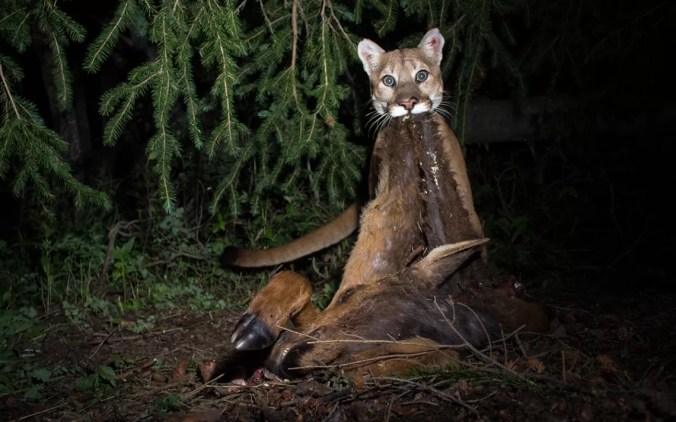
Puma in Wyoming. | Photo by Neal Wight, courtesy of Panthera
Thanks to Grace van Deelen for this article in the magazine of the Sierra Club:
Mountain Lions Are Murder Gardeners
By leaving carcasses, mountain lions create lush landscapes for future victims that could attract prey
If you’re hiking in Yellowstone and stumble upon an unusually lush landscape, you might have found a mountain lion’s garden. Mountain lions alter specific areas within their range by leaving the carcasses of their prey there to decay and fertilize the surrounding foliage, like an exceptionally violent compost pile. “If it were your neighbor, you’d say they were gardening,” said Mark Elbroch, Puma Program director at Panthera, a global wild cat conservation organization, and an author of a new paper about these big cat gardens, published recently in Landscape Ecology.
Elbroch and the team documented this “gardening” behavior by tracking 50 mountain lions within the Greater Yellowstone Ecosystem for almost four years and mapping where they left their prey (a total of 172 carcasses) along the way. They collected soil and plants from beneath those carcasses every three to six months, and tested them for nitrogen and other indicators of energy content for a total of three years.
The tests found that nitrogen—a key nutrient for plant growth—increased in the soil following the deposition of a carcass. The plants showed a similar trend too: The nitrogen content in the plants growing at the kill sites was, on average, 30% higher than in plants growing elsewhere. “The plants are sucking up a lot of this carcass deposition, which is pretty amazing,” said Elbroch. Since previous research has shown that plants with higher nitrogen content are generally more attractive to prey species like deer and elk, it’s likely that the carcass deposition is luring in prey…
Read the whole article here.
 Organikos