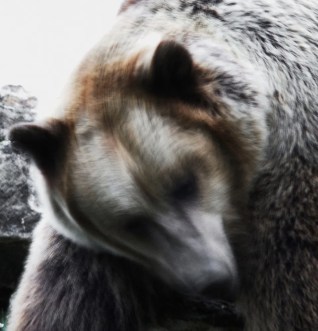
Bear populations are plummeting in most of the world. But in North America “human-bear conflicts” have been on the rise. Photograph by Alex Majoli / Parc de la Villette / Magnum
On the rare occasions when the historian and elegant writer Jill Lepore has essays whose topics overlap with our interests on this platform, we say hoorah:
Throughout North America, they’re showing up in unexpected places. Can we coexist?
I keep a cannister of bear spray on a shelf by the mudroom door, next to a cakey-capped tube of sunscreen and two mostly empty and partly rusty green aerosol cans of OFF! Deep Woods insect repellent. I’ve never used the bear spray, and most days I forget to bring it with me when I trudge out into the woods, even though, to encourage the habit, I got a nifty little holster for it, with a carabiner for hooking it to a belt loop. Honestly, I’m more scared of the spray than of the bears. A few years ago, a robot in an Amazon warehouse in New Jersey inadvertently burst a cannister of bear spray, and twenty-four humans had to be hospitalized. (The robot was unharmed.) Technically, according to the label on my cannister, which is decorated with a drawing of a grizzly with a gaping red mouth, baring his teeth, it’s not bear spray. It’s “bear attack deterrent,” and you can see why the clarification is necessary. Last spring, the Oklahoma Department of Wildlife Conservation tweeted:
 Organikos