Our thanks to Robert Sullivan for this attention-getting article on a new device:
A Trash-Eating Sea Monster Appears in the Hudson!
A team of scientists and environmentalists tests out the WasteShark, an unmanned watercraft that vacuums up soda cans and potato-chip bags.
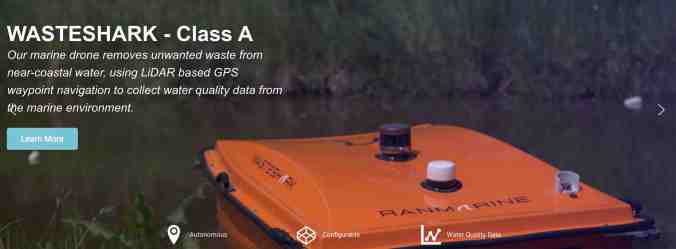
WasteShark is not a shark. It is an unmanned watercraft that its creators named for a shark, owing to similarities between how WasteShark collects its prey and the feeding habits of the Rhincodon typus, or whale shark. Cruising slowly, the whale shark takes in water and filters it for plankton and krill; WasteShark, meanwhile, filters urban waters for trash. But, whereas the whale shark can grow to the length of a subway car, WasteShark is only five feet long, three and a half feet wide, and a foot and a half thick. As the bright-orange fibreglass craft floated on the Hudson River recently, off Pier 40—collecting trash at or near the surface in its wire-basket-like interior—it looked less like a fish than like something accidentally dropped from a cruise liner. “I thought it was somebody’s luggage,” a member of the Village Community Boathouse said, after WasteShark whisked past.
When full, WasteShark’s hold is emptied by its minders—in this case, Carrie Roble, a scientist who is in charge of research and education at Hudson River Park, and Siddhartha Hayes, who oversees the park’s environmental monitoring. Hayes grew up jumping into swimming holes in the Catskills, while Roble swam in metropolitan Detroit, affording her insight into a still widely held view of urban rivers. “I used to swim in the Detroit River, and people would see me and say, ‘I can’t wait to see your third arm,’ ” she said.
WasteShark, which costs twenty thousand dollars, is joining the park’s scientific team more as mascot than as player. Roble hopes that it will generate interest among passersby and among “field assistants” (interns), who will pilot the trash-eating drone this summer. “We see WasteShark as a tool,” she said.
WasteShark’s latest test run in the Hudson happened to take place on the very day that forest fires in Quebec turned New York into a Mars-scape, adding a sense of urgency to WasteShark’s mission. As Roble and Hayes wheeled it out on a dolly from Pier 40’s Wetlab, the park’s aquarium and field station, they donned N95 masks and life jackets, and were joined by two interns: Vivian Chavez, a student at the Borough of Manhattan Community College, and Stefan Valdez, from Lehman College, in the Bronx…
Read the whole article here.
 Organikos