Clea Simon, correspondent for the Harvard Gazette, has these book recommendations from professors around campus:
Climate change, global hunger: What to do?
Black holes, warming seas, new treatments for disease: No matter how you approach it, the news is full of science-based stories. For those of us who aren’t scientists, however, understanding the context — not to mention the technical jargon — can be a challenge. With that in mind, we asked Harvard science faculty in various fields to recommend their favorite science book for nonscientists. Ideally these accessible reads will give the rest of us a leg up on understanding our changing world.
William “Ned” Friedman
Arnold Professor of Organismic and Evolutionary Biology, Director of the Arnold Arboretum
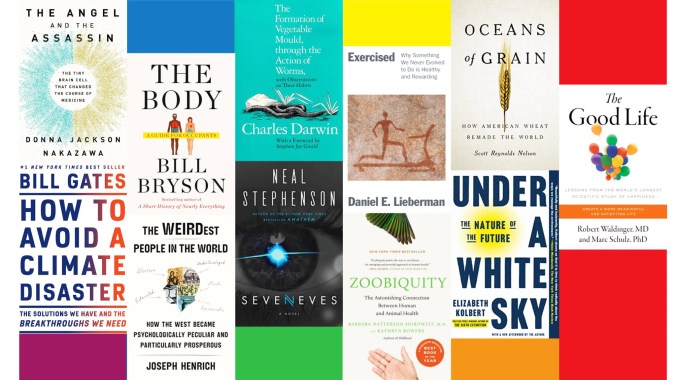
“Immediately, one book comes to mind: My favorite book by Charles Darwin (and his last — published in 1881): ‘The Formation of Vegetable Mould Through the Action of Worms.’ While some of his books changed the world (‘On the Origin of Species,’ ‘The Descent of Man’) and some were highly technical (‘Orchids,’ ‘Barnacles,’ ‘Power of Movement in Plants’ …), his book on worms, which reflected a lifelong interest (beginning in the 1830s and ending with his death in 1882) in the slow but steady effects of earthworms on the terrestrial world is one of the most charming and heartwarming books I can imagine in the world of natural history books.
“It reveals the loving father, grandfather, and husband experimenting with earthworms with his family (wife Emma, son Francis whose wife had died in childbirth and was now living with his parents, and grandson Bernard) at Down House. Imagine the science: Darwin with a pot of worms trying to determine if they can hear. To conduct this experiment, his wife Emma is called upon to play the piano loudly, his son to play his bassoon, and his grandson to play a whistle! Darwin’s personification of the worms shows the true extent of his feelings for the intelligence of fellow creatures and his sly sense that something quite wonderful is lurking behind even the lowly earthworm. Truly, if one is going to read only one book by Charles Darwin, this is the one!”
David S. Ludwig
Professor of Nutrition, Harvard T.H. Chan School of Public Health
Ludwig, who is also a professor of pediatrics at Harvard Medical School, went with the science fiction novel “Seveneves” by Neal Stephenson, which imagines a catastrophic event that has rendered the earth uninhabitable — sending humans on a desperate race to re-create a habitable environment in space.
“A fascinating thought experiment in how humans might evolve and adapt to extreme changes in their environment. Although science fiction, the narrative is grounded in plausible biology and physics. A wonderful, long read,” he said. “Start now, should last the rest of the summer.”
Read the whole article here.
 Organikos