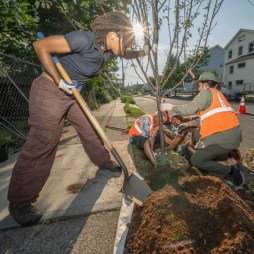
From left, Jess Jones, Ed Rodriguez, Zach Herring and Joshua De-Anda, planting a crab apple tree at 10 Wolcott Street in the Fair Haven neighborhood of New Haven, Conn. Tony Cenicola/The New York Times
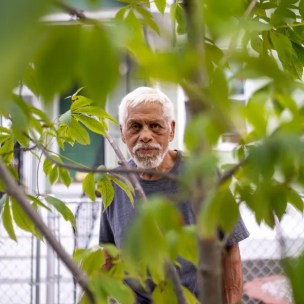
Ed Rodriguez has a few years on me, but we have comparable tree counts. The caption of the second photo below captures my my own preference of activity on any given day. Having grown up in Connecticut and moved to Costa Rica decades ago, I note our reverse patterns of migration.
Colbi Edmonds, a member of the 2023-24 New York Times Fellowship class, reports from Seth’s previous hometown New Haven on an initiative I love reading about as much as I enjoy my own versions of the same kind of activity:
“I love to dig and mess around in the soil,” said Ed Rodriguez, who grew up in Puerto Rico but moved to Connecticut in the 1960s. Christopher Capozziello for The New York Times
One Neighborhood, 90 Trees and an 82-Year-Old Crusader
Ed Rodriguez is on a mission to convince his neighbors that they need trees to help combat summer heat — and to make the world a better place. It’s not always so easy.
Maria Gonzalez, who lives in New Haven, Conn., was envious of the other side of her street. It was lined with trees, offering some beauty as well as a shield from this summer’s unusual heat. But the sidewalk directly in front of her residence was bare, with trash littering patches of grass.
Then she met her neighbor Ed Rodriguez, an 82-year-old tree evangelist on a mission to fill the neighborhood with trees. Ms. Gonzalez was a willing convert.
This month, Mr. Rodriguez planted a crab apple tree in front of her home — his 90th tree in 13 years.
“I love to dig and mess around in the soil,” said Mr. Rodriguez who grew up in Puerto Rico, where he said he was surrounded by trees. He moved to the New Haven neighborhood in the 1960s.
As the United States sweats through another unbearable summer of record-breaking heat, planting more trees has emerged as a practical solution to cooling cities, especially areas known as “heat islands” where concrete and congestion magnify already brutal temperatures.
Yet filling a neighborhood with trees is not as simple as it seems. Funding and maintenance are issues for cities grappling with crime and housing. And not everyone, it turns out, wants a tree.
Mr. Rodriguez, who volunteers with the Urban Resources Initiative, a nonprofit partnered with Yale University, spends much of his time persuading his neighbors that trees are worth the trouble. Because the trees are planted by a volunteer organization, residents have to take some responsibility for making sure the trees survive and thrive…
Read the whole article here.
 Organikos