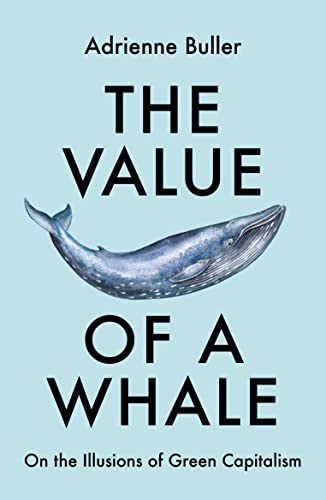
 We shared an interview with the author of this book a few months ago, but missed the numerous reviews when her book was published last year. Thanks again to a Dutch biologist named Leon at the Inquisitive Biologist for this book review now:
BOOK REVIEW – THE VALUE OF A WHALE: ON THE ILLUSIONS OF GREEN CAPITALISM
In an attempt to address climate change and other environmental problems, governments are increasingly turning to economic solutions. The underlying message is clear: capitalism might have created the problem, but capitalism can solve it. Adrienne Buller, a Senior Fellow with progressive think tank Common Wealth, is, to put it mildly, sceptical of this. From carbon credits to biodiversity offsets, she unmasks these policies for the greenwashing that they are. The Value of a Whale is a necessary corrective that is as eye-opening as it is shocking.
As Buller defines it here, green capitalism sees governments and corporations pursue ideas and policies that use the logic and force of economic markets to address environmental problems. It has two defining characteristics that she returns to throughout the book (and I am paraphrasing here): whatever you do, do not disrupt the existing economy, and while we are at it, let us turn crises into new opportunities to get filthy rich. The book roughly breaks down into two halves: the odd chapters provide background information on how the global economy works while the even chapters critically evaluate several green capitalist solutions. Before I discuss some notable examples, it is useful to mention what is not in the book. This is not an account of the people undermining the scientific consensus. As she points out, those merchants of doubt have been covered at length elsewhere. Nor is this a manifesto of solutions, though in the process of exposing our failures, she outlines some of the necessary changes.
Let me first highlight the background chapters as they give a useful indication of the kinds of people and ideas that are coming to the table when it comes to formulating “solutions”. There were various things here that I found eye-opening and even shocking, though I will gladly concede my ignorance of economics and the inner workings of the global financial system. Readers more familiar with these topics might not be as surprised as I was.
For example, you would think that the idea of limiting global warming to 2°C above pre-industrial levels is based on the best available science. Instead, Buller traces it back to a 1975 thought experiment by the influential economist William Nordhaus. Despite some very questionable assumptions, the idea has become a central pillar of climate change policy. Nordhaus is representative of a large group of well-meaning economists who look at climate change strictly through the lens of economics. Their flawed models “that collapse the complexity of our globalised economy, climate and biosphere into improbably simple predictions” (p. 43) are legitimising inaction by politicians. We should call them out for what they are: false prophets. Similarly, why do we seem powerless to hold companies accountable? Because we are. Buller explains how neoliberal reforms from the 1970s onwards were explicitly framed in terms of reigning in democracy and insulating the financial world from popular demands. After all, such interference only stifles economic progress. She discusses other facets of the global financial system, but this should give you a taste of the background against which climate change policy is being formulated. Let us take a look at some of these green capitalist solutions in more detail…
Read the whole review here.
 Organikos