
Beka will hand-deliver a letter to the Cargill-MacMillian dynasty in Minneapolis on Thursday, calling on the billionaire owners of America’s biggest private company to stop destroying the Amazon rainforest and its people. Photograph: Thalia Juarez/The Guardian
Cargill has appeared a few times in our pages over the years, not always showing poor stewardship. But today, we have to ask whether they really are trying as diligently as possible to do the right thing. We applaud Beka and her community for this letter, and hope the recipients respond with the sense of responsibility that comes with their wealth:
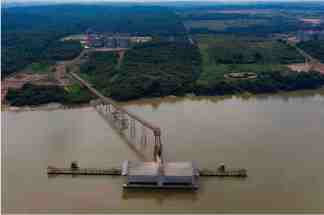
A Cargill transshipment port for soy and corn projects on the Tapajos River in Itaituba, Para state, Brazil, in 2019. Photograph: Léo Corrêa/AP
Beka Saw Munduruku , 21, traveled 4,000 miles to deliver letter and confront family behind Cargill empire over what she says amounts to a litany of broken promises
A 21-year-old Indigenous activist from a remote Amazonian village will hand deliver a letter to the Cargill-MacMillan dynasty in Minneapolis on Thursday, calling on the billionaire owners of the US’s biggest private company to stop destroying the Amazon rainforest and its people.
Beka Saw Munduruku traveled more than 4,000 miles to confront the family behind Cargill, the world’s largest grain trader and a major meat producer, over what she says amounts to a litany of broken promises that pose an existential threat to Indigenous peoples and the global climate.
“Your executives tell us that Cargill is a good company, that they have pledged to end the destruction of nature. But this is not our experience. In every region where Cargill operates, you are destroying the environment and driving out or threatening the communities who live there,” writes Beka, whose requests for face-to-face meetings with family representatives went unanswered.
“Despite your many commitments to end deforestation, the destruction has increased … We have lived here in the heart of the Amazon for over 4,000 years. But now our world hangs by a thread.”
Beka is part of the Munduruku community of 13,000 people who live in 160 communities across three states in northern Brazil. “We are known as the Red Ants for our determined resistance and protection of our territory,” she told the Guardian in New York – en route to Minneapolis…
Read the whole article here.
 Organikos