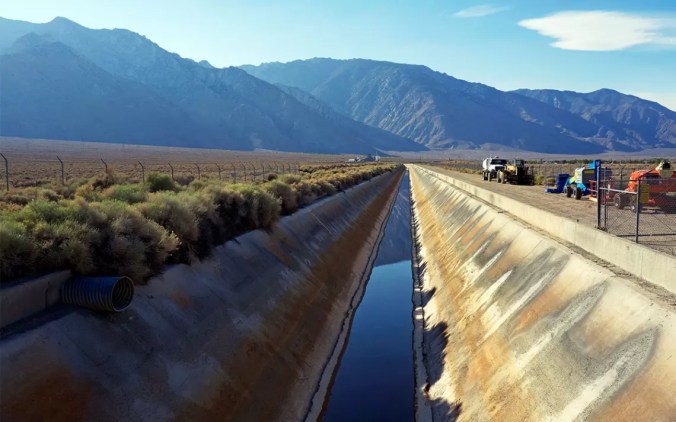
The Los Angeles Aqueduct. | Photo by Brian Melley/AP
California water has been covered in earlier posts, and it keeps getting more important. Once again, with abundance comes responsibility:
Dear Los Angeles: You’re Drinking Indigenous Water
How LA can localize its water supply and finally do right by the Owens Valley Paiute tribes
In August 2023, a tropical storm bore down upon Southern California for the first time in 84 years. As Hilary’s northward-rolling blanket of rain touched off mudslides from Hollywood to the San Bernardino Mountains, thigh-deep water floated vehicles in the streets of Cathedral City. To the east, 120 miles of Highway 395 were closed due to flooding and rock slides, pinching off the route between the city of Los Angeles and the once-green valley 300 miles away from which it has, for over a century, sourced fresh water.
Since the early 20th century, Los Angeles has siphoned liquid snow from a beautiful, high-desert basin between the austere peaks of the Sierra Nevada and the softened summits of the White Mountains. In the view of a migratory bird passing overhead, its namesake river cuts a sinuous path through the valley’s heart.
The Owens Valley has never received much rainfall, but it wasn’t always a desert. Historically, ample groundwater and the Owens River provided a water supply so superabundant that the valley’s Indigenous people, the Paiute (in their language, Nüümü) named their homeland Payahuunadü, or “Land of the Flowing Water.” Now, the Owens Valley is a desert by design—the end state of a plot by the architect of Los Angeles, William Mulholland. And the Paiute are still fighting for the right to water taken from them long ago.
For at least 15,000 years, the Nüümü (and a smaller population of Shoshone) thrived throughout the Owens Valley, massaging water through hand-dug irrigation ditches to support their crops. They gathered pine nuts and caught fish and wild game.
In the 1850s, white European settlers “discovered” the valley and set about overtaking it. They slaughtered over 200 people, forced the Nüümü into the Owens Lake to drown, and assaulted and raped Native women. In 1863, they removed 1,000 Native people from their homes and marched them to Fort Tejon, on the southern end of the Central Valley, a journey of over 200 miles. Many did not survive the trek—the Dry Lake contains human remains of Nüümü with musket balls in their backs.
By the time the survivors made their way on foot back to Payahuunadü a year later, “All their lands, especially the very fertile lush lands, were claimed by settlers,” says Noah Williams, a member of the Bishop Paiute Tribe. The Nüümü were left to work for the ranchers who had taken their land.
In the early 1900s, it was clear that LA’s population would soon outpace local water supplies. William Mulholland and Fred Eaton, a former Los Angeles mayor, began purchasing land and water rights from ranchers in the Owens Valley. By 1905, the Los Angeles Department of Water and Power (LADWP) owned almost everything in the valley. LA residents approved a bond to construct a gravity-fed aqueduct to the San Fernando Valley, over 200 miles away. Construction was completed in 1913, and water diversion through the Los Angeles Aqueduct began immediately. By 1926, the Owens Lake was a windswept dust bowl.
Annoyed by the presence of the Paiute, who remained after their homeland became LADWP property (often because the concept of ownership was senseless in their worldview), LA set out to solve what they called the “Indian problem.” President Taft had reserved over 67,000 acres in trust for the Native people, but as Teri Red Owl, director of the Owens Valley Indian Water Commission, explains: “When LA found out about it, they went to Washington and lobbied and had those lands removed from trust status for the tribes and set aside ‘for watershed protection for the city of Los Angeles.’”…
Read the whole document here.
 Organikos