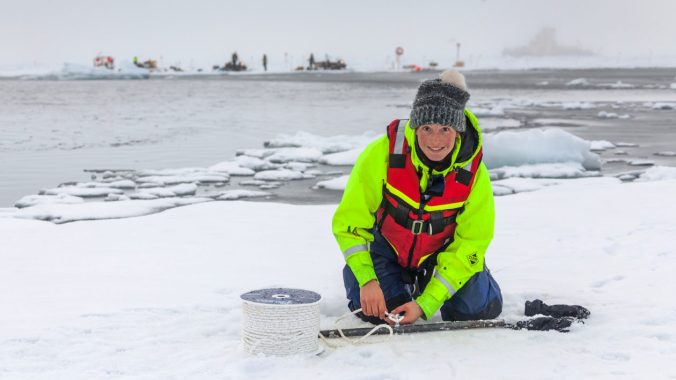
Helen Czerski on a 2018 ocean research expedition to the North Pole. MARIO HOPPMANN
We non-scientists have learned much from the scientists who study climate change, and surprises keep coming, this one from physicist Helen Czerski:
The Pacific Ocean, as seen from space. NASA
The Planet’s Big Blue Machine: Why the Ocean Engine Matters
The ocean is an enormous engine, turning heat energy into motion, says physicist Helen Czerski. But human activity is threatening that machine — depriving the seas of oxygen, increasing stratification, and potentially changing the currents that influence global weather.
Photographs of Earth taken by astronauts in space more than half a century ago revealed a blue planet dominated by oceans and billowing with clouds. Since then, says British oceanographer and physicist Helen Czerski, scientists have been documenting how global warming is changing the seas in ways that are transforming weather patterns worldwide and, in some cases, imperiling the agricultural systems upon which humanity depends.
In her new book, The Blue Machine: How the Ocean Works, Czerski — a frequent science presenter on the BBC — offers a lyrical primer on the natural forces that power the global ocean and how human activities are putting some of these processes at risk. While reporting on the ocean often focuses on the well-known scourges of plastic, chemical pollution, and overfishing, Czerski examines our impacts on the physics of the ocean system, which she describes as a gigantic and highly complex engine.
In an interview with Yale Environment 360, Czerski warned that critical ocean currents may slow down or change course as surface waters continue to warm. Oxygen levels in the sea have been declining, she said, potentially turning some parts of the sea into biological deserts. However, she remains skeptical of ambitious ocean geoengineering schemes designed to mitigate the effects of climate change, which she said risk further destabilizing a natural system that we imperfectly understand.
“The ocean humbles you all the time,” said Czerski, who is an associate professor at University College London. “There’s this illusion that we are in control of our planet and that we’ve got some handles on the driving levers. But we should be very, very careful before we use them.”
Yale Environment 360: The oceans are vast. But even people who are concerned about the environment rarely focus on them. You’ve gone so far as to say that we just “don’t see the ocean.” What do you mean by that?
Helen Czerski: People talk about fish and whales and pollution. They talk about the things in the ocean. Almost nobody talks about the [physical reality of the] ocean itself. That has started to change in the past year because we’ve been having these marine heat waves. And suddenly people are like, “Oh, the ocean has a temperature, and maybe that temperature matters.” It’s a perspective shift once you start to see the ocean not just as the canvas that these stories are written on, but as the engine that drives the whole thing…

Read the whole interview here.
 Organikos