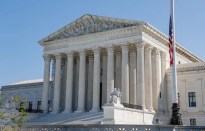
Relentless and Loper Bright have been brought before the Supreme Court with the same all-but-explicit goal: to make it more difficult for the federal government to protect the public. Photograph by Jemal Countess / UPI /Shutterstock
Courts with politically appointed jurists can tilt to an extreme, as we see now at the highest level in the USA’s judicial system. Even as the environment needs more protection, the infrastructure for providing it is being dismantled (thanks as always to Elizabeth Kolbert):
The Supreme Court Looks Set to Deliver Another Blow to the Environment
Two upcoming cases take aim at the government’s power to regulate.
Last week, the United States Supreme Court agreed to hear a case that’s nominally about herring. Arguments will be heard this winter, in tandem with a case that the Court had agreed to hear earlier, that one also ostensibly about herring. In both cases, though, the Justices have much bigger fish to fry: what’s really at issue is the fate of federal regulation. The stakes are enormously high, and, given the Court’s predilections, the outcome seems likely to undermine still further the government’s ability to function.
Like many potentially precedent-setting cases, the one that the Court agreed to hear last week—Relentless, Inc. v. Department of Commerce—has a long and complex backstory. In 1981, the first year of the Reagan Administration, the Environmental Protection Agency issued a set of regulations aimed at reducing environmental protection. (The head of the agency at the time was Anne Gorsuch, the mother of Supreme Court Justice Neil Gorsuch.) The rules were technical in nature. Basically, they enabled big emitters to replace a major piece of equipment—a boiler, say—without triggering a Clean Air Act requirement that new equipment be less polluting. The Natural Resources Defense Council, an environmental group, sued the agency to block the rules, and won the case in D.C. district court. (That decision was written by Judge—later Supreme Court Justice—Ruth Bader Ginsburg.)
The Chevron Corporation, a potential beneficiary of the Reagan-era rules, appealed the case to the Supreme Court. Arguments in Chevron U.S.A., Inc. v. N.R.D.C. were heard in the winter of 1984, and the Court handed down its ruling in the spring. (By that point, Gorsuch had been forced to resign from the E.P.A. She resigned after being held in contempt of Congress in connection with an inquiry into the use of toxic-waste cleanup funds.) David Doniger, the N.R.D.C.’s lead attorney on the case, learned about the decision from Nina Totenberg, the National Public Radio reporter.
“This was before the days of the Internet,” Doniger recalled recently. “So I had no idea the case had been decided that day. Nina Totenberg called, and I said, ‘Tell me what happened.’ And she said, ‘Well, you lost.’ I think my next twelve words were ‘shit.’ ”
In deciding against the N.R.D.C., the Court established what has since become known as the “Chevron deference.” According to this principle, judges faced with disputes over federal regulations should follow a two-step process. The first is to ask whether Congress explicitly addressed “the precise question at issue” when it wrote the legislation underlying the rules. If it did, then the court’s job was simple: to insure that the regulations furthered Congress’s intentions.
If Congress hadn’t spoken to the “precise question,” or if its intentions were ambiguous, judges were to proceed to step two. They should ask: Is the agency’s interpretation of the legislation “reasonable”? If so, then the court should defer to the agency. It should not substitute its “own construction of a statutory provision.”…
Read the whole comment here.
 Organikos