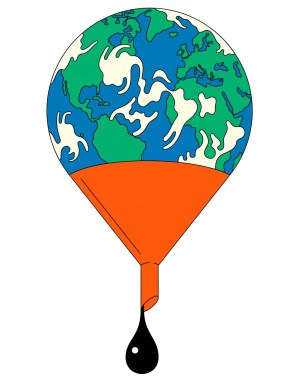
Faced with climate change on the one hand and the material demands of new energy infrastructure on the other, humanity had better figure out how to reuse the resources it has already dug up. Illustration by Laura Edelbacher
Not to rain on the parade of the candy and costumes fun of October 31, but to heighten the mood of the day with some sobering truths facing all of us, our thanks as always to Elizabeth Kolbert for getting our attention pointed where it needs to go:
The Real Cost of Plundering the Planet’s Resources
Our accelerating rates of extraction come with immense ecological and social consequences.
The town of Spruce Pine, North Carolina, doesn’t have a lot to say for itself. Its Web site, which features a photo of a flowering tree next to a rusty bridge, notes that the town is “conveniently located between Asheville and Boone.” According to the latest census data, it has 2,332 residents and a population density of 498.1 per square mile. A recent story in the local newspaper concerned the closing of the Hardee’s on Highway 19E; this followed an incident, back in May, when a fourteen-year-old boy who’d eaten a biscuit at the restaurant began to hallucinate and had to be taken to the hospital. Without Spruce Pine, though, the global economy might well unravel.
Spruce Pine’s planetary importance follows from an accident of geology. Some three hundred and eighty million years ago, during the late Devonian period, the continent of Africa was drifting toward what would eventually become eastern North America. The force of its movement pressed the floor of a Paleozoic sea deep into the earth’s mantle, where, in effect, it melted. Over the course of tens of millions of years, the molten rock cooled to form deposits of exceptionally pure mica and quartz, which were then pushed back up toward the surface. In the twentieth century, Spruce Pine’s mica was mined to make windows for coal-burning stoves and insulation for vacuum tubes. In the computer age, it’s the town’s quartz that’s critical.
Silicon chips are essentially made of quartz, although this is a bit like saying that the “Mona Lisa” is essentially made of linseed oil. Manufacturing microchips is phenomenally complex and supremely exacting. The process generally begins with quartz’s cousin, quartzite, which consists in large measure of silicon dioxide. Under very high heat, and in the presence of carbon, the quartzite gives up most of its oxygen. Then acid and a great deal more heat are applied, until the silicon reaches a purity level of 99.9999999 per cent, or, as it’s known in the business, “nine nines.” At this point, the silicon is ready to be fashioned into a “boule,” or ingot, that weighs upward of two hundred pounds and consists of a single perfectly aligned crystal. It is here that Spruce Pine’s quartz comes into play.
To form a boule, pure silicon has to be heated in a special crucible to twenty-seven hundred degrees Fahrenheit. The crucible must be tough enough to withstand this temperature, and, at the same time, it must have the right chemical composition, so it won’t introduce contaminants. The only substance that meets both these criteria is high-purity quartz, and one of the only spots where the right sort of quartz can be found is Spruce Pine.
Spruce Pine’s quartz is so valuable that, as the Vancouver-based journalist Vince Beiser observes in his book “The World in a Grain,” almost everything about it, outside of its purity, is a closely guarded secret. The company that owns the town’s largest mine—Sibelco, a Belgian conglomerate—doesn’t publish production figures. When contractors arrive to make repairs at the mine, they are reportedly led to the equipment in blindfolds. According to documents filed in a case that the company once brought against a former employee, it tries to divvy up its contracting jobs, so that no individual can learn too much, and for the same reason it purchases its supplies from multiple venders.
All this stealth, Ed Conway suggests in his new book, “Material World: The Six Raw Materials That Shape Modern Civilization” (Knopf), is justified. “There are few such cases where we are so utterly reliant on a single place,” he writes. He quotes an unnamed industry veteran who notes that someone flying a crop duster over Spruce Pine and releasing “a very particular powder” could “end the world’s production of semiconductors” within six months. No production of semiconductors would mean no production of computers, cell phones, automobiles, microwaves, game consoles, fitness trackers, digital watches, digital cameras, televisions—the list goes on and on.
“Even in devices that don’t have ‘smart’ in their name, mechanical linkages have long since given way to a network of semiconductors,” Conway, a London-based journalist, observes. “Nearly every economic activity, nearly every dollar of global GDP, relies in one way or another on the microscopic switches of semiconductors.” Prudently, he does not reveal what that very particular powder is.
Of the ten largest corporations in the world, six are tech companies. In 2021, fifty per cent of Americans said they spend more than half the day in front of a screen, and a recent survey found that kids in the United States devote almost seven hours a day to staring at pixels. Statistics like these can produce the sense that matter doesn’t matter all that much anymore. Conway thinks that this is an illusion, and a dangerous one. Contemporary society continues to rely on raw materials, like Spruce Pine’s quartz, taken from the earth. Indeed, extraction rates, far from slowing, keep accelerating. These days, Conway reckons, humanity mines, drains, and blasts more stuff out of the ground each year than it did in total during the roughly three hundred millennia between the birth of the species and the start of the Korean War. This comes with immense consequences, both ecological and social, even if we don’t attend to them.
Consider sand, the first of Conway’s not so dark materials. According to a 2022 report from the United Nations Environment Programme, global demand for “sand resources” has tripled in the past two decades, to something like a hundred trillion pounds a year; this amounts to almost thirty-five pounds a day for every person on the planet. A lot of sand (though no one seems to know exactly how much) goes into land building. Among the world’s biggest sand importers is Singapore, which has grown by more than fifty square miles since the nineteen-sixties. Among the major exporters is Vietnam, where sand dredging along the Mekong Delta has caused so much erosion that whole villages’ worth of homes have been swept downstream.
“Where once there were riverbanks, today there are sheer drops into the water,” Conway writes. Such is the hunger for sand that, in many parts of the globe, an illicit trade has sprung up. In India, so-called sand mafias are rumored to pay off cops and politicians. According to the South Asia Network on Dams, Rivers and People, a Delhi-based advocacy group, at least a dozen civilians and two government officials were killed by sand mafias between December, 2020, and March, 2022. (This was down from twenty-three civilians, five journalists and activists, and eleven government officials killed during the two years prior.)…
Read the whole article here.
 Organikos