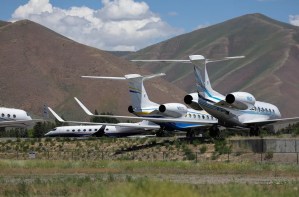
Planes account for roughly two per cent of the world’s CO2 emissions—if all the world’s aircraft got together to form a country, they’d emit more than the vast majority of actual nations. Photograph by Kevin Dietsch / Getty
I have had precisely one direct experience with otherwise elusive alternative aviation fuel. It was during my first of multiple work trips to Paraguay. The fuel was made from sugarcane, and while I am still here to write about it, the experience was among the most harrowing of my lifetime. I only have time and space here to mention that I spent an unexpected night in the Chaco. I highly recommend visiting the Chaco, but I do not highly recommend traveling with experimental fuel. That said, read on:
Looking for a Greener Way to Fly
The Treasury Department is about to announce tax credits for sustainable aviation fuel, which raises the question: What fuels are actually “sustainable”?
Sometime in the next few weeks, the Department of the Treasury is expected to decide who—or, really, what—will qualify for a new set of tax credits. The credits were created under the Inflation Reduction Act, which many argue was misnamed, and they involve “sustainable aviation fuel,” which some argue is an oxymoron. For months, a debate has been raging over how the credits should be allocated, and though the arguments can get pretty deep into the weeds—some of them literally involve weeds—they’re worth attending to because of the stakes. The fight could determine whether key provisions of the I.R.A. help to address climate change or end up making things worse. As a briefing paper from the Environmental Defense Fund (E.D.F.) put it, there is a risk of substituting “one environmental threat for another.”
Key to the debate are two unfortunate facts, the first of which is that aviation emissions are a big problem. Planes account for roughly two per cent of the world’s CO2 emissions, meaning that, if all the world’s aircraft got together to form a country, they’d emit more than the vast majority of actual nations, including Germany, Brazil, and Indonesia. And this still underestimates their impact. Owing to a variety of complex processes, airplane emissions have an oversized impact on the atmosphere; it’s been estimated that, historically, aviation may be responsible for two to four times more warming than the CO2 numbers alone suggest. Meanwhile, in a highly inequitable world, flying is particularly unequal: a study published in 2020 found that just one per cent of the global population is likely responsible for more than fifty per cent of passenger-plane emissions. (Although aviation emissions fell during the covid lockdowns, they are once again rising fast; according to a recent report, in 2023, they are expected to increase by twenty-eight per cent over 2022.)…
Read the whole article here.
 Organikos