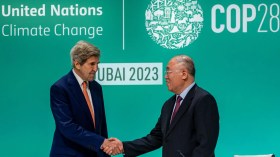
United States’ Special Presidential Envoy for Climate John Kerry(L) and China’s special envoy for climate change Xie Zhenhua (R) attend a press conference during the 2023 United Nations Climate Change Conference (COP28), in Dubai, United Arab Emirates, on December 13th, 2023. Martin Divisek/ZUMA
It started on a flawed premise, that a petrostate bigwig could honestly lead the forum to a legitimate outcome. We knew it was not going to end dirtier than it should have, but still we must parse what just happened. Thanks to Mother Jones for republishing Damien Carrington’s explanation from the Guardian:
Good Cop, Bad Cop: Breaking Down the UN’s New Climate Resolution
Some call the COP28 agreement “historic,” others call it weak. Here’s why.
Language on coal power was no stronger than that of Cop26 in 2021. Photograph: Maxim Shipenkov/EPA
The decision text from Cop28 has been greeted as “historic,” for being the first ever call by nations for a “transition away” from fossil fuels, and as “weak and ineffectual” and containing a “litany of loopholes” for the fossil fuel industry. An examination of the text helps to explain this contradiction.
Reducing Fossil Fuel Use
The text states the huge challenge with crystal clarity:
Limiting global warming to 1.5C [above pre-industrial levels] with no or limited overshoot requires deep, rapid and sustained reductions in global greenhouse gas emissions of 43% by 2030 and 60% by 2035 relative to the 2019 level and reaching net zero carbon dioxide emissions by 2050. [Countries] further recognise the need for deep, rapid and sustained reductions in greenhouse gas emissions in line with 1.5C pathways.
The problem is that carbon emissions are not plunging as required—they are still rising. So the text on action is vital. The previous draft suggested measures that countries “could” take. The final agreement is somewhat stronger and “calls on” countries to do the following:
Tripling renewable energy capacity globally and doubling the global average annual rate of energy efficiency improvements by 2030.
This is good but, due to objections by China and India, fails to quantify the goals. That means countries could choose whatever baseline suits them, undermining the target.
Accelerating efforts towards the phase-down of unabated coal power.
This is no stronger than the text from Cop26 in 2021, which is disappointing as the dirtiest fossil fuel must unquestionably be phased out rapidly. Next in the decision text comes the pivotal paragraph:
Transitioning away from fossil fuels in energy systems, in a just, orderly and equitable manner, accelerating action in this critical decade, so as to achieve net zero by 2050 in keeping with the science.
Extraordinary as it might seem, this is the first time the root cause of the climate crisis—fossil fuels—have been cited in a decision text in nearly 30 years of UN climate talks. But “transitioning away” is weaker than “phasing out.” The latter was supported by 130 countries but fiercely opposed by petrostates. In the real world, fossil fuels are actually being phased up, with many new fields being exploited. Is “transitioning away” a strong enough signal to halt these investments? Probably not, but at least the direction of travel is finally clear.

Read the whole article here.
 Organikos