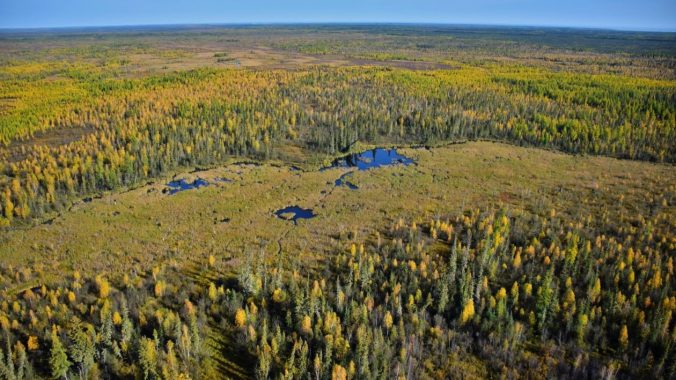
Beavers are not always welcome, but where they belong, they are a wonder to behold. Ian Frazier offers this dispatch from the great North:
Deep in the Wilderness, the World’s Largest Beaver Dam Endures
The largest beaver dam on Earth was discovered via satellite imagery in 2007, and since then only one person has trekked into the Canadian wild to see it. It’s a half-mile long and has created a 17-acre lake in the northern forest — a testament to the beaver’s resilience.
Wood Buffalo National Park, the largest national park in Canada, covers an area the size of Switzerland and stretches from Northern Alberta into the Northwest Territories. Only one road enters it from Alberta, and one from the NWT. If not for people observing it from airplanes and helicopters, and satellites photographing it, little would be known about big parts of it. The park is a variety of landscapes — boreal swamps, fens, bogs, black spruce forests, salt flats, gypsum karst, permafrost islands, and prairies that extend the continent’s central plains to their northern limit. The wood buffalo in the park’s name are bison related to the Great Plains bison. In this remoteness, the buffalo descend from the original population, and the wolves that prey on them are also the wild originals. Millions of birds summer and breed here. The park holds one of the last remaining breeding grounds of the whooping crane.
Other superlatives and near-superlatives: the delta in the park’s southeast where the Peace River and the Athabasca River come together is one of the largest freshwater deltas in the world; last summer, some of Canada’s largest forest fires burned in the park and around it; and — just inside the park’s southern border — is the largest beaver dam in the world.
The dam is about a half-mile long and in the shape of an arc made of connected arcs, like a recurve bow. The media has known about it for 16 years, and in that time no bigger beaver dam has come to light, so it’s still known as the biggest, and scientists believe it almost certainly is. Animal technology created it, but human technology revealed it. In 2007, Jean Thie, a Dutch-born landscape ecologist who lives near Ottawa, was looking at the latest satellite imagery of places he had examined via satellite in 1973 and 1974, when he was studying permafrost. It’s hard to remember, but in the early ‘70s some scientists thought the Earth might be cooling. Thie’s research had showed evidence of the opposite; the paper about permafrost melting that he published in 1974 is now considered one of the pioneering studies of climate change.
As he looked over 1970s images taken by NASA’s Landsat satellite and compared them with the latest images from Google Earth and other sources, he noticed that in certain landscapes the evidence of beavers now was everywhere. From being almost wiped out by the fur trade between about 1600 and the 20th century, beavers had bounced back. Just one example was a belt about 1,100 miles long that extended into Wood Buffalo Park. Among the hundreds of beaver dams in this area Thie came across one that looked bigger. He measured it and found it to be 2,790 feet long, or about a half-mile. The 17-acre lake created by the dam reposed undisturbed, shiny and opaque in its swampy northern forest, and in the middle of the lake the small brown dot of a beaver lodge could be seen…
Read the whole article here.
 Organikos