
The New York Times building uses fritted glass clad with rods, which make its facade more visible to birds. Photograph: Daniel Slim/AFP/Getty Images
Birds fall victim to carelessly designed buildings. Bravo to the New York Times for building a bird-friendly HQ. Also to the Guardian for reporting on their competitor’s leadership, and on the architects leading the way with careful design:
Buildings kill a billion US birds a year. These architects want to save them
Highly transparent glass can lead to devastating collisions. But innovations in design are creating safer skylines – without sacrificing beauty
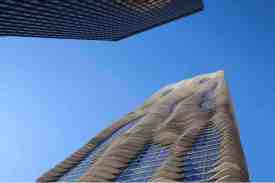
Chicago’s Aqua Tower was designed with birds in mind. Photograph: Radomir Rezny/Alamy
Chicago’s 82-story Aqua Tower appears to flutter with the wind. Its unusual, undulating facade has made it one of the most unique features of Chicago’s skyline, distinct from the many right-angled glass towers that surround it.
In designing it, the architect Jeanne Gang thought not only about how humans would see it, dancing against the sky, but also how it would look to the birds who fly past. The irregularity of the building’s face allows birds to see it more clearly and avoid fatal collisions. “It’s kind of designed to work for both humans and birds,” she said.
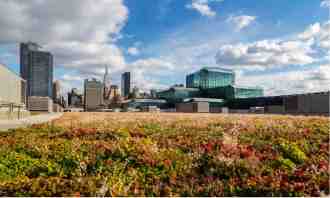
A green roof on the Javits Convention Center serves as a sanctuary for birds. Photograph: David Sundberg/Courtesy of Dan Piselli
As many as 1 billion birds in the US die in building collisions each year. And Chicago, which sits along the Mississippi Flyway, one of the four major north-south migration routes, is among the riskiest places for birds. This year, at least 1,000 birds died in one day from colliding with a single glass-covered building. In New York, which lies along the Atlantic Flyway, hundreds of species traverse the skyline and tens of thousands die each year.
As awareness grows of the dangers posed by glistening towers and bright lights, architects are starting to reimagine city skylines to design buildings that are both aesthetically daring and bird-safe.
Some are experimenting with new types of patterned or coated glass that birds can see. Others are rethinking glass towers entirely, experimenting with exteriors that use wood, concrete or steel rods. Blurring lines between the indoors and outdoors, some architects are creating green roofs and facades, inviting birds to nest within the building.
“Many people think about bird-friendly design as yet another limitation on buildings, yet another requirement,” said Dan Piselli, director of sustainability at the New York-based architecture firm FXCollaborative. “But there are so many design-forward buildings that perfectly exemplify that this doesn’t have to limit your design, your freedom.”
How modern buildings put birds in danger
For Deborah Laurel, principal in the firm Prendergast Laurel Architects, the realization came a couple of decades ago. She was up for an award for her firm’s renovation of the Staten Island Children’s Museum when the museum’s director mentioned to her that a number of birds had been crashing into the new addition. “I was horrified,” she said.
She embarked on a frenzy of research to learn more about bird collisions. After several years of investigation, she found there was little in the way of practical tips for architects, and she teamed up with the conservation group NYC Audubon, to develop a bird-safe building guide.
The issue, she discovered, was that technological and architectural advancements over the last half-century had in some ways transformed New York City – and most other US skylines and suburbs – into death traps for birds.
Before the 1960s, much of the large sheet glass used in buildings was made via a painstaking and costly process of casting and polishing. The glass often contained bubbles or other imperfections that obscured its clarity…
Read the whole article here.
 Organikos