THR illustration.
Civic responsibility, short in supply in 2023, is worth pondering. The always interesting Hedgehog Review gets our vote for this final article link of 2023:
No Exit
The Uncivil Folly of Libertarian Flight
David BosworthOf all 36 ways to get out of trouble, the best way is—leave. —Chinese proverb
One of the scandalous revelations of the COVID pandemic was just how many of America’s superrich—our digerati, venture capitalists, corporate monopolists, hedge fund managers—had long been planning to abandon their fellow citizens should a dire national crisis arise. While poorly paid EMTs and other frontline health workers were risking their lives caring for the desperately ill, wealthy Americans who had amassed their fortunes during our tech-driven Gilded Age were fueling their private jets and stocking their remote shelters in unabashed displays of their proudly vaunted libertarian creed.
Such plans of escape took two forms: one leading to the private hideaway, the other to the utopian settlement. In the case of the former, the billionaires themselves initiated the project, commissioning fail-safe residences in places such as New Zealand, which, remote from global turmoil and offering government policies hospitable to foreign wealth, has become a favorite destination for today’s digerati deserters. PayPal cofounder and aspiring philosopher-mogul Peter Thiel, who has said that he “no longer believes freedom and democracy are compatible,”1 owns several properties on the island nation, having acquired citizenship in 2011. Other Americans who have purchased real estate there include Google cofounder Larry Page and the director of Avatar and other high-tech megahits, filmmaker James Cameron. For most of these owners, their properties are less residences or even vacation homes than standby retreats, investments against the calamity to come. Their unfamiliarity with these havens was exemplified in the early phase of pandemic panic when one American flew to his expensive hideaway only to discover that he had forgotten the combination that would let him into his doomsday bunker—a grimly comic scenario that could have been the climax to an episode of Twilight Zone.
Concerns about natural disasters or possible wars are not the only motivation for the most radical of America’s libertarians to secure hideaways or acquire citizenship in foreign lands. For this group of exiteers, paying taxes, submitting to government regulations, or simply living in a society made uncivil in part by the very technologies that have fed their wealth are burdens or dangers to be avoided. According to their credo of freedom über alles, to be a “man without a country” is not a punishment but a privileged exemption from the manacles of communal obligation. Rather than a role defined by duties as well as rights, citizenship for them is just one more consumer option in a competitive global marketplace.
Confounding the image of the survivalist as a loser driven by economic failure or religious fanaticism, other high achievers are prepping for the ultimate disaster in the United States. They have purchased remote properties in Idaho, Montana, and on islands off the coast of Washington State, stocking their retreats with food, fuel, and armaments, and investing in cryptocurrencies to insure their wealth against the imminent collapse of a financial order that has heretofore served them so well. Some preparations are more personal and particular: Reddit CEO Steve Huffman had Lasik surgery in 2015, not for appearances’ sake but out of fear that when our society collapsed, as he expected, he would be unable to buy contact lenses.2
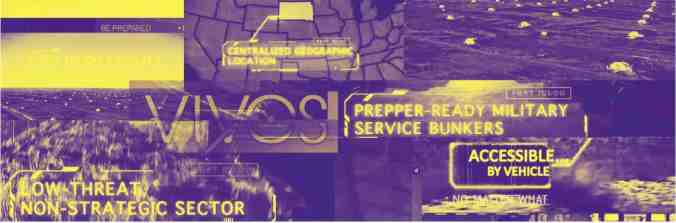
Inevitably, entrepreneurs in the service economy have spotted ways to profit from the paranoid flight plans of the ultrarich. There are real estate agents who specialize in doomsday listings, construction companies dedicated to building tony bunkers, and security firms, staffed by ex-cops and former soldiers, that for a fee will defend these caves and castles of last resort. Some developers offer a full suite of goods and services, a pricey package deal. One of the biggest is Vivos, which owns large tracts of land in America and Europe, including subterranean sites in Indiana and South Dakota. The latter includes 575 decommissioned military bunkers, luxuriously updated. The company bills it as “The Largest Survival Community on Earth.”3
Vivos’s website reminds each prospective client that “Earth Is An Increasingly Dangerous Place With Real Extinction Level Threats All Around Us.” The alarming words accompanied by an image of a nuclear missile ready to launch from its open silo. Not to worry, though, because the company insists that its “fully self-contained complexes [can] survive or substantially mitigate virtually any catastrophe,” including natural disasters such as volcanic eruptions, pandemics, and asteroid strikes, as well as manmade ones like nuclear explosions or terrorist attacks. Meanwhile, its more upscale site in Europe offers “bespoke” subterranean havens “comparable to a mega-yacht,” with potential amenities such as “pools, theaters, gyms,” and a “five star staff” that can include a chef, waiters, personal assistants, doctors, educators, and a well-armed private security team. “The possibilities,” Vivos promises, “are limited only by [clients’] personal desires”—and of course, though it goes unmentioned, by their bank accounts.4
As reported by Douglas Rushkoff in his illuminating book Survival of the Richest: Escape Fantasies of the Tech Billionaires, a different kind of doomsday retreat has been initiated in the Northeast.5 There, J.C. Cole—whose core concern is the loss of food security when, following the apocalypse, supply chains break down—is building a series of “Safe Haven Farms” where crops will be grown by his survivalist clients. Of his two retreats now in development, he keeps the location of one a fast secret, fearing that hordes of hungry people might storm its fenced perimeter when the expected calamity arrives. Yet even as he trains future clients in the use of firearms and frets online about gun control and the deep state, Cole is vocal about the importance of sustainable farming—a form of greenwashing if ever there was one. Indeed, the incoherence of his paranoia about gun control joined with his kumbaya commitment to communal agriculture raises an interesting question about these larger projects: When safety is sold as a luxurious commodity to a group of strangers who have in common only the privilege of their wealth and their fear of catastrophe, what kind of community can possibly evolve?
LinkedIn founder Reid Hoffman has stated that, in the event of a disaster, he would opt for “some form of community” rather than a private shelter. “Being around other people is a good thing,” he said, adding that “I also have this somewhat egotistical view that I’m a pretty good leader.”6 But among those enriched by our digital economy, Hoffman is hardly alone in possessing such an elevated view of his leadership skills. Whether underground, on an island, or at one of Cole’s haven farms, they would constitute an unlikely community of CEOs, each driven, to quote Mark Zuckerberg’s motto, to “move fast and break things” as they compete to run the show.
Read the whole article here.
 Organikos