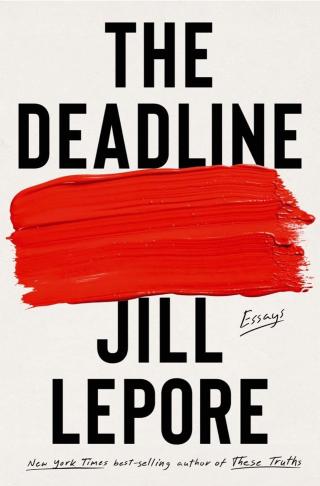
 There is an interview with Jill Lepore discussing this book to the left, which I link to below. It got me thinking about an earlier post I wrote about having read April Morning and The Hessian in my teens and my brief encounter with their author Howard Fast. That post was primarily a thank you to the librarians who got me interested in reading. I knew from the return address on the letter he sent me that Mr. Fast lived on my same street, a five minute walk from my home. I enjoyed that fact because I enjoyed the two of his books that I had read. But I never saw him after the library lecture.
Who I did see frequently, because he drove an easily identifiable red convertible Cadillac, and also lived close by, was Roy Cohn. Yes, that guy. If you know a certain bit of mid-20th Century history, the bit called the Red Scare, you might understand my first glimpse of irony. I had learned that Howard Fast was punished early in his career for his political beliefs. By the time I knew who Roy Cohn was I knew he had something to do with that punishment, directly or indirectly. What I found ironic, as a teenager, was that Howard Fast was influential on my sense of why patriotism exists; and Roy Cohn, a self-proclaimed protector of American values, made me fear patriotism. I always wondered if they knew they lived so close to one another. History does not seem to have recorded anything about that. The interview by Julien Crockett below reminded me of that irony of patriotic fervor I sensed in my teens:
The Hold of the Dead Over the Living: A Conversation with Jill Lepore
“I WROTE THESE essays during a period of terrible, tragic decline in the United States,” historian Jill Lepore writes in the introduction to her new essay collection, The Deadline. Wide-ranging and often provocative, the essays cover the past decade of “political violence, endless vicious culture war, a series of constitutional crises, catastrophic climate change, and a global pandemic.” In short, “a time that felt like a time, felt like history.”
But Lepore’s United States is not merely bleak—it is multifaceted, evolving, complicated. It is at once “held hostage” to its history, but also full of potential for “generativity and invention.” It is the home of clownish techno-futurists, “spin,” and “truthiness,” but also of the ingenious engineers who created the internet, and the investigative reporters gumshoeing through city halls. Lepore strives to understand the transformations that have tipped the scales in any given direction—and does so with verve and even hope because, as Lepore says, “you can’t successfully make a better future if you’re convinced that the future is terrible.”
¤
JULIEN CROCKETT: In the introduction to your collection, you write that the essays concern “the hold of the dead over the living.” What do you mean?
JILL LEPORE: Many of the essays engage with the question of written constitutionalism in the United States, meaning, in a specific legal way, that we are ruled by the dead. But a lot of the essays also engage broadly in questions about how memory and devotion and obligation to the dead inform decisions that we make. I don’t think it’s an unshakable hold. And sometimes, as in the title essay (from 2019), that hold is an embrace.
Two other thoughts came to mind when I read the phrase “the hold of the dead over the living”: there is the hold or inertia of things continuing to be as they are and seemingly have always been, but there is also history as the story we tell that is used to explain and justify actions. Do those ring true to you too?
I’m working on a long book about the history of attempts to amend the Constitution. And on the one hand, we have a Constitution that has a provision that allows for generativity and invention and adjustment and improvement and alteration and remedy and making amends, and all of these wonderful, beautiful ideas that we associate with the idea of the future. And yet, we live in a world where we can’t actually use that provision because our politics are so overridden with the idea of the past. Consider the Supreme Court’s history-and-tradition test, under which we can’t do anything that doesn’t derive from the past. The week that we’re speaking, the Supreme Court is hearing oral arguments on the question of whether people who have restraining orders against them due to domestic abuse can be prohibited from buying or owning weapons, and the test that the Supreme Court uses is to ask: “Was there an analogous law like that in 1787?” That is plainly nuts. In that sense, we are held hostage by the dead.
Do you find that the way history is practiced in academia has changed because of how history is used in politics?
What people mean when they say the “practice of history” is really quite different, and always changing. The field of academic historical inquiry derives from an 18th-century notion of empiricism that was professionalized in the 19th century and has been called into question in the 21st century by a call for advocacy that rejects the idea of objectivity and even the very notion of empiricism. A similar transformation has taken place in journalism. You could date the current iteration of the struggle over the practice of history to the Tea Party movement; there has been a really weird and crude version of American history that operates as a political narrative to justify a set of political commitments on the right. I think of the Tea Party movement as a marriage of populism and originalism. It has a pretty big cultural and political hold right now, but its idea of history is to academic history what astrology is to astronomy or alchemy is to chemistry. By which I mean, it is bunk.
In “Just the Facts, Ma’am” (2008), you talk about history’s role as a purveyor of “truth” and ask, “Is ‘historical truth’ truer than fictional truth?” What are the differences between these “truths”?
Since Aristotle, there has been a debate about the relationship between literature and history, and in the 18th century, this took the form of a debate between the novel and history. As this line of argument goes, history has the truth of the particular—you can learn from history the particulars of the reign of George III—but the novel has the truth of the universal, meaning you can read Robinson Crusoe and learn something about the human condition. I myself find that very persuasive. I think the universality of the truth revealed by art is really very different from the quite particular, almost legalistic or prosecutorial nature of the truth revealed by the work of the historian. Only the most beautiful history ever reaches the truth of literature. It’s a very rare thing.
That is well captured by the definition of the novel as “a private history.”
Yeah. The novel is meant to be the story of the ordinary life. And that is the life that most of us have. The study of George III was meant historically to be edifying to future statesmen, so the reader is not an ordinary person either. The great turn of social history in the 1960s and 1970s was meant to be a remedy to that.
Read the whole interview here.
 Organikos