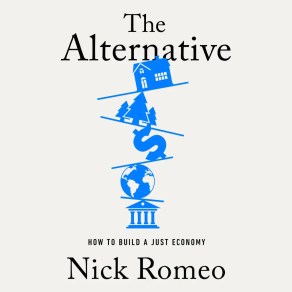
 Nick Romeo has a new book coming out, and the Guardian recommends it, tentatively. It is up to all of us to answer the reviewer’s doubts through our choices and actions:
The Alternative by Nick Romeo review – moral substitutes for the free market model
A survey of the global alternatives to the current economic system makes for an enlightening, inspiring read, but you’re left wondering why such initiatives have failed to take hold
Anti-capitalist street art in the 11th arrondissement of Paris. Photograph: Soma/Alamy
I wrestled with how to approach this review. On the one hand, The Alternative brings together an appealing range of ways people across the west are imaginatively and determinedly contesting the givens in today’s capitalism. There is an ache for better – for more just ways of organising the way we work and adding more meaning to our lives. You can’t help but applaud Nick Romeo for showing the workable alternatives to capitalism and the moral driver behind them – everything from the way companies are incorporated to how employees are hired, paid and enabled to share in the value they create. There is no need for ordinary workers to be pawns in a system that makes humanity and ethics secondary to the unbending logic of the marketplace and blind, selfish capital.
On the other hand, is it all worth more than a can of beans? How are a collection of disparate, often small scale, if great, initiatives going to grow into a systemic challenge to the way things are currently organised? The Mondragon co-operative movement that Romeo applauds fascinated me as a teenager for all the reasons he sets out. The hope was the virtues he cites – essentially treating workers fairly, decently and with respect – would unleash such increased engagement, productivity and purpose that the good would drive out the bad of its own accord. A more moral economy, retaining the pluralism of capitalism but less of its innate exploitativeness, was there for the having. Well, more than 50 years later Mondragon has grown into one of the top 10 companies in Spain – but has too few emulators even in its own country. This admirable, readable book tries to offer hope. But for all Romeo’s enthusiasm, the question is left hanging. Why so little progress when the case against how so much of the way work and welfare is organised is so strong – and the alternatives so viable?
For example, in his tour of different possibilities he takes us to the Marienthal job guarantee programme in Austria. For those who don’t know, Marienthal was the scene of a social science investigation in the 1930s into the desperate social, psychological and collective depressive consequences of mass unemployment. Today the town is piloting the impact of a universal jobs guarantee for all of its out-of-work citizens. Essentially there is a job for anyone unemployed for more than 12 months – you can even have a hand in designing what it is you will do with your time when you work – and you get paid up to £2,000 a month. People opt to work rather than receive welfare benefit, and there is ample evidence it raises their self-worth while delivering a service – care to the elderly or tidier parks – that was not there before. Better still, it costs the state virtually nothing because unemployment benefit is simply transferred to the now employed worker’s pay packet.
Britain did something similar after the financial crisis with the Future Jobs Fund – a grant to employers who offered the long-term unemployed paid work – and with similar success. Britain’s welfare benefits are more paltry than Austria’s so the scope to offer a decent wage that is self-financing is much less, but even so the evaluations were positive. Worthwhile jobs were wished into being, goods and services produced by redeploying welfare benefit as wages. However, it was ideologically scrapped by the coalition government as a classic example of New Labour waste: state initiative was a priori bad; only the private sector should be in the economic driving seat. Tax credits would be given for providing work, rather as Rishi Sunak attempted with the Kickstart programme in the wake of the pandemic. But take-up was abysmal and the various Tory schemes collapsed. The lesson is that a public authority has to lead, to be the paymaster and organise the furnishing of work itself. Yet even in Austria the success of Marienthal has not been copied, and it is unclear whether it will be extended beyond 2024…

Read the whole review here.
 Organikos