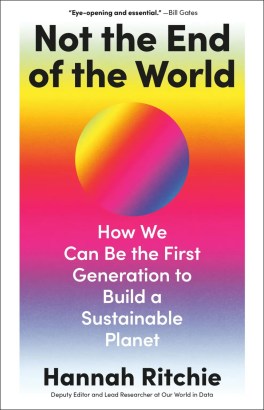
 Bibi van der Zee’s reviews and other articles in the Guardian are always insightful:
Not the End of the World by Hannah Ritchie review – an optimist’s guide to the climate crisis
This book is full of pragmatic, hopeful solutions to environmental challenges. But is there something missing?
Data scientist Hannah Ritchie has written a good-hearted, generous book that tries its very best to reassure us about the various environmental crises we face. Which, obviously, is much appreciated: God knows we need all the optimism we can get.
Ritchie is lead researcher at the groundbreaking Our World in Data, a website run out of Oxford University. She begins by describing the moment of revelation she experienced when, after years of feeling helpless and anxious about the state of things, she discovered the Swedish professor Hans Rosling, and “everything changed”.
Rosling, who died in 2017, was one of what you might call the “big optimists”, alongside cognitive psychologist Steven Pinker. Like Pinker, he tried to present a counterpoint to the creeping sense of global doominess – what he called the “overdramatic worldview” – that has overtaken many of us in the past couple of decades. He argued, with plenty of good evidence to back it up, that poverty was declining, global health improving, and that many of the things we thought were wrong with the planet are actually fine.
Rosling’s positive outlook proved infectious for Ritchie, and she reoriented her work in a similar direction. With this book she wants to do for environmental problems what Rosling did for social ones – zoom out from the daily news stories, which are a “terrible way to understand the bigger picture”, look at the long-term data in order to get a clearer view of what is really going on, and then explain that to people. “If we take several steps back, we can see something truly radical, game-changing and life-giving: humanity is in a truly unique position to build a sustainable world,” she writes. And thus, with some sensible caveats in place, she addresses air pollution, climate change, deforestation, food, biodiversity loss, ocean plastics and overfishing.
I would love to say that I came away from this book as convinced and optimistic as Ritchie. I was genuinely excited about reading it, as someone who spends my days editing and commissioning the daily news stories that Ritchie is so concerned about. And it’s certainly true that there is lots of interesting information in here. In the chapter about deforestation, for example, she explains that palm oil is actually an extremely productive crop, with yields of 2.8 tonnes of oil per hectare compared with, say, 0.34 tonnes for olives, 0.26 tonnes for coconuts and 0.7 tonnes for sunflowers – so if companies turned to alternatives because of palm oil’s bad reputation, that could actually lead to far more deforestation. In the same chapter she presents a wonderful graph showing the way that forests have come and gone in the US, France and Scotland over the past 1,200 years.
In the section about climate change she points out that her carbon footprint is on average smaller than her grandmother’s: when her grandparents were in their 20s the average footprint was 11 tonnes of CO2 per year – and it’s now just five, thanks to the way that the UK’s carbon emissions have gone down in the past 30 years. The chapter about food and the problems caused by farming (Ritchie’s specialism) includes the interesting observation that the world has most probably passed or will soon pass peak land-use for agriculture. “That is … momentous,” says Ritchie. “The world’s wildlife has been waiting thousands of years for us to stop expanding.” She is incisive about the damage caused by the amount of meat and dairy we consume…
Read the whole review here.
 Organikos