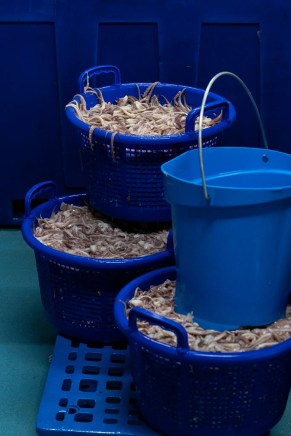
Bins of squid waiting to be packaged in Cape May. In a good week, Mr. Bright said his boats can bring in $100,000 worth of herring. Rachel Wisniewski for The New York Times
You can read the story or click the photo of William Bright below right to hear an explanation of how his case may be the end to regulation as we know it.
A Fight Over a Fishing Regulation Could Help Tear Down the Administrative State
The Supreme Court will hear arguments on Wednesday over whether to overturn a key precedent on the power of executive agencies.
On a blustery fall morning in southern New Jersey, the weather was too rough for the fishing boats at the center of a momentous Supreme Court case to set out to sea.
William Bright, a fisherman in New Jersey. He is the lead plaintiff in a case that could undermine the power of executive agencies, a long-sought goal of the conservative legal movement. William Bright, a fisherman in New Jersey. Photo: Rachel Wisniewski for The New York Times
A herring fisherman named Bill Bright talked about the case, which will be argued on Wednesday and could both lift what he said was an onerous fishing regulation and wipe out the most important precedent on the power of executive agencies, a long-sought goal of the conservative legal movement.
As workers cleaned squid and the salt air whipped over the docks, Mr. Bright, who has been fishing for 40 years and whose family-owned company is one of the plaintiffs, said he recognized the impact the case could have.
“I can see why this case is such a political thing,” he said. “But to me, it’s not political. This is my livelihood.”
Mr. Bright is backed by a conservative group with ambitions that extend far beyond fishing regulations. Its aim is to do away with a seminal 1984 decision, Chevron v. Natural Resources Defense Council, one of the most cited cases in American law.
The conservative legal movement and business groups have long objected to the ruling, partly based on a general hostility to government regulation and partly based on the belief, grounded in the separation of powers, that agencies should have only the power that Congress has explicitly given to them.
Overturning the decision could threaten regulations on the environment, health care, consumer safety, nuclear energy, government benefit programs and guns. It would also shift power from agencies to judges.
Mr. Bright laid out the basic question in his case.
A 1976 federal law requires herring boats to carry federal observers to collect data needed to prevent overfishing. That was fine with him….

Read the whole story here.
 Organikos