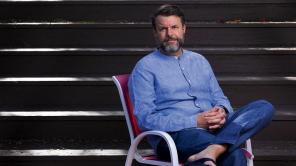
Charles Duhigg at home. PHOTOGRAPH OF CHARLES DUHIGG BY GLENN MATSUMURA
The themes in Charles Duhigg’s work are ones we aim to pay more attention to this year. So, thanks to Jonathan Shaw at Harvard Magazine for this:
Charles Duhigg unpacks how business and finance—and you—really work.
IN THE HISTORY OF stock market rallies and economic recessions, much defies quantitative explanation. Whether looking back on the tulip mania that gripped the Netherlands in the 1630s, or to the present obsession with bitcoin, the decisive role of human behavior fascinates journalist and author Charles Duhigg. “Researchers have pinpointed moments when investors’ imaginations become especially labile: during periods of social uncertainty, or when new technologies emerge, or when it seems that some improbable group has become fantastically rich overnight,” he says. “At such times, a few financial storytellers often rise to prominence: people you’ve never heard of who fill the media with sensational tales of wealth earned in bold, exciting ways.” Duhigg extracts crisp observations like these, made in a recent New Yorker profile of contemporary financial storyteller, Chamath Palihapitiya, from messy, complicated particulars. And in the course of drawing a telling portrait of the man, he explains the intricacies of a newish financial instrument—and its ability to swiftly make some people rich, and others poor.
Duhigg, M.B.A. 2003, is the author of two books, The Power of Habit, and Smarter, Faster, Better, that use such stories to elucidate scientific research into human and organizational behavior. While the narrative structure of his work is similar to that employed by his New Yorker colleague Malcolm Gladwell—memorable essays linked to scientific studies in surprising ways—Duhigg’s interests and approaches are distinct. He is both a student of intellectual history, and at bedrock, a tenacious investigative journalist, delving into what makes organizations, and the people within them, tick. In 2013, as part of a New York Times team that produced a series of stories about Apple, he won the Pulitzer Prize for explanatory reporting. To find the 20 or 30 former Apple employees willing to speak with him about the company’s business practices—including its role in the difficult, underpaid, and sometimes deadly work at Foxconn, its manufacturing partner in China—he contacted some 900 people. Shortly after the series appeared in 2012, Duhigg recalls, “Foxconn gave a raise to every single employee. Because Foxconn was such a dominant player,” other manufacturers had to follow to remain competitive. “Someone figured out that about three million people got raises equivalent to hundreds of millions of dollars—all because there were employees courageous enough to say, ‘Let me paint a picture for you of what it was like to work at this place.’”
Storytelling can change the world, Duhigg knows. And he is an exceptionally gifted raconteur, who frequently uses his talent to pull back the veil on systems and practices that operate, often opaquely, in the worlds of business and finance. From Wall Street to Silicon Valley, he has unpacked complexities that most readers, and other reporters, might reflexively shun. He’s written engagingly about the perils of reverse mortgages, insurance scams, the widespread and growing problem of water pollution, the story behind Google’s hegemony in online search, the economics of fads, and the rise of risk at Fannie Mae (the government’s mortgage-loan guarantor) during the Great Recession. Common to these stories are clear explanations set within a compelling narrative. “My number one goal, in anything that I’m writing,” he says, “is to entertain the reader. Because if I’m not drawing you in, then you’re not going to read it. And it doesn’t matter how good the ideas are…. I’m always thinking about how to communicate some idea that I think is important and interesting—and complex. But the way I want to do that is through a story. Because the story is the key that is going to draw you in. And most importantly, it’s going to be a lot easier to remember that idea. Because you’re going remember the story.”…
Read the whole article here.
 Organikos