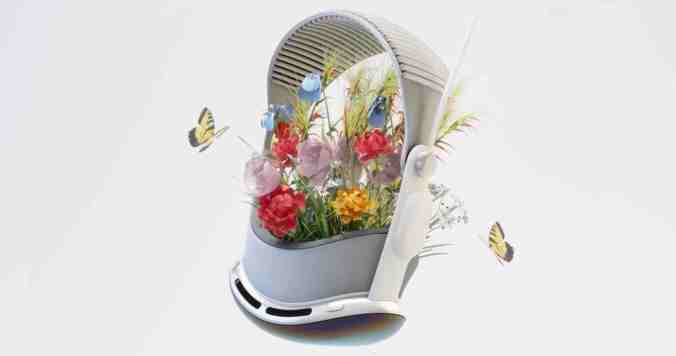
Illustration by Jackie Carlise
Jaron Lanier has been our go-to voice of reason at important moments in technology hype. Here is his take on the latest hype:
Where Will Virtual Reality Take Us?
Apple’s Vision Pro headset suggests one possible future—but there are others.
Because we in Silicon Valley are newness junkies, it can feel like an act of sabotage to have memories, but, for better or worse, I have them. It’s been more than forty years since I co-founded the first company to make headsets and software for simulated experiences, and came up with familiar terms like virtual and mixed reality. Since then, virtual reality has flooded the public imagination in waves; back in the nineteen-eighties, for instance, it had quite a presence in movies, cartoons, TV shows, the occasional arcade game, and a few early consumer products, like the Nintendo Power Glove. I still love V.R. But, these days, I sense that what I experience of it, what I enjoy in it, is different from what it has come to mean to many enthusiasts.
Back then, at the beginning, did I talk about V.R. like the people I disagree with now? Sometimes I did! I did occasionally promote V.R. as an alternate cosmos that might swallow us all to good effect. I don’t agree with that sort of talk now, but at the time the joy of being edgy and extreme was too great to resist. Every young technical person wants to see around the corners that others cannot, to be the harbinger of great change. To explain to someone in the early eighties what V.R. was—to give them a demo—was an ego rush, because they often couldn’t grasp what was being said or what had just happened to them. It was a primal validation, a power trip, and I wish I had done it with more humility. But here we are, after almost a half century of products, movies, and startups, and V.R. people still seek that rush. Apple’s promotional videos for its new headset—the Vision Pro, a metal-and-glass, ski-goggle-like apparatus that costs around thirty-five hundred dollars—show people experiencing V.R. for the first time. The producers either had to search hard for those people or ask actors to pretend.
Apple’s entrance into V.R. has symbolic weight, because the company has had so much influence on computers and phones. Back in 1984, when the Macintosh was introduced, a few members of the Mac team left Apple to join my startup, V.P.L., and help us create the first generation of commercial V.R. products. At the time, we guessed that Apple itself would enter the market in 2010. We knew that the consumer adoption of the technology was a long way off. We were selling tools for millions of dollars to customers like nasa. But despite the conservative clients, our early V.R. software was radically strange. You could program while in our virtual world, and see all the variables not as textual symbols but as virtual objects; there was no source code. I used to wax on about how virtual reality would lead to a new style of “post-symbolic” communication, in which we would make experiences for one another, sharing them directly instead of just describing them.
The hope was to make V.R. a place for spontaneous invention. Virtual reality would allow groups of people to “play the world into existence” on virtual devices that resembled musical instruments. (Instead, we now talk about “speaking the world into existence” using A.I.) It would be like a social lucid dream.
In the intervening decades, V.R. has thrived at two extremes in the quest for “killer apps.” It has long been an established industrial technology: if you’ve flown, ridden, or sailed in a factory-built vehicle in the last thirty years, virtual reality may have played a central role. It’s been used to design surgical procedures and train surgeons ever since our first simulated gallbladder, at Stanford Med, some three decades ago; Boeing, Ford, and many other companies started using VR for design in the early days as well. And then there are the visionary, mystical, and philosophical applications. V.R. can be a way of exploring the nature of consciousness, relationships, bodies, and, perception. In other words, it can be art. V.R. is most fun when approached that way.
In between the two extremes lies a mystery: What role might V.R. play in everyday life? The question has lingered for generations, and is still open. Gaming seems likely—but, for most gamers, not so much. There are many reasons why V.R. and gaming don’t quite work, and I suspect that one is that gamers like to be bigger than the game, not engulfed by it. You want to feel big, not small, when you play. (“Star Wars” might have got this right with holographic chess.) Apple’s initial round of Vision Pro apps, like those from its competitors, aren’t entirely compelling, either, and can even have a lonely, dystopian flavor. (Watching a simulated big-screen movie, by yourself?) But my belief is that the quotidian killer apps will come. Maybe you’ll use V.R. to learn quickly about the Airbnb at which you’ve just arrived. Maybe V.R. will help you assemble ikea furniture. Maybe!…
Read the whole essay here.
 Organikos