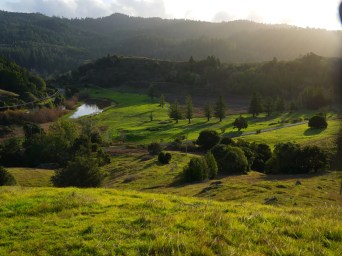
The San Geronimo Golf Course is being reclaimed and rewilded and is now known as San Geronimo Commons. Jim Wilson/The New York Times
Golf is known to be problematic. But then again, what is not problematic? And we appreciate seeing cases where golf gives way to nature. Our thanks to Cara Buckley for bringing this story to our attention in the New York Times. We applaud the imagination of those responsible:
After Shutting Down, These Golf Courses Went Wild
The restoration of the San Geronimo land is still underway. Trails are planned that would skirt sensitive habitat and help to make it starkly different from its time as a golf course. Jim Wilson / The New York Times Image
Most defunct golf courses get paved over, but a number are getting transformed into ecological life rafts for wildlife, plants — and people.
There was scraggly grass in one sand trap and wooden blocks and a toy castle in another, evidence of children at play. People were walking their dogs on the fairway, which was looking rather ragged and unkempt. This was only to be expected.
Nowadays, these grounds are mowed just twice a year, and haven’t been doused with pesticides or rodenticides since 2018, which was when this 157-acre stretch of land stopped being the San Geronimo Golf Course, and began a journey toward becoming wild, or at least wilder, once again.
A small number of shuttered golf courses around the country have been bought by land trusts, municipalities and nonprofit groups and transformed into nature preserves, parks and wetlands. Among them are sites in Detroit, Pennsylvania, Colorado, the Finger Lakes of upstate New York, and at least four in California.
“We quickly recognized the high restoration value, the conservation value, and the public access recreational value,” said Guillermo Rodriguez, California state director with the nonprofit Trust for Public Land, which bought the San Geronimo course, in Marin County, for $8.9 million in 2018 and renamed it San Geronimo Commons.
During a recent tour of the land, which sits low in San Geronimo Valley, less than an hour’s drive north of San Francisco, Mr. Rodriguez motioned to rolling hills that serve as habitat for wildlife, including hawks that were wheeling overhead. “On either side, you have public lands,” he said. “This was the missing link.”
The restoration of the San Geronimo land is still underway. Floodplains will be reconnected, and a fish barrier has been removed, allowing access to more robust migratory and breeding grounds for endangered coho salmon and threatened steelhead trout. Trails are planned that would skirt sensitive habitat, making the land a publicly accessible ecological life raft, starkly different from its time as a golf course…

Read the whole article here.
 Organikos