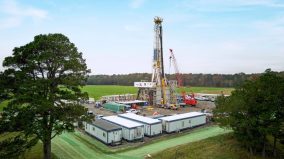
The drilling rig at ExxonMobil’s first lithium well, in southwest Arkansas. EXXONMOBIL
Thank you, Fred Pearce. It is not easy to trust ExxonMobil or any other petroleum company to do the right thing, but this sounds better than most of what we hear about their common practices:
In Rush for Lithium, Miners Turn to the Oil Fields of Arkansas
The Smackover Formation in southern Arkansas was once a major oil producer. Now, companies hope to extract lithium — a key metal for electric vehicle batteries — from its underground brines using technologies they say could reduce mining’s carbon emissions and water use.
The town of Smackover, Arkansas, was founded a hundred years ago when a sawmill operator got lucky: his wildcat oil well yielded a gusher. For a time in the 1920s, the oil field beneath the clay hills and swampy creeks in this stretch of southern Arkansas was the world’s most productive site. Now, boosters say the region will help usher the world into an oil-free future, thanks to the discovery of underground brines that are rich in lithium.
Lithium is one of the most important metals in the transition to renewable power. Lithium-ion batteries are, thanks to their light weight and high energy density, the most popular choice for storing energy in electric vehicles, and a potential tool for grid storage, too. Global production of the metal tripled throughout the 2010s, and demand is projected to increase as much as 40-fold by mid-century.
But that presents several conundrums. Though geologists have already identified more than 100 million tons of lithium across the globe, easily enough to meet projected demand for decades, the world’s supply is currently blasted out of rocks — which are then roasted at temperatures as high as 2,000 degrees F — or extracted from brines in the high Andes, a process that lowers the water table in an already arid region and leaves behind toxic residues. Given the carbon emissions from hard-rock mining and the water stress induced by evaporative mining, a recent article in Nature, written by five researchers at Lawrence Berkeley National Lab and an industry consultant, warned that “simply ramping up lithium production at existing sites could negate the benefits of the clean technologies they power.”…
Read the whole article here.
 Organikos