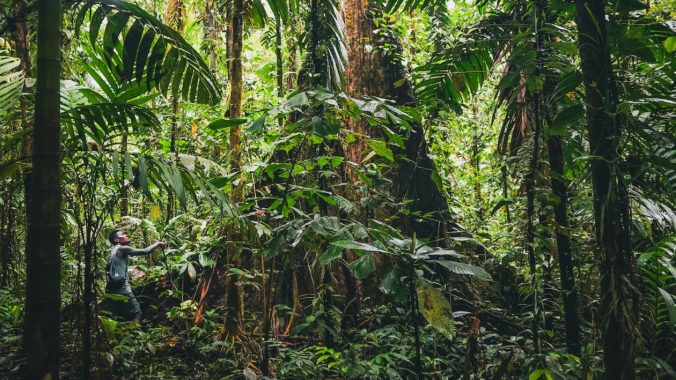
Sirebe tribal ranger Elijah Qalolilio Junior in the rainforest. DOUGLAS JUNIOR PIKACHA / NAKAU

A sign marks the boundary of protected Sirebe land. DOUGLAS JUNIOR PIKACHA / NAKAU
Of all the methods for addressing climate change, new incentives for protecting forests are among those we have most confidence in. Thanks to this article by Jo Chandler in Yale e360, if your introspection after reading this previous article had you down on carbon credits, there may be a way to restore your confidence:
The Sirebe forest at dusk. DOUGLAS JUNIOR PIKACHA / NAKAU
Solomon Islands Tribes Sell Carbon Credits, Not Their Trees
In a South Pacific nation ravaged by logging, several tribes joined together to sell “high integrity” carbon credits on international markets. The project not only preserves their highly biodiverse rainforest, but it funnels life-changing income to Indigenous landowners.
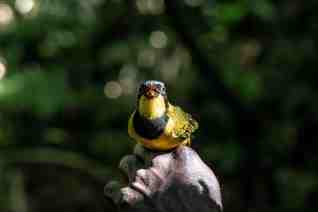
A male oriole whistler on a forest ranger’s hand. DOUGLAS JUNIOR PIKACHA / NAKAU
When head ranger Ikavy Pitatamae walks into the rainforest on Choiseul Island, the westernmost of the nearly 1,000 islands that make up the South Pacific archipelago of Solomon Islands, he surveys it with the heart of a tribal landowner and the eye of a forester.
Leading the way up a track into the bush, he wades into a glassy stream, stirring small, brown fish into a spin. Surveys have identified some 50 freshwater species in these waters, a haven of biodiversity in a nation ravaged by high rates of logging. At the sound of a thumping whoosh overhead, Pitatamae points up just as two Papuan hornbills flash across a gap in the canopy. “They always fly in pairs,” observes Wilko Bosma, a lanky Dutchman trailing behind the ranger. “They’re committed for life.”
Bosma made his own commitment to this forest after landing here 25 years ago as an idealistic forestry graduate, working alongside Indigenous tribal landowners on small, sustainable timber projects. That’s how, in 2004, he came to establish with tribal partners a local conservation NGO — the Natural Resources Development Foundation (NRDF) — and got to know Linford Pitatamae, the older brother of ranger Ikavy and a leader of their tribe, the Sirebe.
Together with a handful of neighboring tribes, the Sirebe resisted offers of quick money from the Malaysian companies whose ships lurk off the coast, piled with logs for export to China, and began laying plans to profit from allowing their trees to stand. Aerial maps reveal their remarkable success: the only expanse of green on the island that is not scarred by logging roads.
“If we misuse or destroy this land, we will not have any other,” explains Linford Pitatamae. “So we have been committed to protect our lands, our forests, our rivers and streams, and all the resources for quite a long time.”
Finally, the Sirebe’s long game is paying dividends. In 2019, the tribe’s three-square-mile forest became the first legally protected area in the nation, a “beacon of conservation and natural resource management,” according to Culwick Togamana, Solomon Islands’ environment minister. In February 2022, the Sirebe became the nation’s first landowners to receive payment from international investors for keeping their forests intact. With neighboring tribes also securing protected areas and selling “high integrity” carbon credits to buyers looking to offset their greenhouse emissions or burnish their green credentials, the Babatana Rainforest Conservation Project — named for the tribes’ shared language group — now covers 26 square miles of protected tropical rainforest…

Read the whole article here.
 Organikos