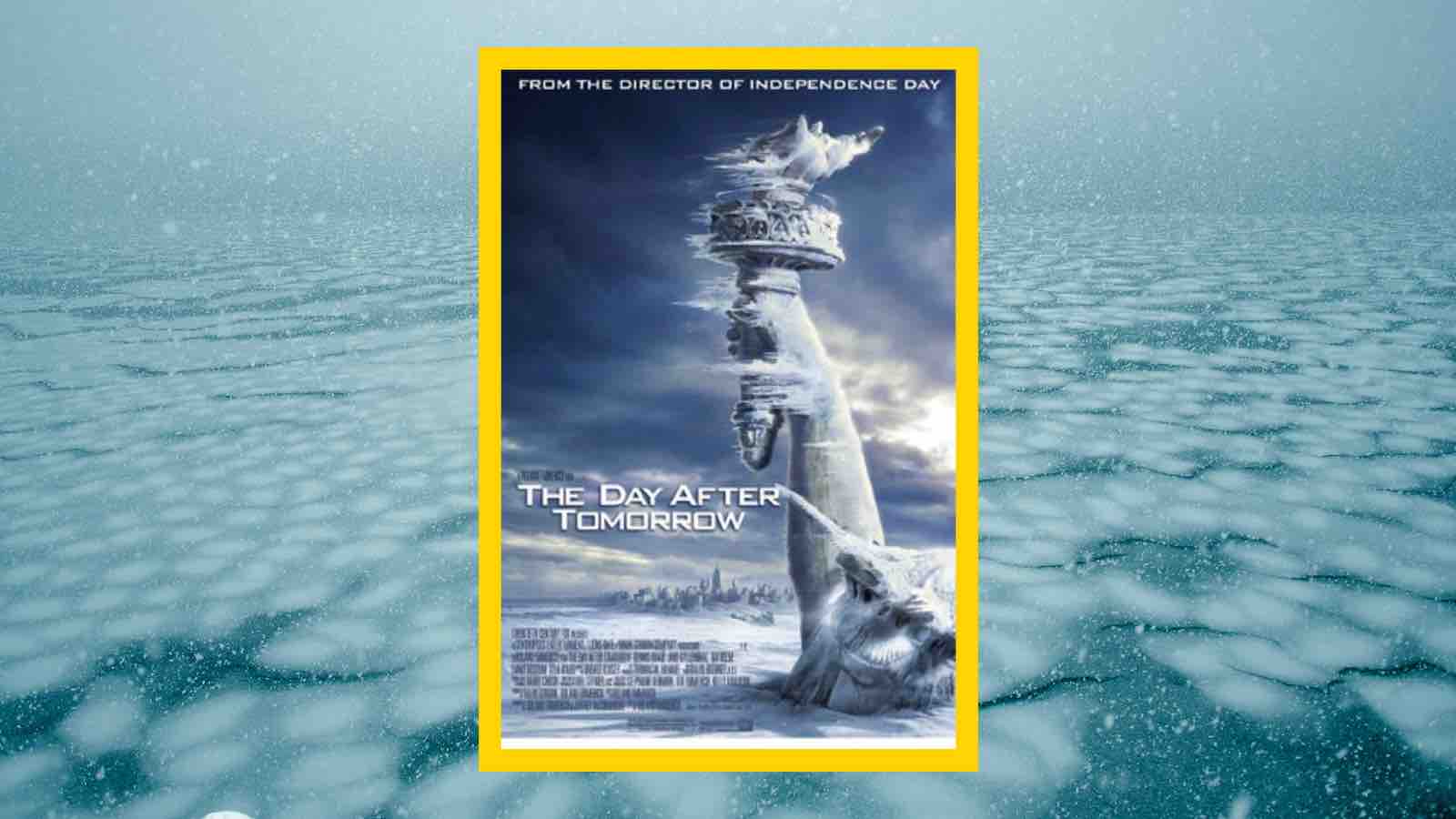
 It has not been top of mind for any of us contributing to this platform, but Michael Svoboda, the Yale Climate Connections books editor, puts the influence of this film in perspective:
The enduring influence of “The Day After Tomorrow,” 20 years later
The groundbreaking film popularized an extreme climate scenario. To what effect?
It has been 20 years since we first saw the paleo-climatologist Jack Hall, played by Dennis Quaid, standing at a railing overlooking a command center at NOAA and asking his colleagues the question that baffled them: “What about the North Atlantic Current?”
The ocean current is failing, he explained, relaying news he had just received from an observatory in the UK; the extreme storms they’re seeing “will not just continue but get worse. … I think we’re on the verge of a major climate shift.”
When it opened on Memorial Day weekend in May 2004, “The Day After Tomorrow” was a box office smash, grossing nearly $70 million in just four days. In several locations around the country, its premiere was also a major media event, drawing in environmental activists and voter registration tables and attracting a wide range of reviews and commentary.
“The Day After Tomorrow” offered an unusual depiction of climate change. And it had followed an unusual route to the screen.
As I explained in two pieces I wrote for Yale Climate Connections for the film’s 10th anniversary in 2014, director Roland Emmerich drew on a recent book, “The Coming Global Superstorm,” for his apocalyptic plot and several scenes. One of the co-authors of that book, Whitley Strieber, purportedly drew on his relationship with the “Master of the Key,” a “preternaturally intelligent being” with profound insights on climate change. More likely, Strieber read the extensive article in the January 1998 issue of The Atlantic by neurophysiologist William H. Calvin, “The Great Climate Flip-Flop,” which described the role the North Atlantic current played in Earth’s climate. Climate scenarios are not typically created by preternaturals or neurophysiologists, but that’s how one of the biggest films of the early 2000s came to such an unusual take: Human-caused global warming could lead to a new ice age…
Read the whole essay here.
 Organikos