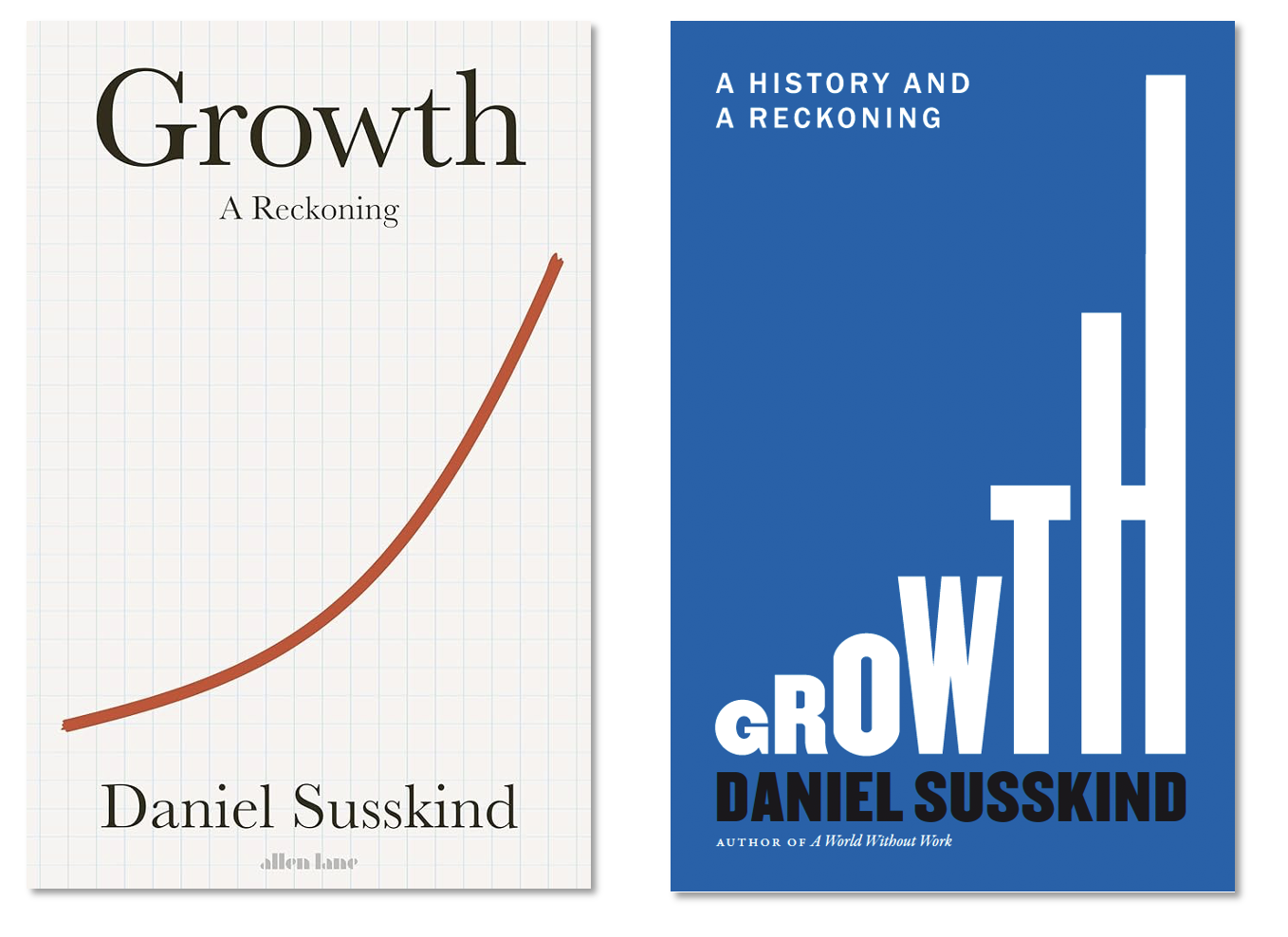
Idrees Kahloon is an excellent discussant on the Economist podcast, and reviews Daniel Susskind’s new book in the current issue of the New Yorker:
Capitalism, as it has been practiced throughout the past century, has brought with it plenty of problems; as with any engine, harnessing it properly requires controlling it properly.Illustration by Carl Godfrey; Source photographs from Alamy; Getty
The World Keeps Getting Richer. Some People Are Worried
To preserve humanity—and the planet—should we give up growth?
In April, 1968, a consequential meeting took place in the Villa Farnesina, a stately Roman home built for Pope Julius II’s treasurer and adorned with frescoes by Raphael. The conveners were Alexander King, a Scottish chemist who directed scientific affairs for the Organization for Economic Co-operation and Development, and Aurelio Peccei, an Italian industrialist who simultaneously held executive positions at the automaker Fiat, the typewriter manufacturer Olivetti, and a large consulting firm. Like many modern friendships, King and Peccei’s was cemented by a shared deep-seated anxiety. They gave the object of their concern a grand name: the “world problématique,” meaning the interrelated cultural, political, and environmental conflicts that threatened humanity. But the organization they launched came to be known, more simply, as the Club of Rome. Its mission, in Peccei’s words, was to “rebel against the suicidal ignorance of the human condition.”
Within a couple of years, the club recruited a brilliant M.I.T. systems analyst named Jay Forrester, and he and his colleagues set about building a computer model to capture the linkages between booming resource consumption, population growth, and ecological exhaustion. The conclusions reached by World3, as the whizzy model was called, were laid out in “The Limits to Growth,” a book that the Club of Rome published in 1972. World3 glumly predicted that humanity was despoiling nature so fast that civilizational collapse would occur “sometime within the next one hundred years.” In bloodless mathematical terms, this was the result of an exponential function outpacing a linear one. In more vivid biological terms, we were like a colony of yeast mindlessly feeding on a pile of grapes, and soon to perish from the effluvia of our rapid growth (ethanol in the case of yeast, environmental pollution in the case of humans). “Deliberately limiting growth would be difficult, but not impossible,” the book maintained. “A decision to do nothing is a decision to increase the risk of collapse.” It sold millions of copies in more than thirty languages.
For all of that, growth continued rather yeastily. In the fifty years since this manifesto, the American economy has increased fourfold, far outstripping the country’s population, which has increased by sixty per cent. For the rest of the world, growth during this period has been even more dramatic. The global economy has become twenty-six times bigger—or twelve times higher per person. In 1970, half of humanity lived in extreme poverty, subsisting on less than two dollars a day. Today, only a tenth of the global population lives in extreme poverty. As astonishing as this growth engine has been to behold, we do seem to be choking on its exhaust. When “The Limits to Growth” was published, humanity had, in its history as a species, emitted half a trillion tons of carbon dioxide into the environment. We belched out triple that amount in the ensuing years. The world was just 0.4 degrees Celsius warmer than the pre-industrial average back then; last year, it was 1.5 degrees warmer, and on track to hit three degrees by the end of the century, at which point all kinds of cataclysms are expected—polar ice caps petering out, swollen oceans swallowing the coasts, almighty wildfires, famine, and more…
Read the whole review here.
 Organikos