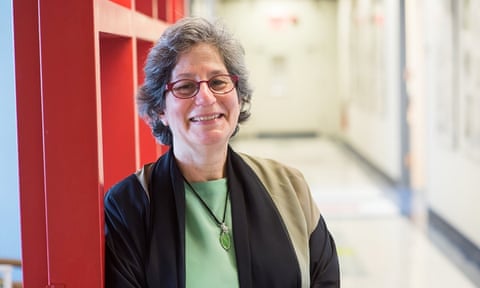
Susan Solomon: ‘Frankly, I worry about climate scientists being encouraged to take a particular stance.’ Photograph: Justin Knight
Killian Fox (long time no see!) offers this wonderful conversation with an optimist who knows the science:
Climate scientist Susan Solomon: ‘Let’s not give up now – we’re right on the cusp of success’
The US atmospheric chemist on why she doesn’t share the pessimism of most climate scientists, fixing the ozone layer, and why Jacques Cousteau is her hero
Susan Solomon was born and raised in Chicago and got her PhD in atmospheric chemistry from the University of California, Berkeley. She is known for her work in the 1980s which established how the Earth’s protective ozone layer was being depleted by human-made chemicals. Her studies formed the basis of the 1989 Montreal protocol – an international agreement that helped eliminate 99% of these harmful solvents. Now a professor of environmental studies and chemistry at MIT, Solomon is the author of three books, the latest of which, Solvable: How We Healed the Earth, and How We Can Do It Again, applies lessons from past environmental successes to the climate crisis.
What got you interested in science?
Easy answer: Jacques Cousteau – I thought it was just the most incredible thing I’d ever seen. But then I didn’t really like biology, and I loved chemistry. As I started reading about planetary atmospheres I thought: Oh, my goodness, chemistry on a planet instead of in a test tube! I want to do that!What prompted you to write this book?
Having done a lot of work on the ozone hole, one is constantly asked: “If we could [solve the problem] for ozone, can we do it for climate change?” I had a lot of experience with the policy community with the Montreal Protocol [an international treaty to protect the ozone layer], as well as with the IPCC, so I learned a lot about how policy is made. And I was fascinated by the question of, why are these problems different?
Read the whole conversation here.
 Organikos