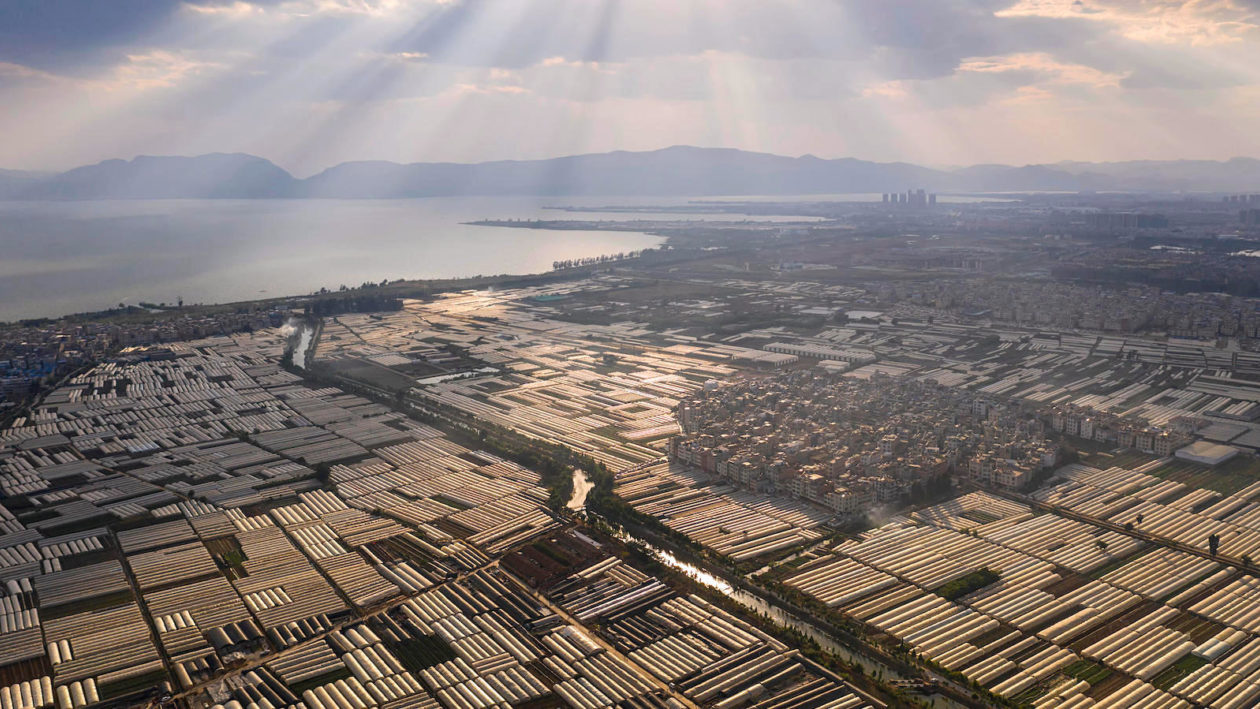
Greenhouse roofs reflect sunlight in Kunming, China. FABIO NODARI / ALAMY STOCK PHOTO
Fred Pearce, in Yale e360, offers reason to further consider the greenhouse:
Could the Global Boom in Greenhouses Help Cool the Planet?
As agricultural greenhouses proliferate, researchers are finding that their reflective roofs are having a cooling effect. Some experts see this as an unintended experiment with lessons for cooling cities, but others point to the environmental damage that greenhouses can cause.
The world is awash with greenhouses growing fresh vegetables year-round for health-conscious urbanites. There are so many of them that in places their plastic and glass roofs are reflecting sufficient solar radiation to cool local temperatures — even as surrounding areas warm due to climate change.
The extent of this accidental climate engineering is becoming ever more apparent as analysis of satellite images dramatically increases estimates of the area of the planet swathed in greenhouses. From southern Spain to northeast China and the Rift Valley in East Africa to Mexico, millions of acres of former scrub and marginal farmland are being replaced by glistening reflective surfaces.
The intensive agricultural methods employed within greenhouses may often damage local environments by overtaxing water supplies and polluting rivers and soils with nutrients, pesticides, and plastic waste. But the influence of these seas of plastic on local temperatures can be even more dramatic — and often beneficial. They increase the albedo, or reflectivity, of the land surface, typically by around a tenth, and so reduce solar heating of the lower atmosphere.
The extent of the planet’s growing enthusiasm for greenhouses was revealed in May by a new satellite mapping exercise, which estimated the land area covered with permanent greenhouses at 3.2 million acres, an area the size of Connecticut, with China hosting more than half of this expanse. This is more than twice previous estimates, and 40 times those made four decades ago.
And the figure is just the tip of the albedo iceberg, says the study’s lead author, Xiaoye Tong, a geographer at the University of Copenhagen. He told Yale Environment 360 that if temporary coverings of crops by reflective plastic sheets were included, the figure would be 10 times higher — more like the size of New York State.
The spread of greenhouses and plastic sheeting on crops amounts to a huge climate experiment, according to researchers who believe it could offer a template for cooling urban areas — or even taking the edge off global climate change. Says Xuehua Fan, a researcher at China’s Institute of Atmospheric Physics in Beijing, “Agricultural plastic film could… be regarded as a potential geoengineering project.”…
Read the whole article here.
 Organikos