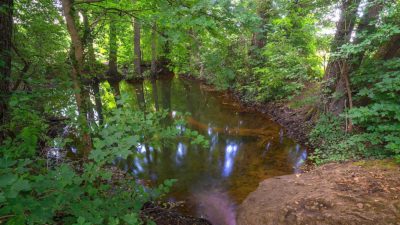
A spring in a forest in Bavaria, Germany. IMAGEBROKER.COM GMBH & CO. KG / ALAMY STOCK PHOTO
Thanks to Yale e360 for publishing this article by Christian Schwägerl, whose influential book The Anthropocene was published one decade ago:
As World’s Springs Vanish, Ripple Effects Alter Ecosystems
Springs, which bring groundwater to the surface and support a host of unique species, are disappearing globally, victims of development and drought. Researchers are working to document and map these life-giving habitats in an effort to save them before they are gone.
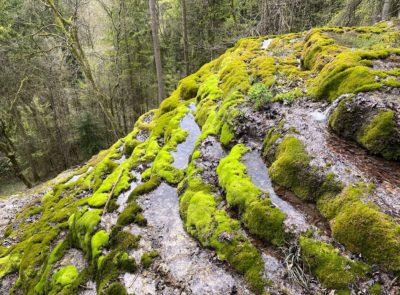
A tufa spring in the Neumarkt region in Bavaria, Germany. CHRISTIAN SCHWÄGERL
Strong winds sweep over the Rhön, a vast region of rolling, forested hills and pastureland in central Germany. Undeterred, Stefan Zaenker, leading a group of four volunteers, runs through his checklist alongside a forest road. Are rubber boots disinfected to prevent introducing potentially harmful microorganisms into the wetland? Are the team app and GPS functioning correctly? Have enough flags been packed?
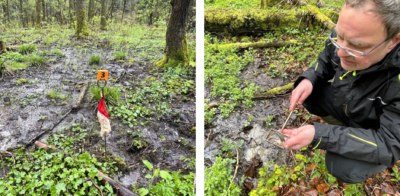
Left: A flag marks a helocrene spring in the Rhön region of Germany. Right: Stefan Zaenker takes a sample from a spring. CHRISTIAN SCHWÄGERL
When all is in order, Zaenker, 56, leads the group into a soggy alder forest. Its mission for the day: to locate and map as-yet-undiscovered springs and document any species inhabiting them.
A senior conservation official for the state of Hesse, Zaenker considers springs so important for human life and biodiversity that he — along with volunteers from the Hesse Association for Cave and Karst Research — spends much of his spare time conducting large-scale searches for them in the Rhön, which includes the German states of Bavaria, Thuringia, and Hesse, and in a nearby national park.
Conservation strategies around the globe focus on rivers, bogs, forests, reefs, and many other habitat types. Springs rarely get any special attention. In the United States, for example, springs do “not appear to be a prominent feature on the conservation radar,” says Kirsten Work, a zoologist from Stetson University in DeLand, Florida.
But for the biosphere, these tiny spots dotted across Earth’s land surface play a powerful role: They connect reservoirs of groundwater to the outside, sunlit world. Only so-called “fossil” aquifers — ancient bodies of groundwater that do not recharge — lack a link with the surface. Without a continual connection to groundwater, which also feeds rivers, many landscapes would quickly dry up and become hotter. In addition, springs are home to a wide range of highly specialized species, some of which live outside by night and in the darkness of groundwater by day.
Far too little is known about where springs occur and what species they harbor, Zaenker says. In a country like Germany, which has no wilderness but a very efficient bureaucracy, most people assume that everything in nature has already been discovered and mapped. This is not true, he claims: “I can stand right next to an impressive spring with water flowing out, but the official topographical map shows nothing.” Official maps denote springs with a blue dot, indicating they are habitats protected by law. Yet many — if not most — springs remained undocumented. “How are we going to effectively protect these important habitats or know if they dry up,” asks Zaenker, “if we don’t even know they exist?”…
Read the whole article here.
 Organikos