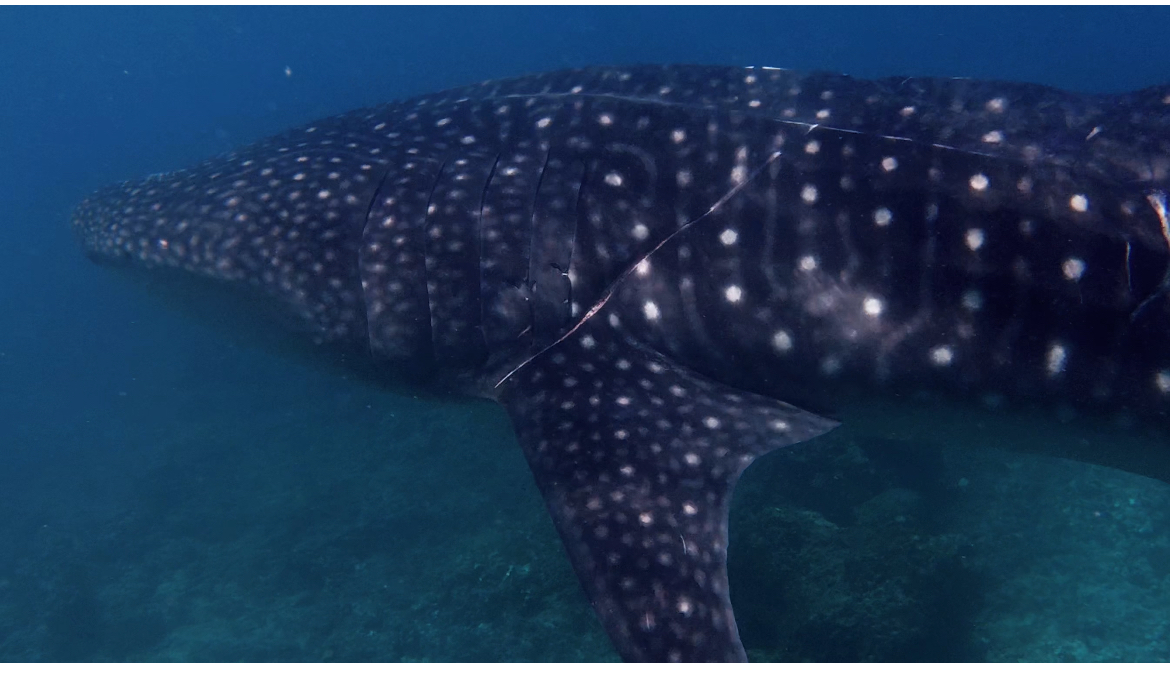
Photo credit: Sommer Laettner
In honor of International Whale Shark Day, which is August 30…
I posted last year about my experience volunteering with the Maldives Whale Shark Research Programme (MWSRP) and the great work they do. Established in 2006, MWSRP undertakes research and monitoring of whale sharks and other marine megafauna in the Maldives and uses the associated findings and data to advocate for sound conservation policy in the country.
Throughout the year, the MWSRP team, together with volunteers, undertakes patrols along the reef in the South Ari Atoll Marine Protected Area and other locations in the Maldives to record sightings of whale sharks and other marine megafauna and to gather data on vessel traffic and behavior. Whale shark encounters are documented via photos and video along with data on location, behavior, and ocean conditions. Encounters are entered into the “BIG FISH network” database, an online citizen science platform developed by MWSRP as a monitoring network for awareness raising and stewardship of whale sharks in Maldives.
I returned to the Maldives this month to get an update on efforts to protect this iconic species and the livelihoods it supports, once again volunteering with MWSRP. I found that there is both good news and bad news.
First the good news. I reported last year that the MWSRP team was working with the Maldives’ environmental ministry to formalize a code of conduct for whale shark encounters and to enshrine this into law. I was pleased to learn that this has in fact happened; in the form of an amendment to the country’s Protected Species Regulations. Here is a summary of the legislation which, at least on paper, puts the country on par with “best practice” when it comes to management of whale shark encounter tourism, which contributes upwards of $15 million per year to the Maldivian economy.
The bad news is that the new rules are, unfortunately, being largely ignored by tour operators. I witnessed this myself on several occasions during my trip. Unlike last year, when South Ari Atoll’s resident population of whale sharks proved to be elusive, we encountered these gentle giants almost every day this year. But these encounters demonstrated the fact that the industry is still far from best practice. In most of the encounters, the number of vessels and quantity of snorkelers in the water at one time were well over the limits prescribed by the new regulations. As we watched helplessly, multiple speed boats would mob the shark, zooming up to the encounter traveling at speeds well over the prescribed 5-knot limit, dodging both the shark and snorkelers from other boats who were already in the water to dump its passengers, in several cases directly in front the of the whale shark, forcing it to change direction or to dive before it finished thermoregulating. Not only is this dangerous to the sharks, but also to the snorkelers already in the water. An accident waiting to happen. We elected to pass on several of the encounters, even though doing so meant not being able to photo ID the shark in question. In the cases of the encounters we did join, the sharks exhibited scars from propellor strikes, which is the case for a large percentage of the sharks in the MWSRP database. One shark, which we encountered twice, had several deep wounds that were clearly fresh. This was confirmed when we identified him via the MWSRP database and compared our photos with ones taken of him only a few weeks earlier when he exhibited no such scars.
We also observed snorkelers touching whale sharks, despite admonitions from their tour guides, seemingly more interested in a selfie than in the welfare of the animals. This has unfortunately become an all-too-common phenomenon when it comes to wildlife encounter tourism. I learned that at least one Maldivian tour operator is taking a somewhat radical approach to address this behavior. Tourists are not only required to sign a pledge to adhere to the code of conduct for wildlife encounters, but they also must post what is in effect a “good behavior deposit” which is returned at the end of the trip if they obey the rules but is forfeited if they fail to do so. Maybe a bit extreme but perhaps a signal to customers who value operators that are committed to responsible tourism.
My second observation of how the new rules are being ignored was during a liveaboard dive trip I joined following my volunteer stint with MWSRP. I noted in my post last year that one of the practices MWSRP was hoping to discourage is light pooling. This involves shining bright spotlights onto the water from the back of boats at night in order to attract whale sharks and manta rays so that guests can get photos and/or swim with them. There is concern that this practice may disorient the sharks or disrupt their normal feeding behavior. The environmental ministry agreed, and the new rules specifically prohibit using lights to attract whale sharks anywhere in the Maldives. But halfway through my liveaboard trip, when we anchored in Baa Atoll, a hotspot for both mantas and whale sharks, I noted that the crew was setting up a spotlight to shine at night. I asked the tour director whether he was aware that this is now illegal. He insisted that I was mistaken and continued to ignore me even after I showed him a copy of the new rules. The spotlight was illuminated all night for each of the nights we were in that area, indeed attracting a couple of whale sharks. I declined participating in the encounters but did call out the operator on an online scuba discussion forum where my post generated multiple likes and several comments supporting me for having done so. As I noted in my post last year, the liveaboard dive industry, which in the case of Maldives (as in many other countries), is largely foreign-owned, already faces criticism due to its limited contribution to the local economy, as compared to land-based dive tourism operations. It is indeed unfortunate if this is exacerbated by a failure to adhere to wildlife protection rules. I believe it is incumbent on the dive community to hold operators accountable even if governments are unable to do so.
Fortunately, there are good examples of well-managed and responsible whale shark encounter tourism industries in several countries around the world, most notably Ningaloo Reef in Australia and the British Overseas Territory of St Helena, a new entry to this field but one already receiving praise for its careful management. Let’s hope that the Maldives will follow suit and that these magnificent creatures and the livelihoods they support will continue to thrive for generations to come.
 Organikos
Thank you very much for bringing these concerns and ethical issues to light (no pun intended). I hope you and others will continue to be vocal advocates and that business operators will grow in their respect for wildlife over profits.
Thank you Carol- we also appreciate your comments!