Animals Having Fun

Thanks to Eric Vance for a fun and interesting read:

Where the Wild Things Play

The animal world is full of games. And tucked in among wrestling monkeys, belligerent birds and wily coyotes are lessons for us all.

As a sophomore in college I interned at a lab that studied dolphin behavior. The animals spent most of the year doing back flips and spraying water onto tourists at a theme park, then called Marine World Africa USA, just north of San Francisco. In their off months, they hung out with behavioral scientists who did experiments with them.

I quickly noticed a few things about dolphin research. One, it’s regularly interrupted by dolphin sex. Dolphins are dirty, dirty creatures. Two, despite this, it’s actually quite dull. Watching dolphins swim in circles eight hours a day gets old. And three, almost all dolphin experiments involve games and toys. Continue reading

Wine & Biophilia

22Pour-Illo-mobileMasterAt3x

Brian Britigan

Biophilia is a frequent topic here; wine, only a fraction as much. An article touching on both is a rare treat:

From Good Wine, a Direct Path to the Wonders of Nature

For this city dweller, wine provided the opening to a greater understanding of food and agriculture, and their precarious balance.

Last year a friend asked me a question I had never considered before: Over the many years I had been writing about wine, what was the greatest thing this job had given me?

I answered almost reflexively. As a New Yorker who has spent most of my life living in Manhattan, wine had provided me a connection to nature that I most likely would never have experienced otherwise. Continue reading

Sleuthing The Breeding Of Rare Birds

Thanks to Brendan Borrell for sleuthing this through to publication, with evocative illustrations, in Audubon Magazine:

THE PARROT KING
OVER THE PAST 14 YEARS, MARTIN GUTH HAS BUILT A MONOPOLY ON SOME OF THE WORLD’S RAREST BIRDS. WILL HIS SECRETIVE ORGANIZATION ULTIMATELY HELP PUT MORE PARROTS IN THE WILD, AS HE SAYS—OR PUSH THEM CLOSER TO EXTINCTION?

For Stephen Durand, March 16, 2018, began like most other days—with an inordinate amount of squawking. Durand lives on the Caribbean island of Dominica and oversaw the federal aviary that houses rescued parrots, including casualties of Hurricane Maria. Six months earlier, the storm had leveled large numbers of the island’s trees and stripped many more of their fruit and foliage, threatening two endemic parrot species. Continue reading

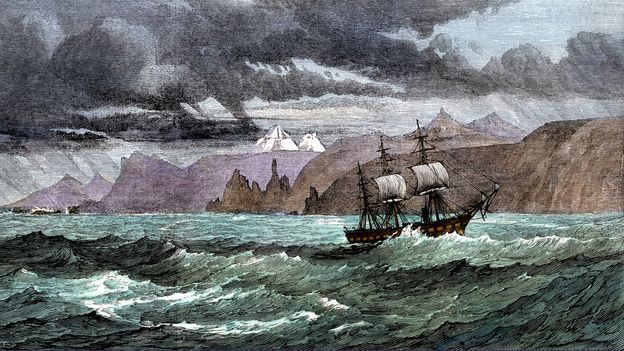
Scientific Expeditions Then, Considered Now

p08j9wrd

The HMS Challenger set sail from England in 1872 and changed the course of scientific history (Credit: North Wind Picture Archives/Alamy)

Thanks to the BBC for reminding us of the value of such voyages in earlier centuries, and their contributions to science, among other things:

HMS-Challenger: The Voyage That Birthed Oceanography

The 3.5-year voyage to the furthest corners of the globe reshaped marine science and permanently changed our relationship with the planet’s oceans.

p08j9wr9

During the four-year journey, the ship uncovered many new species and shaped our understanding of the seas (Credit: LeeYiuTung/Getty Images)

In the foyer of the National Oceanography Centre in Southampton, England, stands a ship’s painted figurehead. It towers well above head height and depicts an armoured knight with a silver chest plate, a raised visor and a thick handlebar moustache. The knight’s eyes have a faraway gaze in them – and well they might. This wooden statue is the sole remnant of a square-rigged ship that once embarked on a three-and-a-half-year voyage to the furthest corners of the globe, reshaping marine science, unearthing all manner of underwater oddities and permanently changing our relationship with the planet’s oceans. The vessel’s name was HMS Challenger. Continue reading

Nature, Human Capital & Wealth

20200718_GDC100_1-Artboard_1

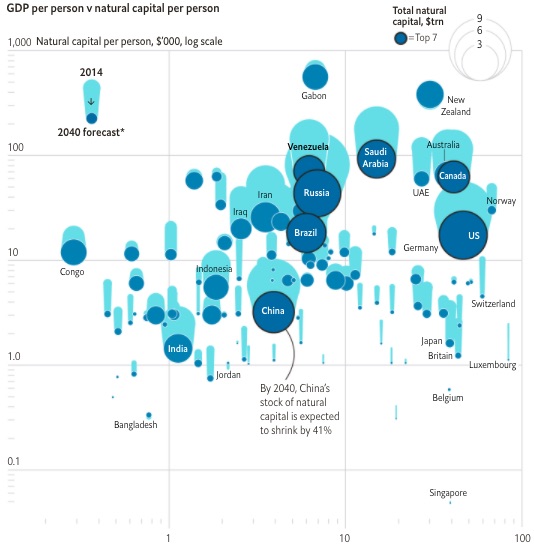
GDP per person, 2014, $’000, log scale                                                          *High-emissions scenario

The Economist, which we have been sourcing from all along, in an earlier era sometimes seemed dogmatic on the topic of markets solving all problems, now frequently could be described as considering all the angles:

The world’s wealth is looking increasingly unnatural

As natural wealth is used up, economies will rely more on human capital

Nature’s bounty is not easy to count, partly because she was kind enough not to bill us for it. Some economists, however, have attempted to put a dollar figure on the value of the world’s land, forests, fisheries, minerals and fossil fuels—or what is left of them. Their work has fed into the Inclusive Wealth project, initiated by the United Nations, directed by Managi Shunsuke of Kyushu University and advised by Sir Partha Dasgupta of Cambridge. They estimate the world’s natural capital amounted to over $91trn in 2014, or over $13,000 per person. (The estimates use 2005 exchange rates and prices.) New Zealand has more natural capital per person ($380,000) than oil-rich Kuwait ($362,000) or Saudi Arabia ($180,000). Gabon has more than anywhere else. Continue reading

Ethiopian Vegan

200727_r36780

The vegan sampler at Ras Plant Based features an assortment of dishes traditionally eaten by Ethiopian Orthodox Christians during periods of religious fasting, when they abstain from animal products.Photograph by Bubi Canal for The New Yorker

Always ready to learn more about Ethiopia’s contributions to the world. And the move to animal-free food is an evergreen topic around here. So the story below is perfect for today. The photography is unusual, in the world of food, but the text by Hannah Goldfield is convincing:

Ethiopian Tradition for the Vegan-Curious, at Ras Plant Based

At Romeo and Milka Regalli’s Crown Heights restaurant, vegan proteins stand in for meats, and tangy, fermented injera soaks up sauces spiked with traditional berbere spice or puckery lime.

200727_r36793

Romeo and Milka Regalli, who describe themselves as passionate about vegetables, wanted to both showcase their favorite fasting dishes and offer vegan iterations of common meat preparations.Photograph by Bubi Canal for The New Yorker

Many of the recipes that the chef Romeo Regalli uses in the kitchen at Ras Plant Based—the restaurant that he and his wife, Milka, opened in Crown Heights in March—have been passed down through generations. A number of them came from Romeo’s grandmother, a passionate home cook who died last year, in Ethiopia, at the age of a hundred and four. Yet the dish that seems most likely to have a long, storied history, Mama’s Tofu, traces its origins only as far back as May, when Romeo’s mother texted, from Addis Ababa, a photo of what she had made for dinner.

200727_r36792

An avocado salad with diced tomato, onion, and jalapeño, in a lime vinaigrette.Photograph by Bubi Canal for The New Yorker

“I was, like, ‘Oh, my God, that looks so good!’ ” Romeo recalled the other day. She rattled off the ingredients: tofu, tomatoes, onions, and jalapeños. After she mailed him a batch of her homemade spice mix (the exact contents of which he keeps tight to his chest), Romeo made an approximation, and promptly added it to the menu. Continue reading
Climate TRACE Coalition

TRACE

Like Skynet, but good! Shutterstock

Thanks to David Roberts, at Vox, for this news:

The entire world’s carbon emissions will finally be trackable in real time

The new Climate TRACE Coalition is assembling the data and running the AI.

There’s an old truism in the business world: what gets measured gets managed. One of the challenges in managing the greenhouse gas emissions warming the atmosphere is that they aren’t measured very well.

“Currently, most countries do not know where most of their emissions come from,” says Kelly Sims Gallagher, a professor of energy and environmental policy at Tufts University’s Fletcher School. “Even in advanced economies like the United States, emissions are estimated for many sectors.” Without this information “you cannot devise smart and effective policies to mitigate emissions,” she says, and “you cannot track them to see if you are making progress against your goals.” Continue reading
Mangroves for the Win

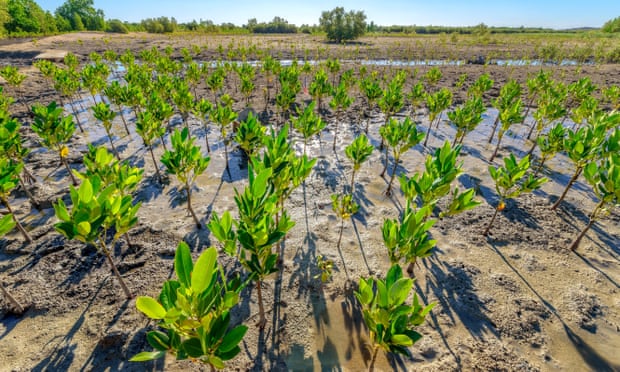
Mangrove restoration in Madagascar. Photograph: Alamy

Our previous posts about the multiple positives of planting trees in response to climate change and toward the goal of economic recovery didn’t take coastal ecosystems into account. These regions tend to be extra vulnerable to the increased pressures of extreme weather, not to mention being the home of many vulnerable populations.

This type of investment seems like a win/win.

Oceans panel presses coastal states to invest in ‘blue recovery’

Report says there are substantial economic benefits to be had from ocean conservation

Investing in the marine environment offers many coastal states the possibility of a “blue recovery” from the coronavirus crisis, according to a report setting out substantial economic benefits from ocean conservation.

Ending overfishing and allowing stocks to recover while ensuring fish farms operate on a sustainable basis would generate benefits of about $6.7tn (£5.3tn) over the next 30 years, according to an assessment of ocean economics by the High Level Panel for a Sustainable Ocean Economy.

This would require reforming perverse subsidies that encourage overfishing, and better regulation of fish farming, but the returns on such investment would repay the outlay 10 times over, the report says.

Mangrove restoration on tropical coastlines offers a quick way to generate jobs in seeding and planting, and returns of about $3 for every $1 spent, in the form of more productive fisheries as well as storm protection.

The costs of offshore wind energy generation have plummeted in recent years, making clean energy generation at sea a viable prospect for many countries for the first time. The UK has long been a pioneer in the field, but many other countries have been slow to take it up.

The report found that the technology has matured so quickly that investors can generate returns of up to $17 on each $1 spent, opening up a potential bonanza globally of $3.5tn by 2050 if governments put the right conditions in place.

Ngedikes Olai Uludong, Palau’s ambassador to the UN and one of the panel members, said offshore wind energy could spell an explosion in highly skilled green jobs. “Technologies like offshore wind offer a rate of return that makes more and more sense,” she told the Guardian. “It looks like it is taking off. I’m seeing interest from countries that I’ve never seen interested before.”
Continue reading

Rewilding, A Good Idea Scaling

5000 (1)

Hugh Somerleyton, right, and Argus Hardy on the Somerleyton estate in Suffolk. Photograph: Si Barber/The Guardian

This idea has caught on, spreading like a good alternative to wildfire:

Farmers hatch plan to return area the size of Dorset to wild nature

WildEast aims to convince farmers, councils and others across East Anglia to pledge land to wildlife

5000 (2)

View over the Somerleyton estate. Photograph: Si Barber/The Guardian

Returning an area the size of Dorset to wild nature, reintroducing extinct lynx, pelicans and beavers and championing regenerative farming to restore soil health are the radical aims of a new charitable foundation.

But the most revolutionary feature of WildEast may be that it is founded by three farmers in the most intensively farmed region of Britain.

Hugh Somerleyton, Argus Hardy and Olly Birkbeck, who own more than 3,200 hectares (8,000 acres) on their family farms in Suffolk and Norfolk, are seeking to persuade farmers and also councils, businesses, schools and ordinary people across East Anglia to pledge a fifth of their land to wildlife. Continue reading

2020 Audubon Photo Contest

original (5)

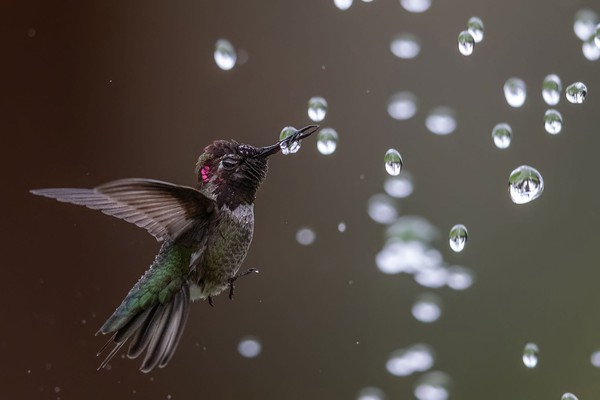
An Anna’s hummingbird, Amateur Honorable Mention, photographed on the Ardenwood Historic Farm in California #
Bibek Ghosh / 2020 Audubon Photography Awards

Alan Taylor has been a go-to visual explainer on our platform for years. He also led us to this contest in 2016. By the time of the 2019 contest we were linking directly from the source but here we give him credit for reminding us it is that time of the year again:

The winners of the the 11th annual Audubon Photography Awards competition were recently announced. Photographers entered images in four categories: professional, amateur, youth, and plants for birds. More than 6,000 images depicting birdlife from all 50 states and seven Canadian provinces and territories were judged. The National Audubon Society was again kind enough to share some of this year’s winners and runners-up with us below. You can also see all of the top 100 entries on the Audubon website.

grid_web_pfb_02_natalierobertson_tennesseewarbler_plantsforbirds_highres

The 2020 Audubon Photography Awards: Winners

This year’s top shots delight with dazzling colors and fresh perspectives.

Every spring, the judges of the Audubon Photography Awards gather at Audubon’s headquarters in Manhattan to review their favorite images and select the finalists. But as with much of life in 2020, this year’s awards had to be handled differently due to pandemic-related travel, work, and social-distancing restrictions. Continue reading

Rewilding & The Wilder Blean Project

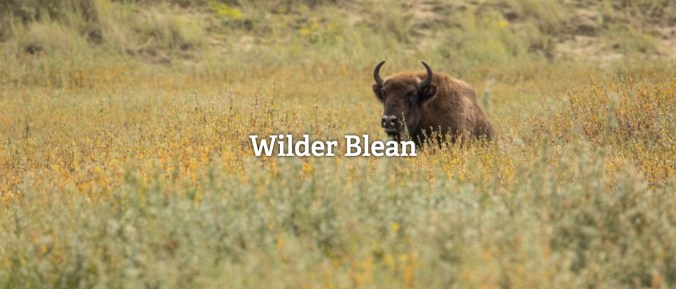
WilderBlean

Credit: Evan Bowen-Jones

Rewilding started featuring in our pages with a bison story in 2013, and one year later a book review made the concept clearer. Since then dozens of related stories have fueled our imaginations, and understanding of how this makes sense.

3872 (3)

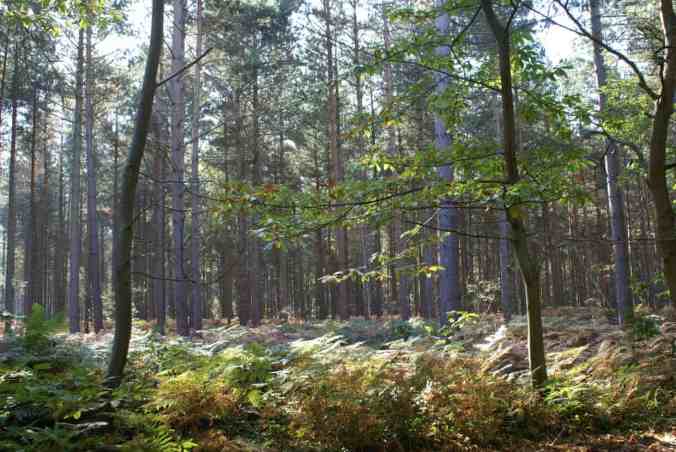
Blean woods, near Canterbury. The Wilder Blean project aims to restore the ecosystem of the area’s ancient woodlands. Photograph: Ray Lewis/Kent Wildlife Trust

Thanks to the Guardian’s Environment editor, Damian Carrington, for bringing this new initiative to our attention:

Wild bison to return to UK for first time in 6,000 years

Release of a small herd of endangered animals in Kent is planned for spring 2022

5252

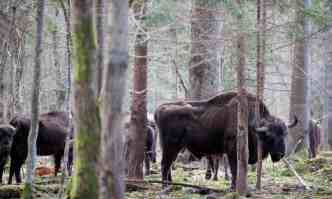
A herd of wild bison is seen in the Białowieża forest, Poland. Photograph: David Levene/The Guardian

Wild bison are to return to the UK for the first time in 6,000 years, with the release of a small herd in Kent planned for spring 2022.

The £1m project to reintroduce the animals will help secure the future of an endangered species. But they will also naturally regenerate a former pine wood plantation by killing off trees. This creates a healthy mix of woodland, scrub and glades, boosting insect, bird and plant life.

During the initial release, one male and three females will be set free. Natural breeding will increase the size of the herd, with one calf per year the norm for each female. The bison will come from the Netherlands or Poland, where releases have been successful and safe. Continue reading

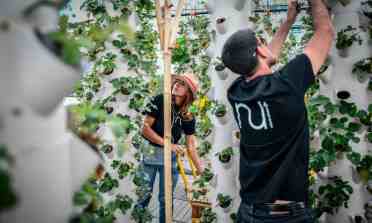
Scaling The Urban Farm, In Paris

8256

Nature Urbaine. Photograph: Magali Delporte/The Guardian

The future of food: inside the world’s largest urban farm – built on a rooftop

In Paris, urban farmers are trying a soil-free approach to agriculture that uses less space and fewer resources. Could it help cities face the threats to our food supplies?

Thanks to the Guardian for keeping stories like this  coming:

5568 (1)

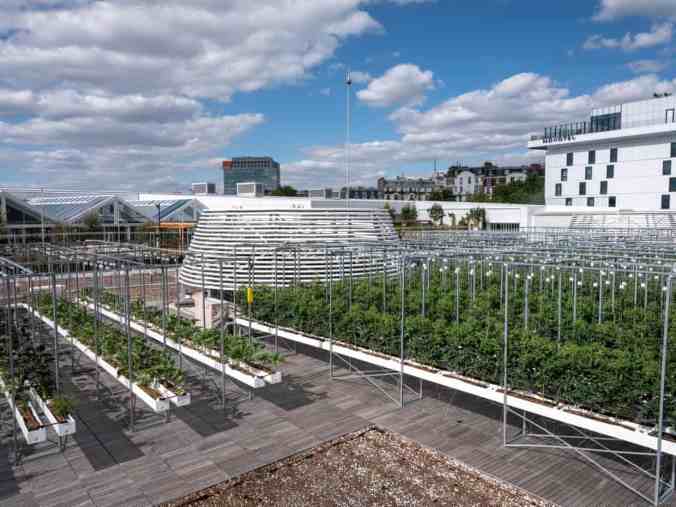
Urban farming on a Parisian rooftop. Photograph: Stéphane de Sakutin/AFP/Getty Images

On top of a striking new exhibition hall in the southern 15th arrondissement of Paris, the world’s largest urban rooftop farm has started to bear fruit. Strawberries, to be precise: small, intensely flavoured and resplendently red.

They sprout abundantly from cream-coloured plastic columns. Pluck one out to peer inside and you see the columns are completely hollow, the roots of dozens of strawberry plants dangling into thin air.

From identical vertical columns nearby burst row upon row of lettuces; near those are aromatic basil, sage and peppermint. Opposite, in narrow, horizontal trays packed not with soil but coco coir (coconut fibre), grow heirloom and cherry tomatoes, shiny aubergines and brightly coloured chards. Continue reading

A Change Of Tone

EnvPod

Usually his writing voice sounds like he is frustrated, and his spoken voice can sound like he is feeling headed for defeat. Today there is a different sound and it is worth listening to:

PoliticsAndMore-McKibbenSCRulingThis week, the Supreme Court rejected the Trump Administration’s request to expand construction on the Keystone XL oil pipeline, and the climate-change task force formed by Joe Biden and Bernie Sanders urged politicians to “treat climate change like the emergency that it is.” Bill McKibben, an activist in the environmental movement for three decades, joins Dorothy Wickenden to discuss whether the United States has hit a turning point in the battle against global warming.


Really, France?

This post was going to link out to one of our favorite sources, celebrating fossil fuel tough times. But at the very end of his post, almost as a throw away, there was this reference to the ad above. It led somewhere more fun–and got us thinking Really?–and a chance to instead shout out again about ebikes and VanMoof:

This e-bike ad has been banned in France – let’s talk about why

by Iain Treloar

E-bikes are the future. That’s what the bike industry thinks, that’s what a bunch of new cyclists think, and that’s what sustainable transportation advocates think.

But not everyone thinks that way, as a spat between e-bike brand VanMoof and the French advertising regulatory body has proven.

At the centre of this stoush is a slick TV commercial by VanMoof, a Dutch urban bicycle brand best known for creating that bike with the top tube that looks like that. In the ad, a glossy black sports car has images of pollution, traffic jams and emergency vehicles projected onto it, before melting into a pile of black goo from which a VanMoof e-bike emerges to the slogan ‘time to ride the future’.

It’s pretty visually striking. It also does a succinct job of boiling down many of the concerns people have about over-reliance on automobiles in light of the, you know, climate emergency that we may or may not* be going through globally (*definitely are).

So it’s a little surprising to learn that the ad has been banned from French television because it “creates a climate of fear” around cars.

So what’s really going on here? Let’s break this down.

357826-Reflections-3-170566-original-1593436632

THE PLAYERS

VanMoof: The quirky Dutch brand launched in 2009 with an analogue town bike with integrated lights and lock, and has since had an electric renaissance. Continue reading

Rock Dust Carbon Cure

1028

 Crushed basalt is applied to an arable field in Norfolk as part of the research programme of the Leverhulme Centre for Climate Change Mitigation. Photograph: Dr Dimitar Epihov

At first glance, this seemed like a headline from a satirical news site, but it is serious:

Spreading rock dust on fields could remove vast amounts of CO2 from air

It may be best near-term way to remove CO2, say scientists, but cutting fossil fuel use remains critical

Spreading rock dust on farmland could suck billions of tonnes of carbon dioxide from the air every year, according to the first detailed global analysis of the technique.

The chemical reactions that degrade the rock particles lock the greenhouse gas into carbonates within months, and some scientists say this approach may be the best near-term way of removing CO2 from the atmosphere.

The researchers are clear that cutting the fossil fuel burning that releases CO2 is the most important action needed to tackle the climate emergency. Continue reading

Your Participation Is Important

640t

Do you plan to fly less when coronavirus travel restrictions ease? Photograph: Alamy

Our business, entrepreneurial conservation, has been fully dependent on air travel for more than two decades, and we have had plenty of indicators before now that something must change. We want to know what others think about this. The Guardian is performing an important service for all of us, so please consider participating:

A new normal: will you stop flying?

We would like to hear from Guardian readers for a video series about what’s next for travel and the environment

In our video series A new normal, we ask Guardian readers what they want a future shaped by Covid-19 to look like. Our next episode will look at air travel and its environmental impact.

Has the pandemic affected your thoughts about the way you will travel for leisure and work in the future? Would you consider giving up flying to offset your carbon footprint? Or do you miss overseas holidays, need to travel internationally for work or have you already booked a flight abroad? Continue reading

McKibben Monday Sermon Notes

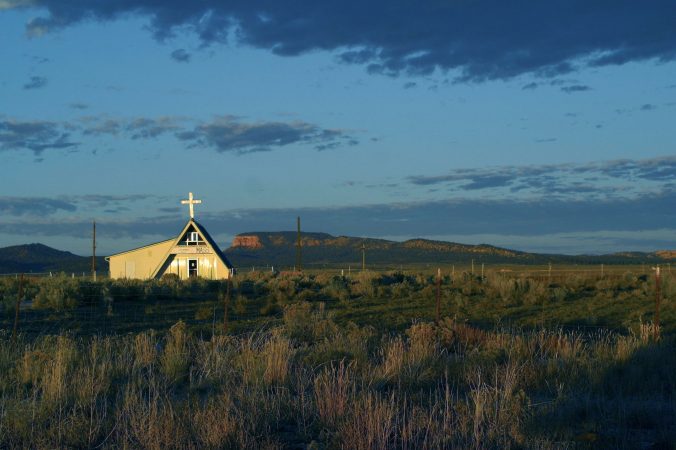
McKibben-Church

The point of church is not just comfort or familiarity: it is, or should be, coming to grips with the gospel demand that we love our neighbors in effective ways.Photograph by Peter Schickert / Visum / Redux

Articles on religious topics are not the norm on our platform, but in this case we make an important exception:

Back to Church—But Not, Let’s Hope, Back to Normal

I went to church for the first time in many months on Sunday; in fact, it was the first even mildly routine public thing I’ve done since March. The service was outdoors, of course, in a small open-sided tabernacle built here in the Adirondacks, along the banks of the upper Hudson, in 1908, to serve a Methodist campground where congregations began meeting in 1871. Continue reading

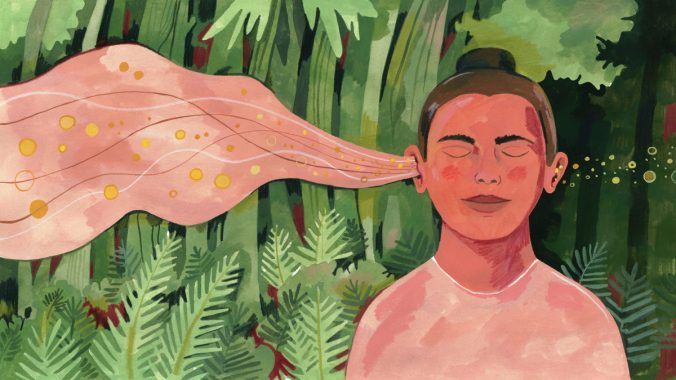
Caring About Quiet

lerivera-yale-e360_web

Point well taken. We came to believe in the importance of efforts to reduce noise pollution while living in southern India, a noisy place indeed. Thanks to Dr. Morber for adding the soundscape to this story:

SoundSilence

Listening to Silence: Why We Must Protect the World’s Quiet Places

As more people push into once-remote areas, truly quiet spots — devoid of the noise of traffic or crowds of tourists — have become increasingly scarce. Now, a coalition of activists, scientists, and park officials are trying to preserve the last quiet places on the planet.

It is a frosty March morning in the Hoh Rainforest, deep within Olympic National Park in Washington state. The forest is full of Jurassic ferns, hanging moss, and towering spruce and cedars, but what I hope to find is an absence. I seek a spot known as the “One Square Inch of Silence” — one of the quietest places in the contiguous United States, free from chattering people, humming power lines, and the whoosh of cars. Continue reading

No Place Like Home

NoPlace

Thanks as always to Bill McKibben, in particular this time for disguising a podcast recommendation (click the image above to go to the website of the podcast) as a recommendation for regulating Facebook:

What Facebook and the Oil Industry Have in Common

Why is it so hard to get Facebook to do anything about the hate and deception that fill its pages, even when it’s clear that they are helping to destroy democracy? And why, of all things, did the company recently decide to exempt a climate-denial post from its fact-checking process? The answer is clear: Facebook’s core business is to get as many people as possible to spend as many hours as possible on its site, so that it can sell those people’s attention to advertisers. (A Facebook spokesperson said the company’s policy stipulates that “clear opinion content is not subject to fact-checking on Facebook.”) This notion of core business explains a lot—including why it’s so hard to make rapid gains in the fight against climate change. Continue reading

Bureo & Tin Shed Ventures

tsv-main-logoBureo is news to us, and we like good news. We are always on the lookout for fellow travelers, and while Tin Shed Ventures is by no means new it is news to us. And newsworthy based on the partners they have chosen:

Tin Shed Ventures is Patagonia’s corporate venture capital fund, which invests in start-ups that offer solutions to the environmental crisis. Originally launched as $20 Million and Change in May 2013, Tin Shed Ventures partners with businesses focused on building renewable energy infrastructure, practicing regenerative organic agriculture, conserving water, diverting waste and creating sustainable materials. Continue reading