San Miguel Reservoir, Turrúcares, Costa Rica
Author: Seth Inman
Bird of the Day: Anhinga
San Miguel Reservoir, Turrúcares, Costa Rica
Bird of the Day: Hoffmann’s and Red-crowned Woodpecker hybrid
male – San Miguel Reservoir, Turrúcares, Costa Rica
Bird of the Day: Black-bellied Whistling Duck
San Miguel Reservoir, Turrúcares, Costa Rica
Bird of the Day: White-crowned Parrot

Tacacori, Costa Rica
We All Like a Good Lek
There’s a couple places where we’ve mentioned leks on this blog before–primarily where grouse have been involved–but the first happens to be from 2012, when I was sharing about another bird from the same family as the species shown in the video below. That was the Club-winged Manakin, which I caught on video with a small point-and-shoot camera looking through a guide’s spotting scope. As I explained back then, lek is a Swedish word that has come to mean competitive displays between males of a species to become the breeding choice of one or more females of the same species, most often in the avian world. This time, I got some video from my hand-held (and a tad shaky) Canon Powershot SX50:
In the video above, you can watch one, and then two, male Long-tailed Manakins call and flutter together in the woods just off-trail at Xandari Resort, perhaps as a display Continue reading
Bird of the Day: Golden-browed Chlorophonia
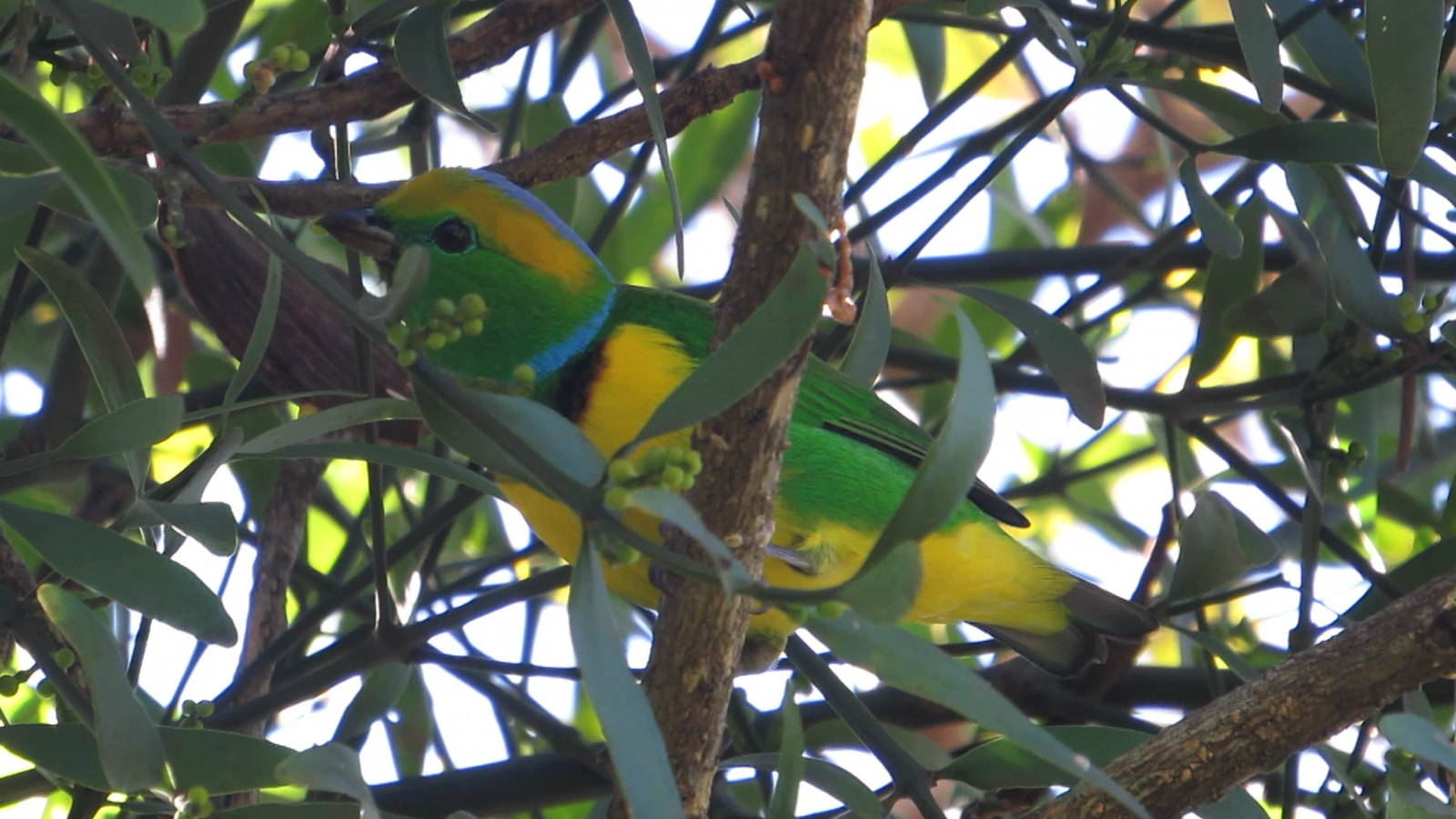
male – Tacacori, Costa Rica
Bird of the Day: Gray-cheeked Thrush

Tacacori, Costa Rica
Great Backyard Bird Count at Xandari

Patricia works at Reception, with the Great Backyard Bird Count sign behind her
Xandari Resort & Spa’s Great Backyard Bird Count started off with the piercing whistle of a Common Pauraque, followed by some wren vocalizations and a Great Kiskadee‘s eponymous (“great kis-ka-dee!”) call. While drinking my morning coffee before the scheduled birdwatching tour I listened to the sounds from the forest and recorded my first GBBC checklist of the day at 5:30.
Then, some guests and I watched birds from the restaurant terrace for almost half an hour before walking through the gardens as well, leading to two more checklists. The most exciting sightings this time were a small group of White-crowned Parrots and a Zone-tailed Hawk soaring alongside a Short-tailed Hawk.
Bird of the Day: Zone-tailed Hawk

Tacacori, Costa Rica
Bird of the Day: Chestnut-sided Warbler

juvenile or female – Tacacori, Costa Rica
Bird of the Day: Rose-breasted Grosbeak

juvenile male – Tacacori, Costa Rica
Bird of the Day: American Redstart

male – Tacacori, Costa Rica
Coffee Going Strong at Xandari
When I got back to Xandari last year in June, I posted a couple photos of the Caturra plot, the Borbón plot, and the bagged seedlings. Since then, all the plants have grown quite a bit, and we’ve gotten a strong yield of cherries–and therefore coffee beans–even though the plants were only a year old in the ground. In fact, many of the plants of both varietals are experiencing a second round of flowers despite the dry season: climate change is putting the plants’ phenology out of whack, and so some shrubs even have cherries and flowers growing at the same time, which normally would never happen. The bees are certainly happy though! Continue reading
Bird of the Day: Summer Tanager

male – Tacacori, Costa Rica
Migration Animation from eBird Data Proves the Worth of Citizen Science
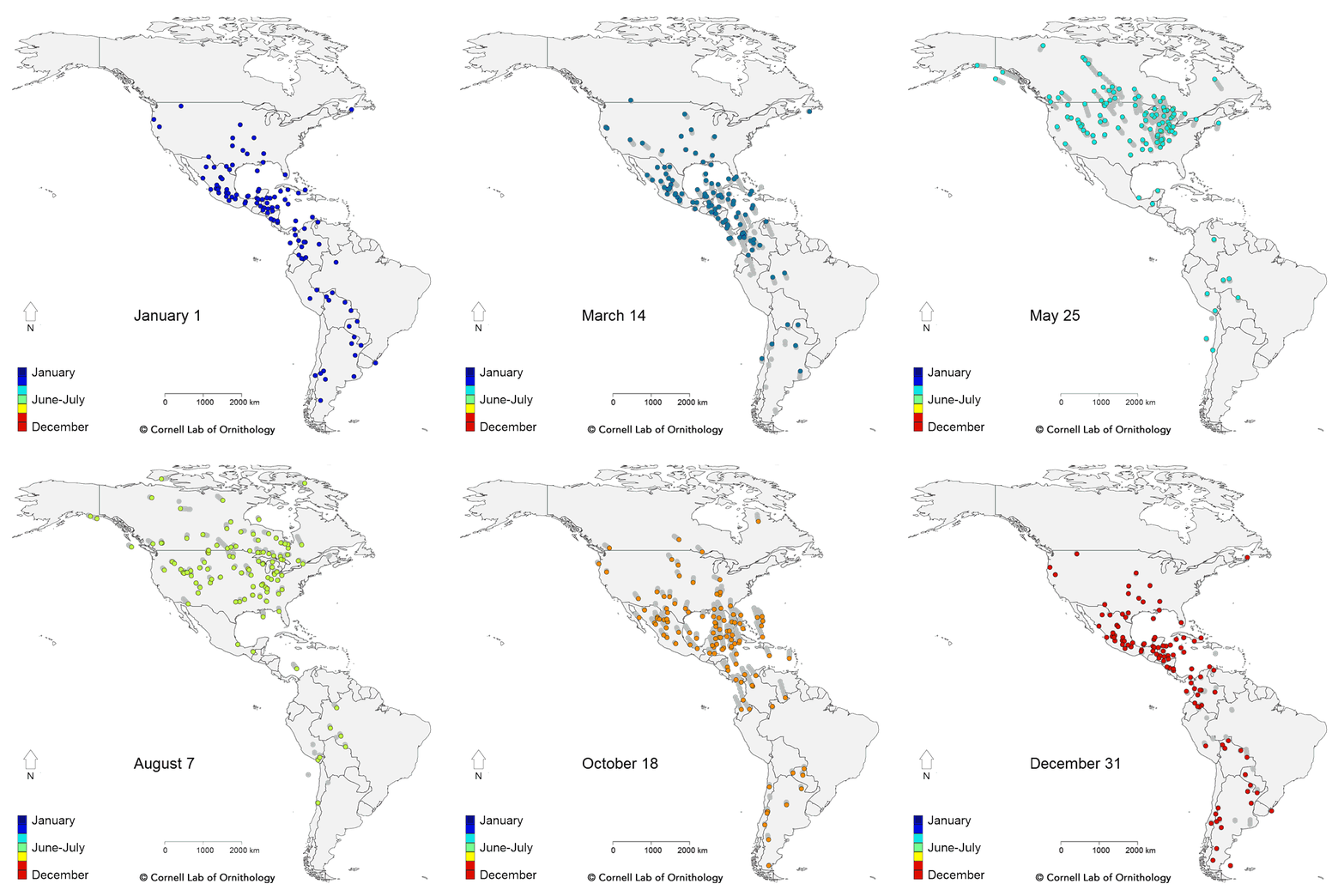
Each dot represents a single bird species; the location represents the average of the population for each day of the year
On January 20th, researchers at the Cornell Lab of Ornithology published a paper in the Proceedings of the Royal Society B titled “Convergence of broad-scale migration strategies in terrestrial birds.” Using data from eBird that indicated the presence and absence of over a hundred different bird species in the Western Hemisphere, they tracked migration patterns among the various species and found that many of them used very similar routes that avoided or took advantage of certain geographical or atmospheric factors. In short, the paper illustrated that scientists can use the data from eBird in just the manner that I always tell guests here at Xandari: with thousands of observations by people in different places and at all times of the year, population statistics, migration data, and other information can be gathered about bird species around the world. All through citizen science.
Bird of the Day: Rose-breasted Grosbeak

female – Tacacori, Costa Rica
Wildlife at Carara and Manuel Antonio National Parks
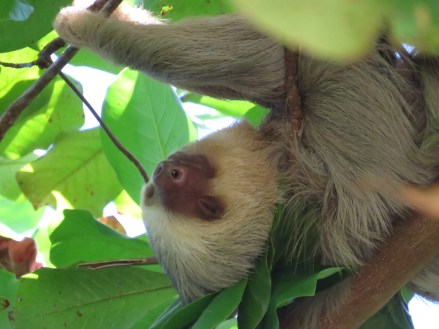
napping Two-toed Sloth at Manuel Antonio National Park
In 2014, I went to Carara National Park with James, and we saw lots of birds and also a bunch of reptiles and mammals. Some of these I got photos of, and others I was able to catch on video. This last weekend I went to Carara again for a morning of birding, and the next day went out to Manuel Antonio National Park for the first time in over a decade. Carara was as fruitful as ever, although there were many birds that I only heard and couldn’t identify since I don’t know my Pacific coastal bird calls very well. Manuel Antonio proved extremely crowded with tourists, and with a couple mammals so accustomed to human interactions that they brazenly robbed unsuspecting visitors, like the raccoons with a pack of chips (which aren’t allowed in the park due to their crackling package that attracts raccoons, coatis, and monkeys) in the video below. I saw a White-faced Capuchin Monkey bare its teeth and snarl at a tourist for trying to take back an empty plastic grocery bag that the monkey had snatched from his backpack webbing, and, in a more peaceful scene, a Two-toed Sloth napping calmly while a horde of tourists snapped photos a meter or two below (pictured left).
In the following video, you can watch Continue reading
Bird of the Day: Montezuma Oropendola, male

Tacacori, Costa Rica
Concurrent and Coinciding Thoughts on 5000+ Birds
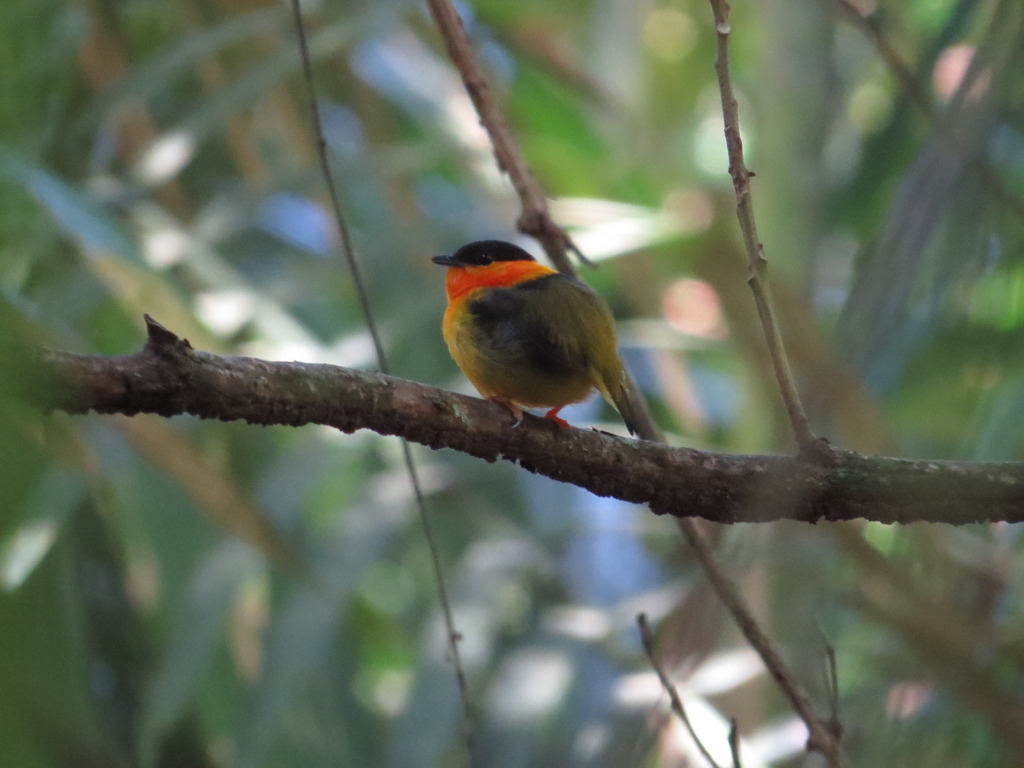
male Orange-collared Manakin seen at Carara National Park, Costa Rica
This week, two birders (one of whom we’ve featured on the blog before, and the other who we should have), Noah Strycker and Tim Boucher, wrote some thoughts on birding and life lists that had much in common, partially because I suspect Boucher’s post on The Nature Conservancy’s blog was inspired by Strycker’s summary of his 2015 Big Year, even though he made no explicit mention of the new world record (6,042 species of bird seen or heard in a calendar year).
Boucher, who saw his 5000th bird at the very end of 2015 (and those 5000 birds are ones he’s actually seen, not only heard), reflects on thirty-four years of birding to achieve his goal. Strycker, on the other hand, summarizes 365 days of straight birding to end up with the biggest big year ever recorded.
 Organikos