
Tacacori, Costa Rica
Tacacori, Costa Rica

A male Red-legged Honeycreeper, the highlight of my 2016 big day
Last year, we shared some details about the Global Big Day, an event that I participated in very casually from Chicago back then, and contributed to more seriously this year, as did the rest of the global birding community, as the data from eBird published today shows. In 2015, 6,158 species were reported on 38,923 complete checklists from 14,787 participants across 140 countries. This year, 6,263 species were reported on 43,848 checklists from 15,953 participants across 145 countries. Every point of comparison displays an increase in participation and effort this time around!
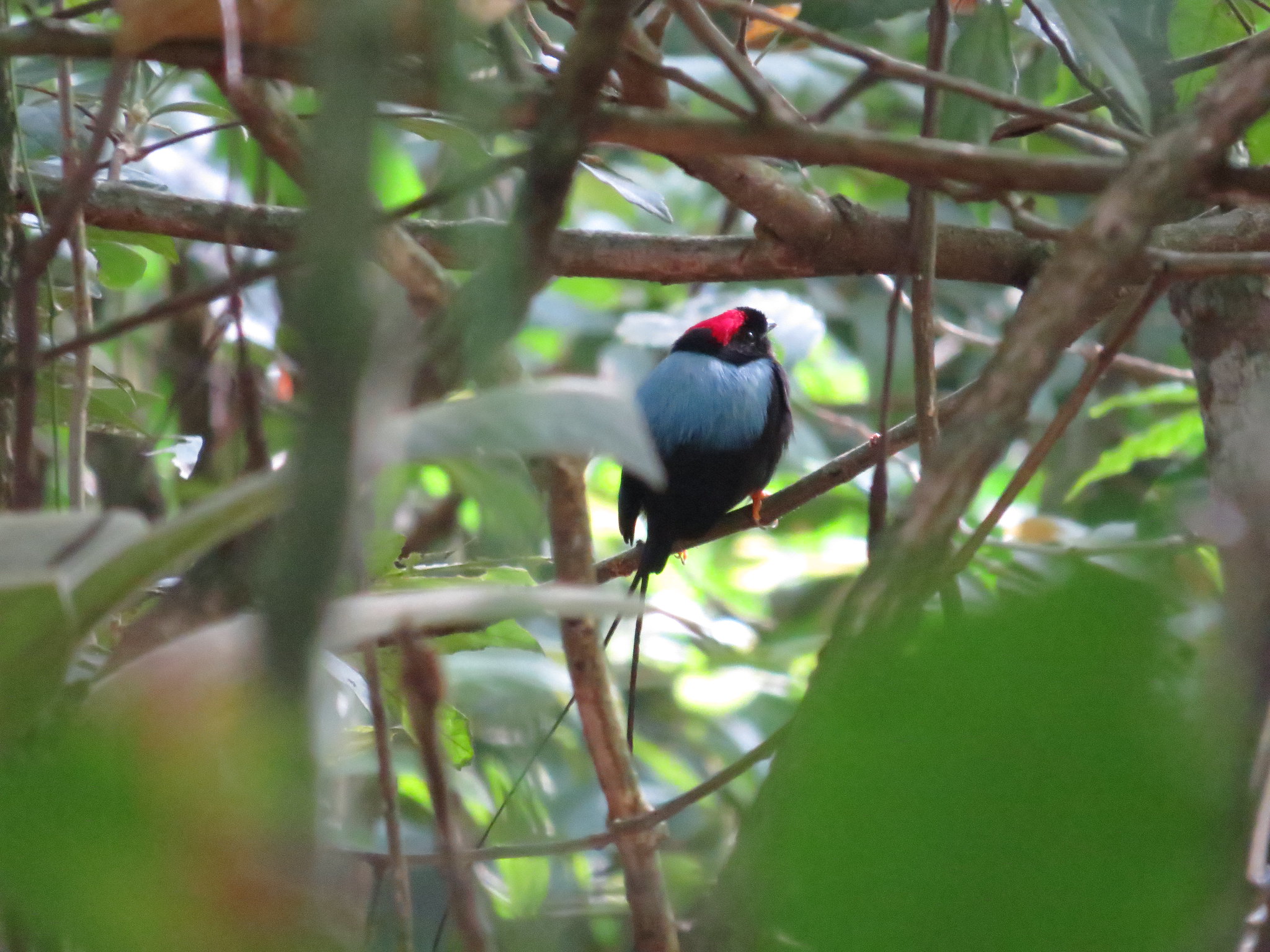
male – Tacacori, Costa Rica

Tacacori, Costa Rica
San Miguel Reservoir, Turrúcares, Costa Rica
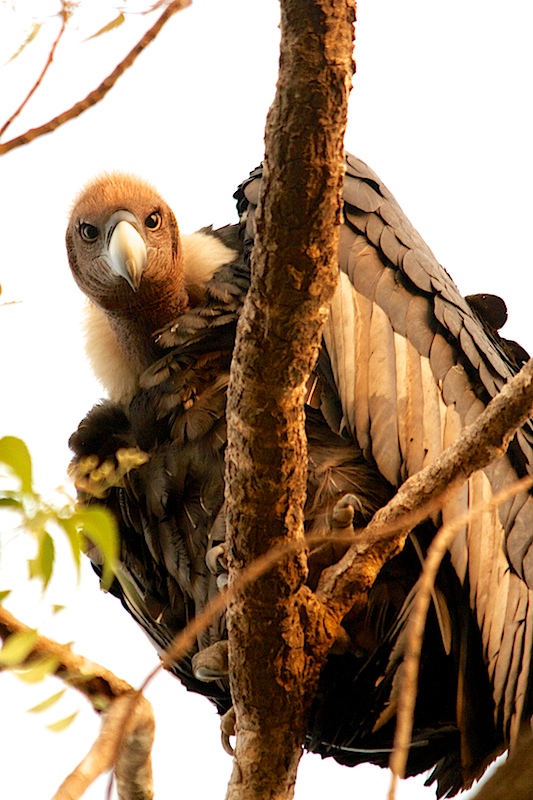
Bird of the Day August 13, 2013: White-rumped Vulture in Ahmedabad, India photographed by Srinivasa Addepalli
Vultures are very important members of many ecosystems in the world as members of a waste-management team, but their role as carrion-feeders is putting them at risk, and has been since the California Condor was endangered in the US (though it’s recovering now). We’ve featured these birds in our daily photo posts quite a bit, even just a week ago, and now there’s news from Scientific American, covering research published in the Journal of Applied Ecology, that European vultures are more threatened than ever, this time by a veterinary drug given to cattle:
A veterinary drug blamed for driving vultures to the brink of extinction on the Indian subcontinent could cause thousands of bird deaths now that it is being used in Spain.
Researchers have expressed concern over use of the anti-inflammatory drug diclofenac in cattle since it was approved for veterinary use in Spain in 2013, as the drug is toxic to vultures who may consume it via dead cows. Now, modelling by Rhys Green, a conservation scientist at the University of Cambridge, UK, and his colleagues suggests that the drug could cause populations of that country’s Eurasian griffon vultures (Gyps fulvus) to decline by between 1–8% each year.

Tacacori, Costa Rica

Bird of the Day 9/19/15: Swallow-tailed Kite (Reserva El Copal, Costa Rica)
I’ve had the fortune of seeing this long-rumped raptor outside of the United States, where they are now considered rare despite their wide range throughout the Caribbean and Central and South America. And although the population did decrease in the last several decades, the IUCN does now list the species as having an “increasing” population trend. This interesting article in The Nature Conservancy, however, does raise concern over habitat loss and the species’ vulnerability. Ginger Strand reports:
Maria Whitehead yanks her feet out of the water as something crashes into Bull Creek next to the boat. Seconds later, a 10-foot-long alligator surfaces a few yards away. As the prehistoric reptile glides off, leaving a sinuous wake in the tannin-brown river, Whitehead casually retrieves her binoculars and goes back to watching a nest of swallow-tailed kites near the top of a soaring pine.
A project director for The Nature Conservancy in the South Carolina Lowcountry, Whitehead seems unfazed by nearly losing a toe on the job. So does Craig Sasser, manager of the Waccamaw National Wildlife Refuge. Wading into primeval cypress swamps, scaling 100-foot pine trees, paddling up tidal rivers through clouds of insects in triple digit heat: These are all part of researching swallow-tailed kites, a spectacular but poorly understood raptor.

Carara National Park, Costa Rica

Screenshot of the first hour of survival mode in Minecraft
In this past week’s edition, the New York Times Magazine published a very interesting story by Clive Thompson about the popular video game Minecraft, which he argues is becoming an educational tool in a way, particularly in the arena of coding and problem-solving. I’ve played the game myself for a number of hours (probably somewhere between 50-150, which among the “Minecraft generation” would be considered pennies). I can affirm that this Swedish blockbuster–the game is built on cubes of different materials that you can break down and build up–is addictive, a creative outlet, and a fun way to spend time with friends.
As Thompson states, the STEM educational movement, where science, technology, engineering, and math are especially encouraged in the US system to increase competitiveness in students, can benefit from some of the habits and skills that Minecraft helps develop for those interested enough. The article is worth reading if you have kids who might play, enjoy playing yourself, or are interested in checking the game out:
Jordan wanted to build an unpredictable trap.
An 11-year-old in dark horn-rimmed glasses, Jordan is a devotee of Minecraft, the computer game in which you make things out of virtual blocks, from dizzying towers to entire cities.
We’ve written about dung before, when it came to beetles rolling it for the poop’s role (ha) in their life cycle, and when it’s been used for recycled paper, and even household cooking gas derived from biodigested manure. Now, we’re learning via Audubon Magazine about another use for the dried doo, and we figured that would be a good time to share about another interesting excremental story from the natural world, which happens to be the fastest moving organism, in a sense.
Both the Black Lark, a bird species found in Europe and western Asia, and the genus of fungi called Pilobolus, more widely distributed around the world, have to deal with something called the Zone of Repugnance when it comes to dung. Although the ornithologists in the Audubon article aren’t quoted using this phrase, it is accepted in mycologist parlance for those who study livestock excrement or something related to it: animals will avoid eating grass or greens in an area where fecal matter is present. Around every pile of poop is a perimeter that the grazers try to not chew on. Black Larks take advantage of that fact to build their nests in no-step zones, and Pilobolus need to shoot their spores behind enemy lines. Matt Soniak, for Audubon:

White rhinos in South Africa. Photo © Michael Jansen / Flickr via Cool Green Science
From our counterparts at TNC’s blog Cool Green Science comes a second post on the wacky strategies sometimes implemented to save endangered wildlife species. Poisoning rhino horns so people can’t use them for so-called medicine, treating bats for fungus with banana bacteria, killing invasive snakes with acetominophen-filled dead mice thrown from helicopters, the list goes on. Justine Hausheer writes:
Consumers of illegal rhino horn products might be in for a bit of a nasty gastrointestinal shock. In an effort to protect their population of rhinos from poachers, the South Africa’s Sabi Sand Game Reserve is injecting parasiticides and pink dye into their rhinos’ horns. The chemical cocktail isn’t lethal (to humans or the rhinos) but it will send anyone that ingests powdered horn racing for the nearest restroom. Reserve staff have already treated more than 100 rhinos and put up sign warning poachers of the treatment.
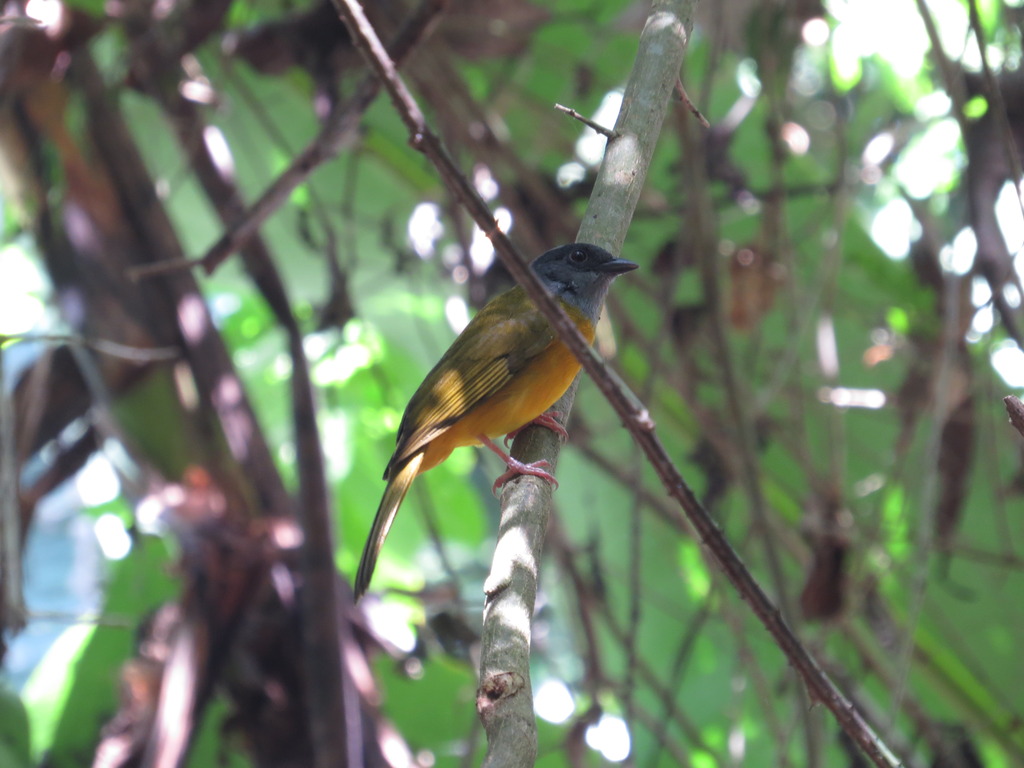
Carara National Park, Costa Rica

Tacacori, Costa Rica
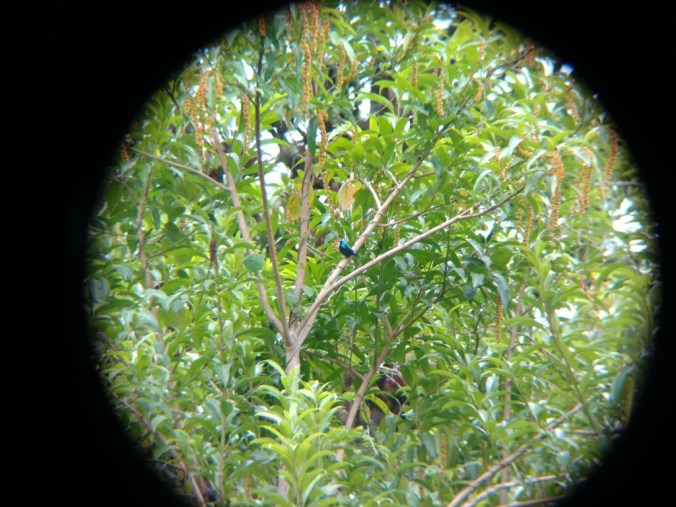
A male Scarlet-thighed Dacnis before zooming in with the camera in the digiscope setup
The first time I digiscoped, I wasn’t aware of the term, and I was using a small, borrowed point-and-shoot camera with a guide’s spotting scope. The results ended up here on the blog, though the images are, in retrospect, fairly low quality. In certain cases, however, digiscoping–basically the pairing of a scope with a camera for photography–can yield quite good shots of wildlife, and is arguably more versatile than having a big camera with a telephoto lens attached. Just check out Sharon Stiteler’s photos in her digiscoping article on Audubon’s webpage last year, or simply look up “digiscoping birds” to find some stunning images. Note, however, that digiscoping almost always refers to using a scope, or, in other words, a high-end piece of optic technology that costs anywhere between $400 and $3000–and that’s without the tripod.

The first waterfall on the Lost Waterfalls Trail
During Easter weekend, I took an eight-hour bus ride from San José, Costa Rica to David, Panama, and then a 45- to 60-minute bus ride from David to Boquete, a mountain town in the foothills of Barú, Panama’s only volcano and the country’s highest peak at 3,474 meters above sea level. Barú Volcano National Park is adjacent to the international park that Costa Rica and Panama share, called La Amistad (The Friendship), though it is far smaller than La Amistad, at around 14,000 hectares compared with 207,000. I was joined on the four-day weekend trip by my friend and coworker, Jocelyn, who had never been to Panama before, and we enjoyed hiking the conservation areas above the town of Boquete, admiring the many waterfalls in the region and also looking for the high-elevation bird species native to the cloud forest, many of which are endemic to Costa Rica and western Panama, as I wrote in my previous volcano-related post.

In addition to the national park, which charges $5 for entrance and has two main trails (one to the peak of the volcano, which takes about five hours to ascend, and one across the forest and part of the mountain ride, called Sendero Los Quetzales), there are some private forest reserves that charge a small admission fee. One is called the Lost Waterfalls Trail, which features three cascades and costs $7; another is called the Pipeline Trail, which follows a series of water tubes to the source and costs $3.

Tacacori, Costa Rica

Tacacori, Costa Rica

Carara National Park, Costa Rica
In the past I’ve shared some of my egg-based artwork, known in Ukrainian as pysanky, that’s for sale at the Xandari Resort gift shop in Costa Rica, including a sped-up video of the process. But my painstaking handiwork, with wax and dye, can now be replicated to some extent by a machine called the Eggbot, which is an open-source robotic machine that can draw on eggs or other spheroids. Most often it uses pens but it can also even work with an electric-heated “kitska” or wax stylus similar to the flame-heated ones that I use.
The video above displays the various works of an Eggbot used by Jiri Zemanek at Continue reading

