Egg Coloration

Gray Catbird nest with eggs. Photo by Flickr user JMK Birder.

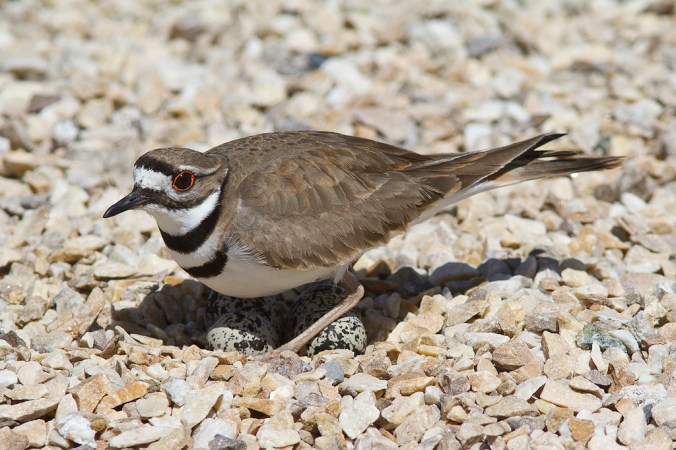
In my last post I covered Killdeer eggs and nests, focusing on their pyriform shape and mottled coloration. Here I’d like to talk a bit about egg pigmentation in more detail, since variation in patterns and colors is so fascinating in itself!

We saw with Killdeer that the spotted coloration of the eggs helped them blend in better with their surroundings, but what about eggs that aren’t marked at all? Well, white eggs, as we might assume, don’t have much camouflage potential unless placed in a white background, which is essentially limited to very light sand or gravel. White eggs, therefore, need to be disguised in other ways. They can be covered by things like feathers or vegetation, which is what many waterbirds do–wet leaves or seaweed can even stain parts of the eggs brown! They can also be laid in burrows or cavities where they won’t be seen anyway, which is what many woodpeckers, parrots, and owls, among other species, do.
Continue reading

CUBs Focal Species Close-up: Killdeer

Photo of Killdeer in Upper Newport Bay Nature Preserve by Morgan Terrinoni

Photo of Killdeer in Upper Newport Bay Nature Preserve by Morgan Terrinoni


If you haven’t heard of CUBs–Celebrate Urban Birds–yet, click here. Unlike the rest of shorebirds in the family of plovers, dotterels, and lapwings, Killdeer inhabit places other than the beach. Why? In part this is because they enjoy expanses of gravelly rocks and short grass, and there is only so much coastline. With all the parking lots, golf courses, well-maintained lawns, grazed pastures, and athletic fields in the US alone, it isn’t surprising that they took to the niches that were much more open to a ground-dwelling bird than the fairly packed shores. The fact that Killdeer have chosen homes that quite often happen to be in (sub)urban areas points to the relative comfort the species has for human proximity, and to a degree explains their successful expansion throughout North America as year-round residents. Continue reading

Red-tailed Hawk Chicks Hatch on Earth Day at Cornell University

Photo by Cornell Lab of Ornithology

If you were up around 6AM this Earth Day you probably didn’t think to check the Cornell Lab Bird Cams, but if you had, you might have seen two hawk chicks hatch into their nest atop a light pole on one of Cornell’s athletic fields.

According to the Lab’s news release, the third chick (i.e. the egg in this picture) is due to hatch in the next 48 hours, so keep a close watch by following the link in the photo, and enjoy your Earth Day! As you check out the live feed, you’ll probably see the father hawk, Ezra (named for Cornell University’s co-founder Ezra Cornell), or the mother, Big Red (after Cornell’s sports teams) taking turns incubating the egg and chicks.

Be sure to refer to the Red-tailed Hawk cam frequently asked question page, and also check out the Great Blue Herons in Sapsucker Woods!

Silky Nests in Funky Places

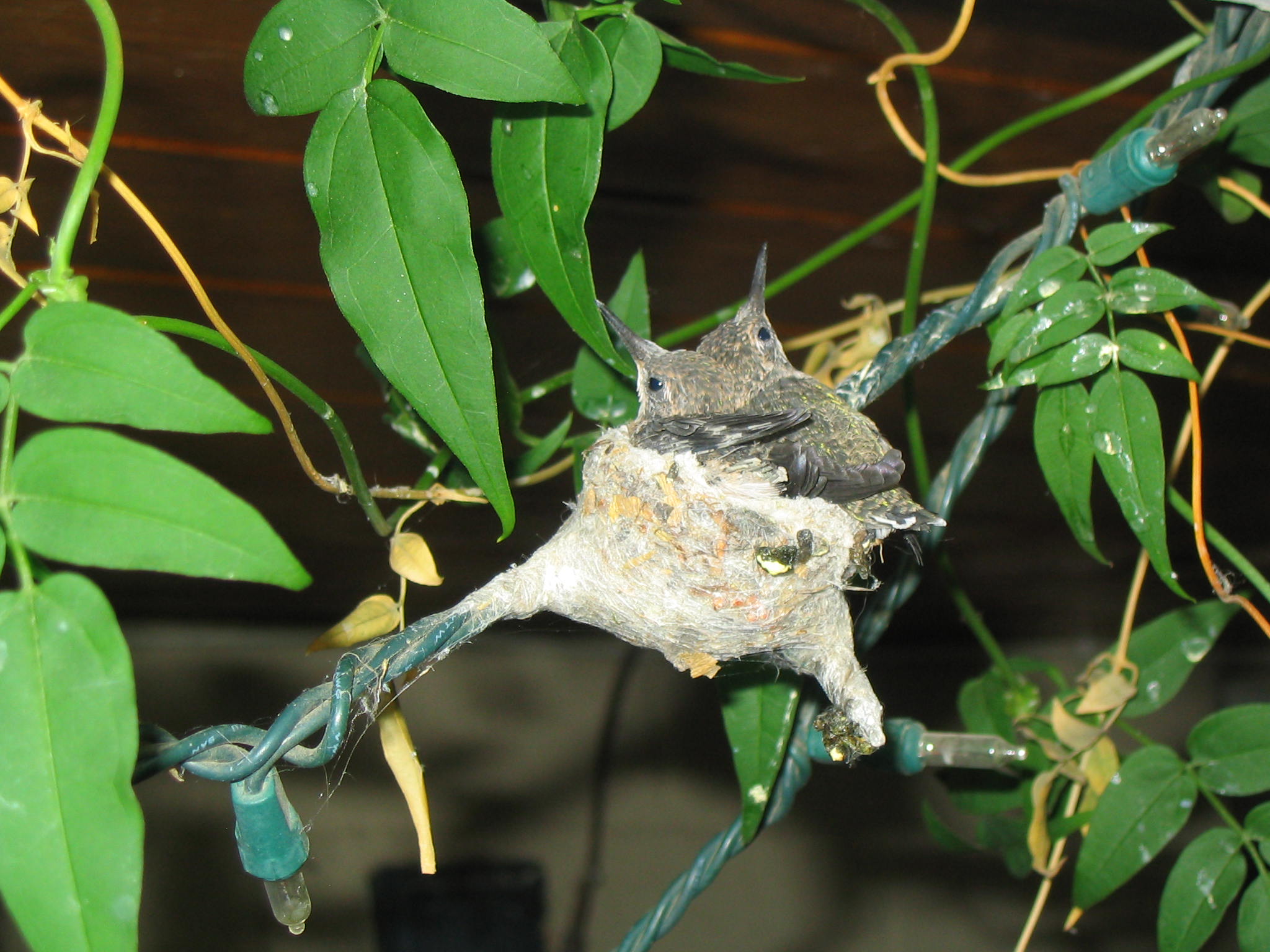
Photo by Charles Spencer, AZ

If you’ve ever watched a hummingbird for some time, you’ve probably thought that they’re one of the cutest and most exciting birds that you can find in your yard. Most would agree that it is some combination of their size, speed, vibrancy (of both color and motion), and relative rarity that can make them so appealing to us, but have you ever seen hummingbird nestlings? Or a nest, for that matter?

In the past couple years of the Funky Nests in Funky Places competition we’ve received photos of over a dozen hummingbird nests, all but one of which have been built on a man-made object! Seeing the hummingbird hatchlings poke their little beaks out of the tiny cup that the mother has created for them is a wonderful experience, and the feat of each minuscule nests’ construction becomes more impressive when you consider what the assembly materials are.

As you take a close look at the contributors’ photos shared here, you should be able to see (despite occasional blurriness) that the majority of the nest cup seems to be comprised of a silky substance. Surprisingly enough, much of this is spider web! Also known as spider silk, these strands of what humans normally think of as a fragile material (though some species of spiders produce silk with a higher tensile strength than steel) are perfect for hummingbirds’ purposes because they are sticky, light, stretchy, and strong.

Continue reading

Getting Grilled About Nests

Photo by Sharon Obery, IL

In the past few years at the Celebrate Urban Birds Funky Nests in Funky Places competition we have seen a fair number of nests found by contributors in their grills. And although at first it might seem surprising to learn that so many people are finding nests there (and, as you can see from their captions, the photographers are usually pretty shocked to open up their grill and encounter eggs or nestlings!), if you think a little about what certain bird species look for in a nesting location, grills actually make sense as nest homes. Why? Well, let’s review a couple facts about bird nests.

First off, many species will always nest in a protected hole, or cavity. The most common of these that you could find around your house include (but aren’t limited to) European Starlings, House Sparrows, House Wrens, and Eastern Bluebirds. Next, we should remember that the most important factor for a nest location is its capability to provide shelter and protection from predators. Does it sound like a grill would meet these requirements? Here’s some of their nest-worthy qualities:

Continue reading

Salamanders Announce Arrival of Spring in Ithaca

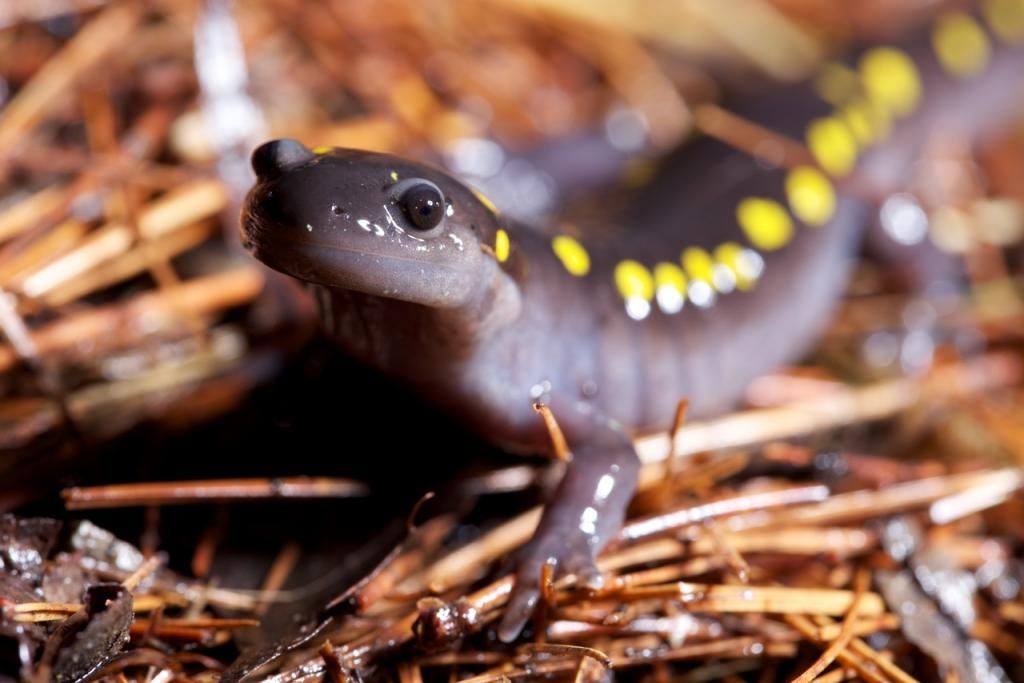
Spotted Salamander by Brian Magnier

Last night, at forty-odd degrees Fahrenheit and under a light drizzle, the salamanders of Ithaca’s Bull Pasture Pond signalled that spring has come. Before I explain, let me tell you a little bit about salamanders:

“The Americas have far more kinds of salamanders than all the rest of the world put together,” the Conant and Collins Field Guide to Reptiles and Amphibians reads in its introductory passage to the order Caudata. Species in eastern and central North America range from barely two inches to nearly four feet long, and some species are practically fully aquatic while others prefer only damp environments. Most of them are active at night and hide during the day, which is an easy way to differentiate them from lizards (except for the gecko family of lizards, which is primarily nocturnal). Other key differences are that lizards have scales on their bodies and claws on their toes, while salamanders have smooth or warty skin (just look at the slime in these photos) and no claws.

Continue reading

If You Happen to be in New York City

Cycle 2, Version 3 by Sopheap Pich, 2008. Photo credit (c) The Metropolitan Museum of Art.

For the next several months, The Metropolitan Museum of Art (aka The Met) has quite a few great special exhibits open that I would recommend seeing. My two favorites from a visit to The Met last week are titled “Cambodian Rattan: The Sculptures of Sopheap Pich” and “Birds in the Art of Japan,” both on the second floor in the Asian Art section.

In the first exhibit, Pich uses wire, bamboo, rattan, and a couple other materials to craft beautiful abstract or representational sculptures, which are presented, as you can see in the picture on the left, with great lighting to create superb shadows around the piece. Pich and his assistants had to boil the rattan and bamboo cane in diesel oil to remove insect eggs, prevent fungal damage, and preserve the cane from discoloration.

Continue reading

Birds-of-Paradise Project

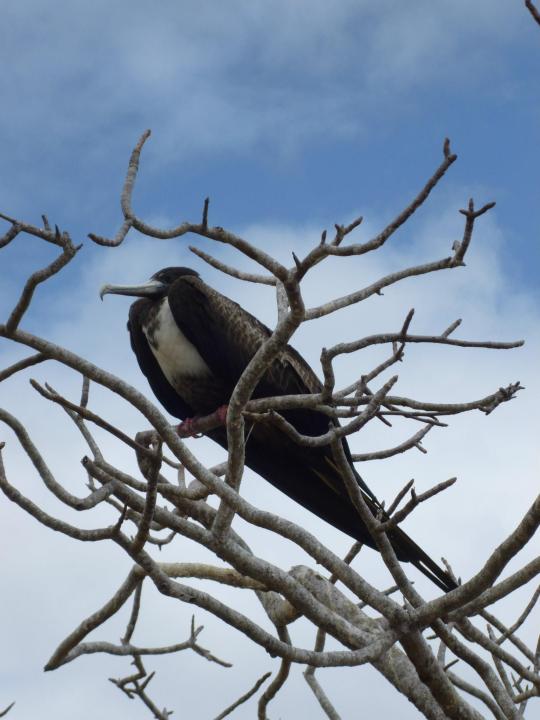
Photo by Tim Laman.

We’ve written about the birds-of-paradise before, mostly to share great images of them. But all that is about to be topped by the same folks who brought us two out of the three links above: Tim Laman and Ed Scholes. On February 19th, a new website was released that contains over two hours of footage never seen before, specifically designed to serve as an educational base for anyone trying to learn more about the whacky birds.

The Cornell Lab of Ornithology was one of the main funders for the project (others include the estate of Madelon G. and Robert Wehner, Conservation International, and the National Geographic Expeditions Council). According to their official press-release, the “website, videos, and interactive features were produced by the Cornell Lab’s Multimedia program with sound and video from the archives of the Lab’s Macaulay Library. Producer Marc Dantzker said the production team sorted through more than 2,500 video clips, almost 40,000 photos, and hundreds of sound recordings to find close-up examples of each adaptation, courtship pose, display feather, and dance move.”

So after eight years of painstaking research by Scholes and Laman, we get to enjoy this unforgettable imagery! Watch the video below of the King-of-Saxony, Continue reading

Industrialized Biofuels Part 2: Brazil’s Production

This post continues my discussion of biofuels from Part 1.

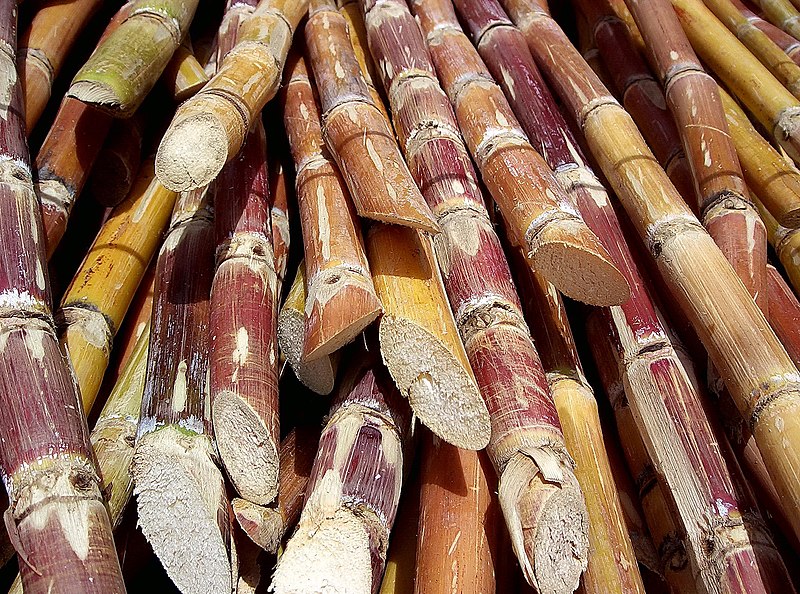
Brazil contains many of the world’s biodiversity hotspots, as well as one of the most important CO­2-sinks in the form of rainforests. As the second largest sugarcane grower in the world, Brazil’s biofuel production relies heavily on sugarcane ethanol, which has one of the highest savings in GHG emissions compared to fossil fuels. However, increasing sugarcane production is not sustainable in the long-term if one of Brazil’s goals is to curtail GHG emissions, since growing more sugarcane means cutting down more rainforest. Instead, second- and third-generation (advanced) biofuels should be considered viable options for replacing sugarcane, or at least strongly supplementing it.

Continue reading

Industrialized Biofuels Part 1: US Production

Image via Renaissance Ronin

The United States plans to produce 70 billion liters of advanced biofuels by 2020. In 2007, the global production of all biofuels roughly matched this amount, and the US used 24% of its corn to produce its share of the ethanol included in those 70 billion liters. Even given this impressive amount of corn used for ethanol, American corn ethanol only accounted for 1.3% of the US’ national liquid fuel consumption. An increase in either corn harvests or ethanol production efficiency is clearly necessary if the US is to meet the 2020 goal with corn alone. Given the significant drawbacks to producing more corn, and the unlikelihood of efficiency increasing enough to meet requirements, it would be more prudent to invest in second- and third-generation, or advanced, biofuels.

These biofuels, such as ethanol made from cellulose, biogas, or hydrocarbon fuels converted from biomass to liquid (BtL) are made from feedstock rich in cellulose like grass and wood. Advanced biofuels have better environmental profiles than what are referred to as first generation biofuels (e.g. ethanol produced from corn or sugarcane) because they generally require less land and are converted from biomass more efficiently—the processes also use less energy and water than ethanol since they do not involve distillation. A biofuel’s emissions depend largely on land considerations, nativity to the region, and feedstock technology. If land was converted from forest or prairie, the feedstock was not native to the region, and the feedstock required excessive fertilizers to grow, then GHG emissions are higher. Continue reading

Integrated Pest Management (IPM)

Photo by Milo Inman, India

During my last post I mentioned this agricultural strategy in passing, and I’m actually fairly surprised that the topic hasn’t come up anywhere on the blog before. After all, IPM is an increasingly effective and interdisciplinary way to curb economic losses in crops around the world, and one that often attempts to reduce reliance on environmentally unfriendly chemicals like pesticides.

Completely eliminating an agricultural pest is not the ultimate goal of IPM. In fact, due to ecological intricacies and the risks of removing certain species from an ecosystem, merely lowering the number of pests to numbers that do not cause significant economic damage is more advisable. Achieving this reduction in pest populations “requires an understanding of the ecology of the cropping system, including that of the pests, their natural enemies, and the surrounding environment,” according to Professor Anthony Shelton of the Entomology Department at Cornell University. For example, knowing that a certain pest caterpillar species has certain predator species, a farmer might introduce some of the natural predators into his crop to prey on the harmful caterpillars. If the farmer also physically removes the caterpillars by hand and the pest population dwindles to zero, the natural predators might turn to a beneficial insect, like a pollinator, or even attack the crop itself. This is a very vague and hypothetical example but one that reflects the need to understand causes and effects in an ecosystem if one is planning to employ IPM effectively.

Continue reading

Bog

Photo credit: BU Dining Services

Earlier this week I wrote about an entirely different sort of swamp. This brief post is about a topic much more in tune with the holiday season: cranberries. Grown in bogs with layers of peat, sand, gravel, and clay, cranberries are native to North American wetlands (our readers across the pond will probably know the European variety of the fruit as lingonberries). In the United States they are primarily grown in Massachusetts, New Jersey, Oregon, Washington, and Wisconsin (ordered alphabetically, not by output). Something not many people may know is that these cranberry bogs are cyclically flooded with vast amounts of water every season; some might worry over the constant waste of this precious liquid in areas of major cranberry production, or the contamination of water tables with pesticides and fertilizers common to agricultural use.

But I am about to tell you about some of the advantages cranberry-growers have over other industrial agriculturalists in terms of their water utilization. Why will I share this with you? Well, cranberry sauce features prevalently in the traditions of recent holidays, namely Thanksgiving and Christmas (and was thus probably consumed in an overwhelming majority of American households at least once in the past 60 days), plus my grandparents swear by cranberry juice, but I also recently found out that cranberries–and the water they are flooded with for harvesting–make for excellent art, or sport. What I never would have guessed is that Red Bull would be the one to show me this; just watch the video below:

Continue reading

Quagmire

In his environmental history of the Mejong River Delta in Vietnam, David Biggs analyzes the influential trend of forced—and often failed—attempts to control the water and earth of the landscape, with various effects on local populations. Looking back even farther than the mid-19th-century colonization of the area by the French, Biggs considers the traditional identities of human “improvements” of the delta such as dikes, canals, and dams essential to habitation and agriculture. The imposed land and water use projects enforced by the French colonists, with their newer, large-scale technologies, expanded what Biggs calls the colonial grid, which colonial officials endeavored to push beyond inhabited areas in ways often contrary to Vietnamese custom or ecological wellbeing.

Canal-digging, road-building, railroad-setting, river-dredging, forest-clearing, and swamp-draining, all part of the colonizing and pioneering process, were frequently carried out without fully considering the ecological and political effects such “nation-building” would have on the Vietnamese people and landscapes, or their relationships to each other. Although the environmental consequences for these earlier projects are not quite as severe as his case studies, Paul Josephson might label these activities as milder brute force technologies—if not these earlier efforts then perhaps those pushed forth by American agencies later in the 1960s and 1990s. The planting of methods tried and tested in quite different locations from the Mekong River Delta, and the frequent disregard or ignorance of the diverse intricacies in ethnic groups or soil and water types, impacted how effective the colonial and post-colonial programs of hydroagricultural reform were. Unlike Johnson, however, Biggs does not represent these technologies as overwhelmingly or constantly negative for the environment.  Continue reading