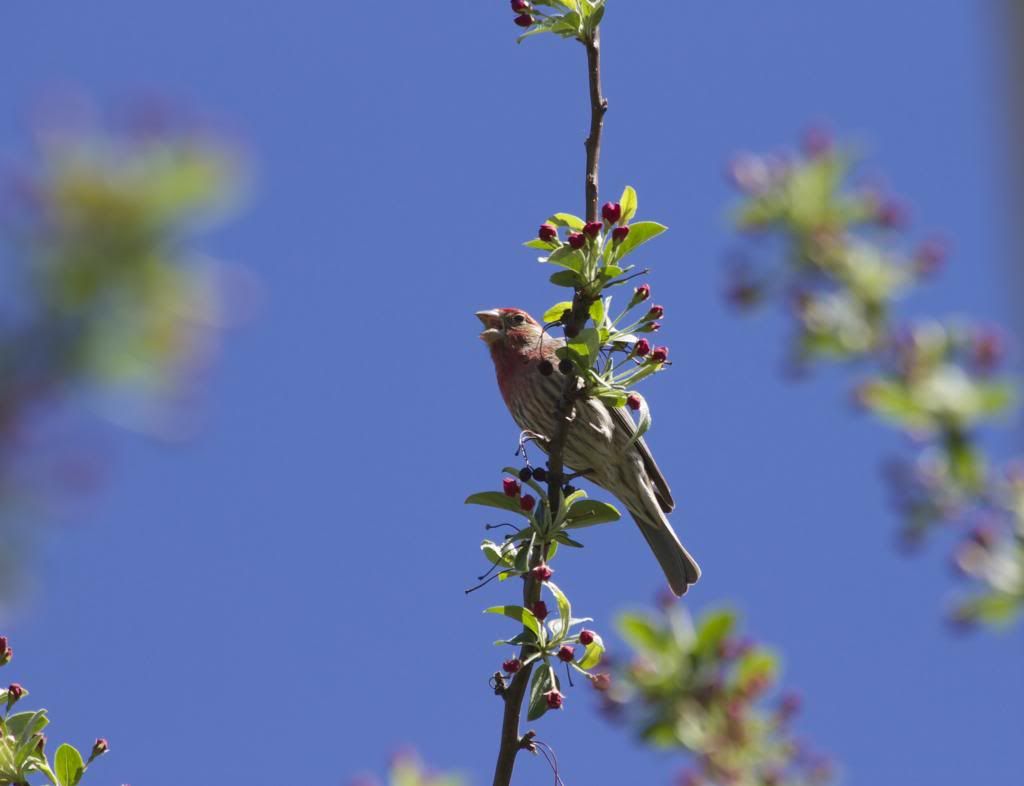
Bird of the Day: House Finch (Cornell University, Ithaca)
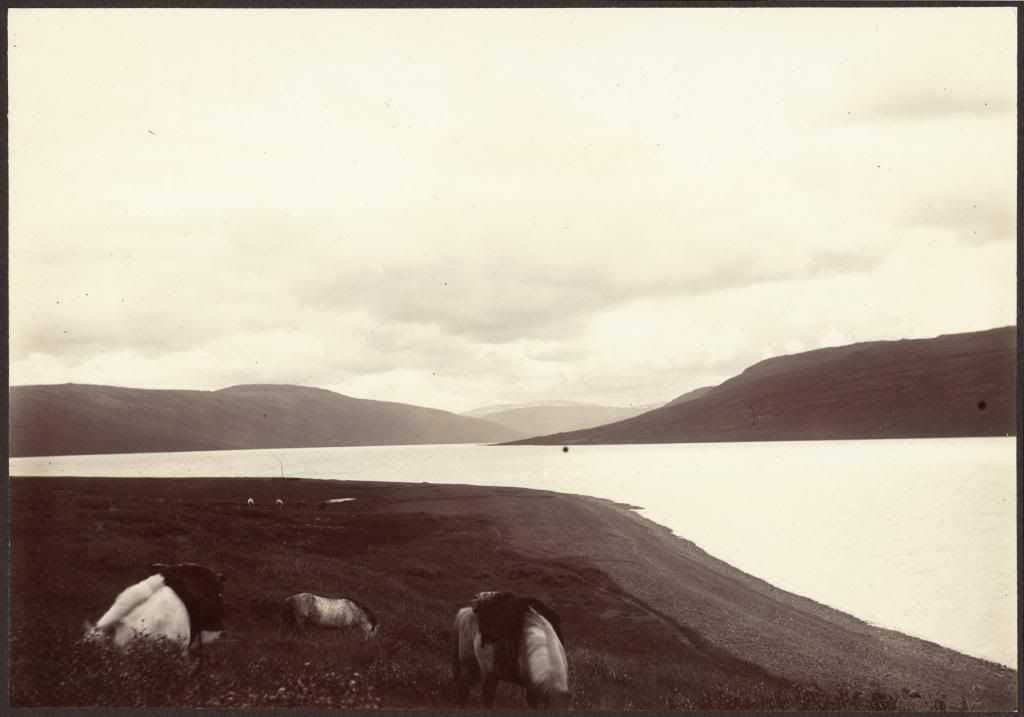
The head of Skorradalsvatn. Collodion print ca. 1900 by Frederick W. Howell. Bequest of Daniel Willard Fiske; compilation by Halldór Hermannsson at the Fiske Icelandic Collection of Cornell University.
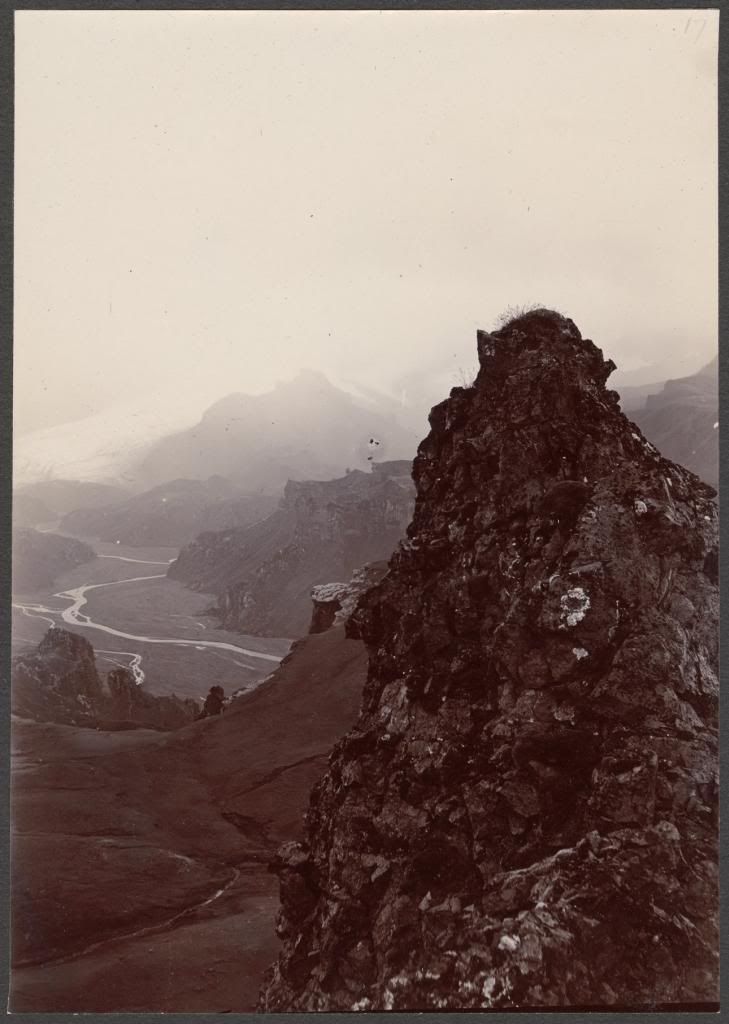
Þórsmörk. Head of Krossárdalur. Collodion print ca. 1900 by Frederick W. Howell. Bequest of Daniel Willard Fiske; compilation by Halldór Hermannsson at the Fiske Icelandic Collection of Cornell University.
It was mentioned a week or two ago that Iceland is in the air. For me, Iceland is on my mind, in my laptop, hidden throughout the Cornell libraries, and scattered about my room. After a couple essays for an environmental history course last year and some preliminary research for finding an honors thesis topic in the history major, I discovered that, thanks primarily to Cornell University’s first librarian, we have one of the largest collections of Icelandic material in the world. Since one of my projects for the environmental history class had shown me that Iceland was an interesting place to examine more closely, I did some more research and found the topic of European travel there during the eighteenth and nineteenth centuries engaging enough to choose as an honors thesis subject.
One of the places in Europe with the most spaces left blank by cartographers through the eighteenth and nineteenth centuries, Iceland’s inner regions were not fully mapped until 1901. Continue reading
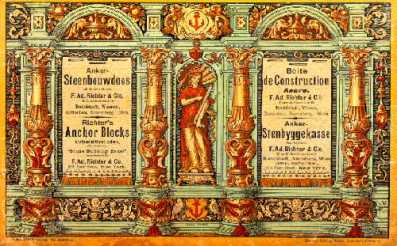
Box Set of Anchor Stone Blocks
In The New Yorker‘s book review last week, Alexandra Lange discussed Amy F. Ogata’s new book “Designing the Creative Child: Playthings and Places in Midcentury America,” focusing on the diverse materials and malleability of toy design over the past several decades.
With increasingly commercialized handmade, all-natural toys on the market, Lange asks, “Do toys need to be as artisanal as our food?”
Nearly two years ago now, Meg wrote about Tegu, wooden magnetic building blocks that support conservation and Hondurans in poverty. Tegu blocks seem to be a perfect blend of the artisanal qualities that wood bring to a toy, while the magnets inside add the opportunity for creativity that simple wooden rectangles and squares might not (unless they have the Lego-like studs that Mokulock does).
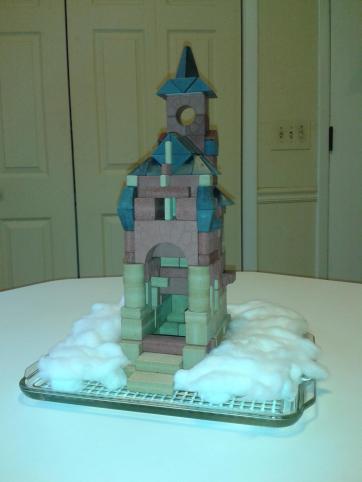 What about stone toys?
You don’t hear much about those, it seems to me. Heavy to carry around, more dangerous as projectiles, and requiring more machinery to produce, playthings built from stone might seem even more cumbersome and antiquated than wooden toys to a child brought up on shiny plastics and polymers. But the stone Anker/Anchor blocks (a box cover of which is pictured at the top of this post, and one of my own creations from these blocks is here to the right) made from quartz sand, chalk, linseed oil, and color pigment, are still able to merit $200+ asking prices on eBay, although part of their appeal comes from their relative–or perceived–antiqueness. Continue reading
Below is a slideshow of birds and their woven nests, which I spoke about in my previous post.
Here you can see the diversity of nesting materials and supporting structures, the state of the strands of vegetation upon building (fresh and green or dry and brown), and the overall craftsbirdship exhibited by these master weavers!

What strange growths protrude from this tree? Photo by Seth Inman.
There are birds around the world that use strands of different materials to craft marvelous woven nests that hang from tree branches — if you’re lucky enough to see them!

Yellow-rumped Cacique in Avian Architecture by Peter Goodfellow © Princeton University Press 2011. p95
Of course, in some circumstances it is not hard to find these pendent, or hanging, nests, as with many species of caciques and oropendolas in Central and South America (birds related to the North American blackbirds, orioles, and cowbirds). That’s right, the photo above isn’t of some weird fruit tree, but a tree-wide colony of oropendolas at Las Isletas, in Nicaragua!
Caciques, close relatives of Oropendolas, often nest beside wasp nests; orioles, only slightly more distant relatives, frequently nest near Eastern Kingbirds and Great Kiskadees. Wasps and these large flycatchers all help defend against nest predators. Yellow-rumped Caciques like the one pictured on the right start their nest building with a loop in a tangled mass of fibers that surrounds the end of a branch. Continue reading
The Barn Swallow’s nesting and habitat preferences have made it the most abundant and widely distributed swallow species in the world. The species adapted to using human structures as nest-bases from their previous preference of nesting in caves (although a single population on California’s Channel Islands still chooses to nest in its ancestral cave-grounds), and today you can find Barn Swallows nesting nearly anywhere in the US, even ranging as far afield as southern Alaska.
Since they nest on man-made structures so often (hence their common name, as well as their species name rustica in the genus Hirundo), they make for a great focal species for Celebrate Urban Birds given that their habitat of choice can coincide with rural, suburban, and urban landscapes that include buildings, open areas, and water, especially bodies of which provide a source of mud. As you can see in the photos above and below, mud is the main building material for their nests, as it is for Cliff Swallows, a few of which are featured in these slideshows! Barn Swallows are also frequent subjects of the Funky Nests in Funky Places challenge at Celebrate Urban Birds.
If you enjoyed my last post on hummingbirds, then I think you’ll like these photos that I uploaded on the Celebrate Urban Birds blog even more!
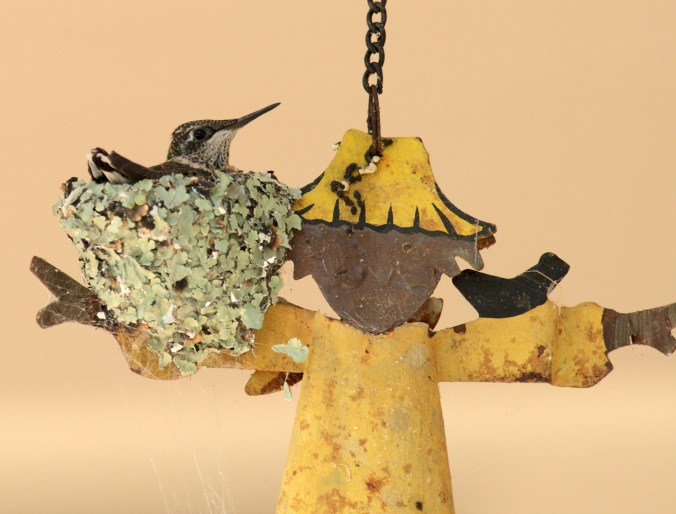
Photo of Ruby-throated Hummingbird by Marshall Faintich

Gray Catbird nest with eggs. Photo by Flickr user JMK Birder.
In my last post I covered Killdeer eggs and nests, focusing on their pyriform shape and mottled coloration. Here I’d like to talk a bit about egg pigmentation in more detail, since variation in patterns and colors is so fascinating in itself!
We saw with Killdeer that the spotted coloration of the eggs helped them blend in better with their surroundings, but what about eggs that aren’t marked at all? Well, white eggs, as we might assume, don’t have much camouflage potential unless placed in a white background, which is essentially limited to very light sand or gravel. White eggs, therefore, need to be disguised in other ways. They can be covered by things like feathers or vegetation, which is what many waterbirds do–wet leaves or seaweed can even stain parts of the eggs brown! They can also be laid in burrows or cavities where they won’t be seen anyway, which is what many woodpeckers, parrots, and owls, among other species, do.
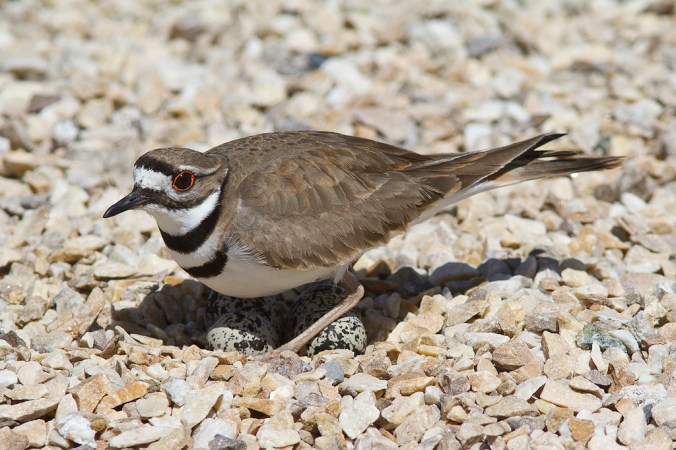
Photo of Killdeer in Upper Newport Bay Nature Preserve by Morgan Terrinoni
If you haven’t heard of CUBs–Celebrate Urban Birds–yet, click here. Unlike the rest of shorebirds in the family of plovers, dotterels, and lapwings, Killdeer inhabit places other than the beach. Why? In part this is because they enjoy expanses of gravelly rocks and short grass, and there is only so much coastline. With all the parking lots, golf courses, well-maintained lawns, grazed pastures, and athletic fields in the US alone, it isn’t surprising that they took to the niches that were much more open to a ground-dwelling bird than the fairly packed shores. The fact that Killdeer have chosen homes that quite often happen to be in (sub)urban areas points to the relative comfort the species has for human proximity, and to a degree explains their successful expansion throughout North America as year-round residents. Continue reading

Photo by Cornell Lab of Ornithology
If you were up around 6AM this Earth Day you probably didn’t think to check the Cornell Lab Bird Cams, but if you had, you might have seen two hawk chicks hatch into their nest atop a light pole on one of Cornell’s athletic fields.
According to the Lab’s news release, the third chick (i.e. the egg in this picture) is due to hatch in the next 48 hours, so keep a close watch by following the link in the photo, and enjoy your Earth Day! As you check out the live feed, you’ll probably see the father hawk, Ezra (named for Cornell University’s co-founder Ezra Cornell), or the mother, Big Red (after Cornell’s sports teams) taking turns incubating the egg and chicks.
Be sure to refer to the Red-tailed Hawk cam frequently asked question page, and also check out the Great Blue Herons in Sapsucker Woods!
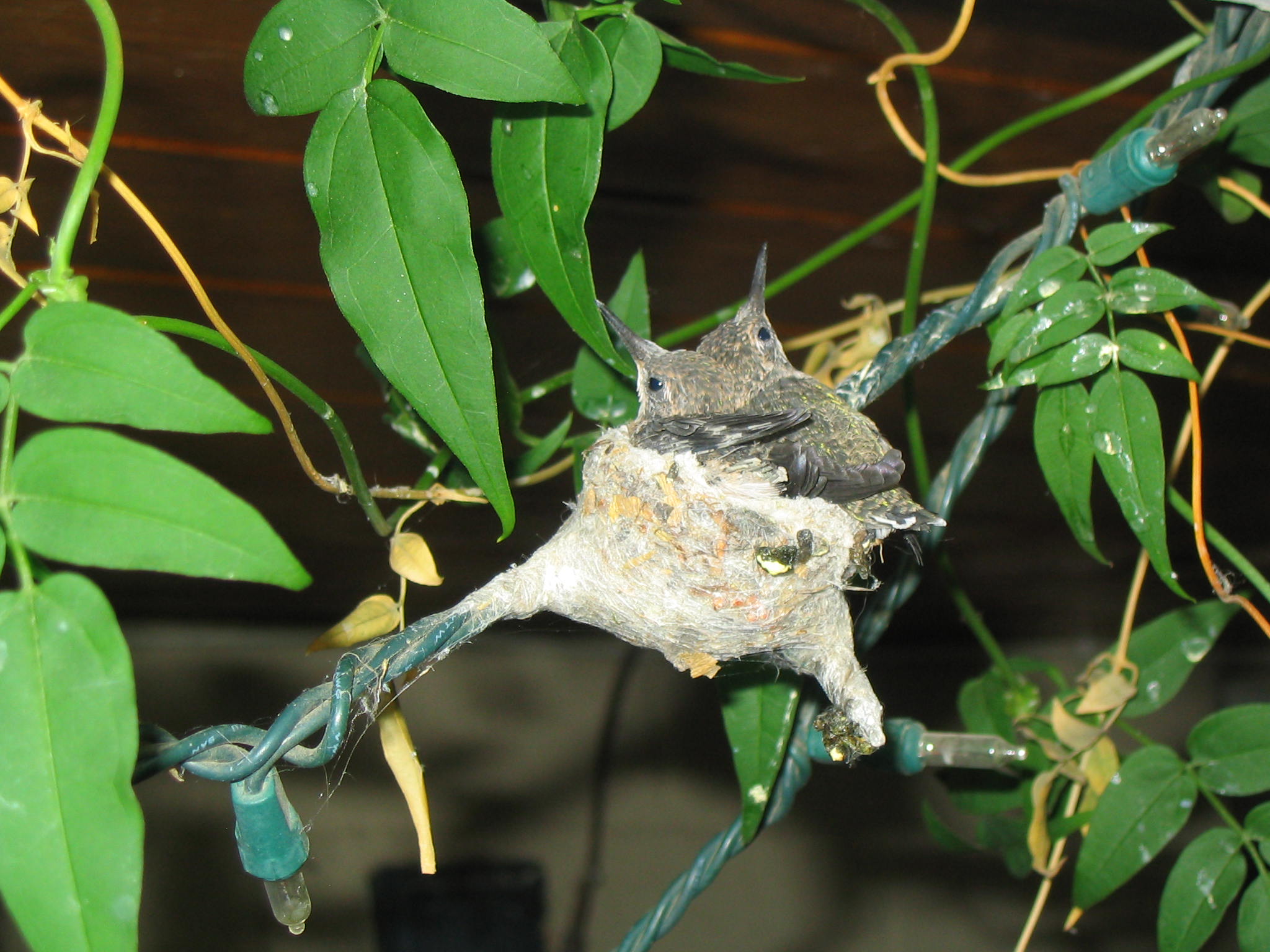
Photo by Charles Spencer, AZ
If you’ve ever watched a hummingbird for some time, you’ve probably thought that they’re one of the cutest and most exciting birds that you can find in your yard. Most would agree that it is some combination of their size, speed, vibrancy (of both color and motion), and relative rarity that can make them so appealing to us, but have you ever seen hummingbird nestlings? Or a nest, for that matter?
In the past couple years of the Funky Nests in Funky Places competition we’ve received photos of over a dozen hummingbird nests, all but one of which have been built on a man-made object! Seeing the hummingbird hatchlings poke their little beaks out of the tiny cup that the mother has created for them is a wonderful experience, and the feat of each minuscule nests’ construction becomes more impressive when you consider what the assembly materials are.
As you take a close look at the contributors’ photos shared here, you should be able to see (despite occasional blurriness) that the majority of the nest cup seems to be comprised of a silky substance. Surprisingly enough, much of this is spider web! Also known as spider silk, these strands of what humans normally think of as a fragile material (though some species of spiders produce silk with a higher tensile strength than steel) are perfect for hummingbirds’ purposes because they are sticky, light, stretchy, and strong.

Photo by Sharon Obery, IL
In the past few years at the Celebrate Urban Birds Funky Nests in Funky Places competition we have seen a fair number of nests found by contributors in their grills. And although at first it might seem surprising to learn that so many people are finding nests there (and, as you can see from their captions, the photographers are usually pretty shocked to open up their grill and encounter eggs or nestlings!), if you think a little about what certain bird species look for in a nesting location, grills actually make sense as nest homes. Why? Well, let’s review a couple facts about bird nests.
First off, many species will always nest in a protected hole, or cavity. The most common of these that you could find around your house include (but aren’t limited to) European Starlings, House Sparrows, House Wrens, and Eastern Bluebirds. Next, we should remember that the most important factor for a nest location is its capability to provide shelter and protection from predators. Does it sound like a grill would meet these requirements? Here’s some of their nest-worthy qualities:
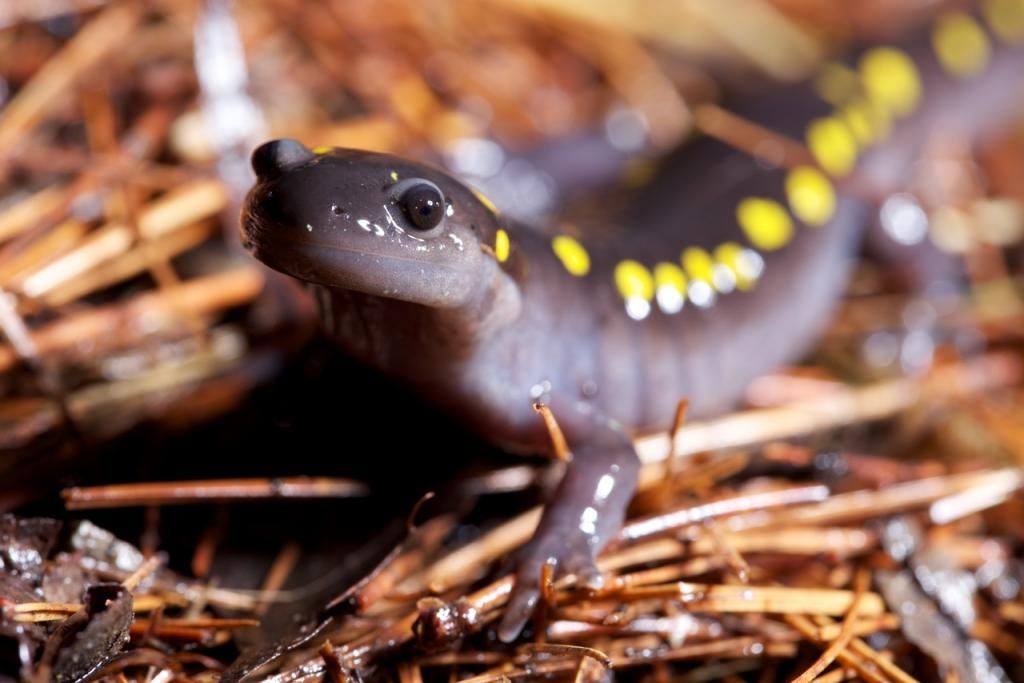
Spotted Salamander by Brian Magnier
Last night, at forty-odd degrees Fahrenheit and under a light drizzle, the salamanders of Ithaca’s Bull Pasture Pond signalled that spring has come. Before I explain, let me tell you a little bit about salamanders:
“The Americas have far more kinds of salamanders than all the rest of the world put together,” the Conant and Collins Field Guide to Reptiles and Amphibians reads in its introductory passage to the order Caudata. Species in eastern and central North America range from barely two inches to nearly four feet long, and some species are practically fully aquatic while others prefer only damp environments. Most of them are active at night and hide during the day, which is an easy way to differentiate them from lizards (except for the gecko family of lizards, which is primarily nocturnal). Other key differences are that lizards have scales on their bodies and claws on their toes, while salamanders have smooth or warty skin (just look at the slime in these photos) and no claws.

Cycle 2, Version 3 by Sopheap Pich, 2008. Photo credit (c) The Metropolitan Museum of Art.
For the next several months, The Metropolitan Museum of Art (aka The Met) has quite a few great special exhibits open that I would recommend seeing. My two favorites from a visit to The Met last week are titled “Cambodian Rattan: The Sculptures of Sopheap Pich” and “Birds in the Art of Japan,” both on the second floor in the Asian Art section.
In the first exhibit, Pich uses wire, bamboo, rattan, and a couple other materials to craft beautiful abstract or representational sculptures, which are presented, as you can see in the picture on the left, with great lighting to create superb shadows around the piece. Pich and his assistants had to boil the rattan and bamboo cane in diesel oil to remove insect eggs, prevent fungal damage, and preserve the cane from discoloration.

Photo by Tim Laman.
We’ve written about the birds-of-paradise before, mostly to share great images of them. But all that is about to be topped by the same folks who brought us two out of the three links above: Tim Laman and Ed Scholes. On February 19th, a new website was released that contains over two hours of footage never seen before, specifically designed to serve as an educational base for anyone trying to learn more about the whacky birds.
The Cornell Lab of Ornithology was one of the main funders for the project (others include the estate of Madelon G. and Robert Wehner, Conservation International, and the National Geographic Expeditions Council). According to their official press-release, the “website, videos, and interactive features were produced by the Cornell Lab’s Multimedia program with sound and video from the archives of the Lab’s Macaulay Library. Producer Marc Dantzker said the production team sorted through more than 2,500 video clips, almost 40,000 photos, and hundreds of sound recordings to find close-up examples of each adaptation, courtship pose, display feather, and dance move.”
So after eight years of painstaking research by Scholes and Laman, we get to enjoy this unforgettable imagery! Watch the video below of the King-of-Saxony, Continue reading
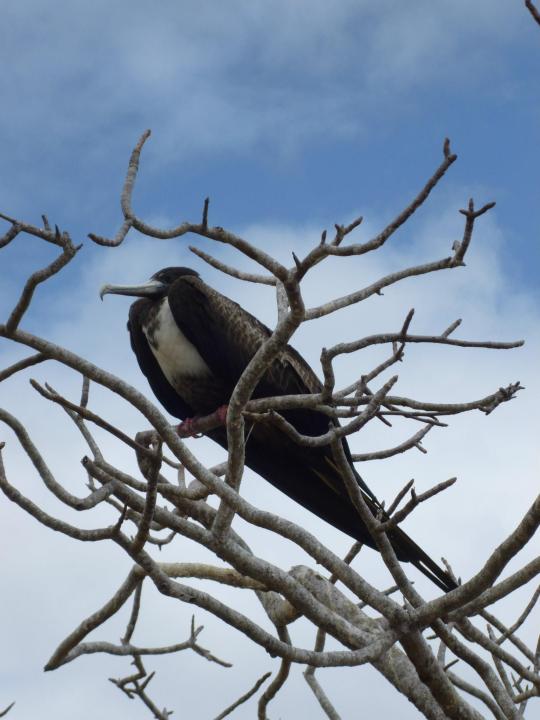
North Seymour Island, Galapagos, Ecuador
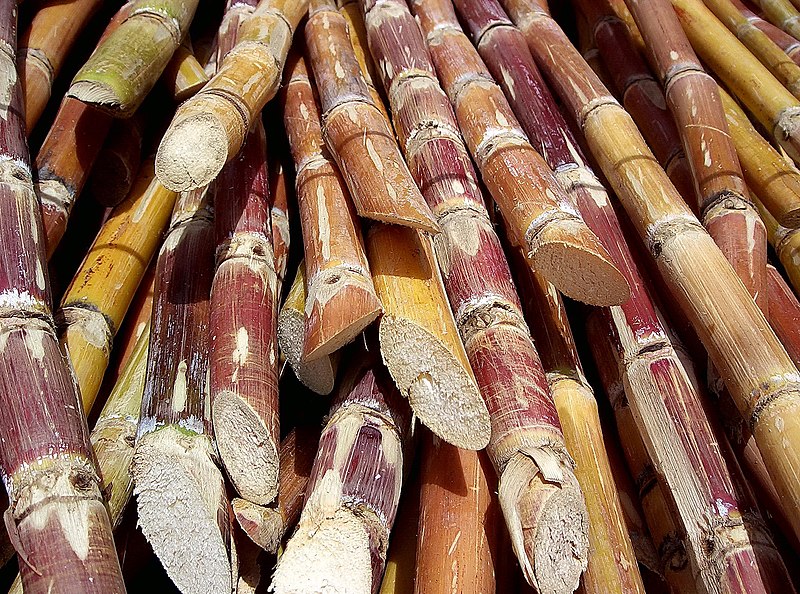 This post continues my discussion of biofuels from Part 1.
Brazil contains many of the world’s biodiversity hotspots, as well as one of the most important CO2-sinks in the form of rainforests. As the second largest sugarcane grower in the world, Brazil’s biofuel production relies heavily on sugarcane ethanol, which has one of the highest savings in GHG emissions compared to fossil fuels. However, increasing sugarcane production is not sustainable in the long-term if one of Brazil’s goals is to curtail GHG emissions, since growing more sugarcane means cutting down more rainforest. Instead, second- and third-generation (advanced) biofuels should be considered viable options for replacing sugarcane, or at least strongly supplementing it.


Los Dolores, Baja California Sur, Mexico

Image via Renaissance Ronin
The United States plans to produce 70 billion liters of advanced biofuels by 2020. In 2007, the global production of all biofuels roughly matched this amount, and the US used 24% of its corn to produce its share of the ethanol included in those 70 billion liters. Even given this impressive amount of corn used for ethanol, American corn ethanol only accounted for 1.3% of the US’ national liquid fuel consumption. An increase in either corn harvests or ethanol production efficiency is clearly necessary if the US is to meet the 2020 goal with corn alone. Given the significant drawbacks to producing more corn, and the unlikelihood of efficiency increasing enough to meet requirements, it would be more prudent to invest in second- and third-generation, or advanced, biofuels.
These biofuels, such as ethanol made from cellulose, biogas, or hydrocarbon fuels converted from biomass to liquid (BtL) are made from feedstock rich in cellulose like grass and wood. Advanced biofuels have better environmental profiles than what are referred to as first generation biofuels (e.g. ethanol produced from corn or sugarcane) because they generally require less land and are converted from biomass more efficiently—the processes also use less energy and water than ethanol since they do not involve distillation. A biofuel’s emissions depend largely on land considerations, nativity to the region, and feedstock technology. If land was converted from forest or prairie, the feedstock was not native to the region, and the feedstock required excessive fertilizers to grow, then GHG emissions are higher. Continue reading

