Latin America Reads

Several hundred teachers sporting green canvas bags filled an auditorium at the Central American University (UCA) of Managua. The bags bore the Nicaragua Lee (Nicaragua Reads) and International Reading Association logos under the inscription, “Cantar Palabras, Dibujar Textos,” or, “Sing Words, Draw Texts.” A large banner across the top of the stage welcomed teachers to the eleventh Latin American and second National Congresses on Reading. The teachers were mostly from Nicaragua and Central America, but many South American countries, as well as Puerto Rico and USA, were also represented.

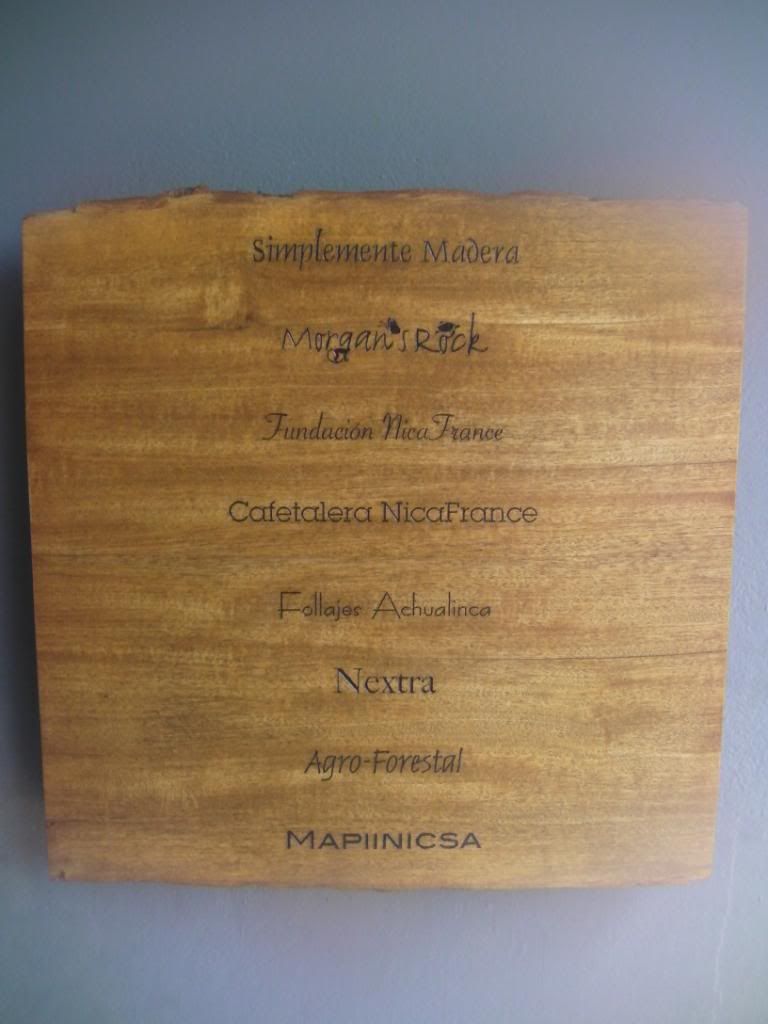
I was there accompanying the delegations from schools supported by Fundación Nicafrance. As I mentioned in a previous post, this foundation sponsors schools with other members of its social enterprise network: Morgan’s Rock Hacienda & Ecolodge, La Cumplida/Cafetalera Nicafrance, and Exportadora Atlantic, S.A. These are all intertwined with the Simplemente Madera Group.

The great highlight of the day’s proceedings was the eagerly-awaited arrival of Sergio Ramírez, who was vice-president of Nicaragua just after the revolution (86-90) and is probably the most celebrated poet and author of Central America since Ruben Dario, who still has a historic importance to Nicaraguan culture. Scores of teachers had copies of his latest book, La fugitiva, which they would ask him to sign at the end of his speech about the importance of reading to future generations of Nicaraguan society. This tall man and his deliberating voice, which rang across the auditorium, actually inspired me to wait in line and ask him to sign my shirt. This was the first time I’d ever asked someone for their autograph.

To find out why I had my shirt signed rather than a piece of paper or a Congress program (see the first link for an Excel sheet), stay tuned for the latter of my next two posts about this Congress and what I learned about the state of Nicaraguan literacy today.
Defensive Insects

My younger brother Milo has posted about Entomotography, sharing his excellent “macro” pictures of dragonflies in India. Yesterday I was walking in the woods at Morgan’s Rock when I remembered that I had promised to describe in more detail the cornizuelo tree, which fronts fierce fire ants and sports sharp spines on its branches. Since these trees are all over the place, I set my camera to macro mode and looked for a good specimen. Below is a video that shows just how diligently the ants patrol their home, both when no imminent danger is present and also when a threat is detected. At the end of the video I’ve included footage of a caterpillar.


When I first saw the little balls on the caterpillar’s back, I wasn’t all that surprised. Many insect species (and other animals like fish and crustaceans, for that matter) cover themselves with debris to disguise themselves from predators. What struck me as odd, however, was that this caterpillar, clearly a poisonous species (or at the very least an example of Batesian mimicry), felt the need to cover itself with crap (which, as the video shows, I discovered to literally be true) and thereby potentially avoid predation. Of course, it may be Continue reading →

Bonds In Theaters

Here on the southern coast of Nicaragua, I have tracked reviews of the latest Harry Potter movie without yet being able to see it for myself.  My parents and brother went to see it in Kerala today.  Their review was less about the movie itself than about the fact that being in a movie theater in India is a kind of spectacle in its own right, apart from whatever may be happening on screen. I’ll describe the Indian experience in more detail later; for now I think back in time.

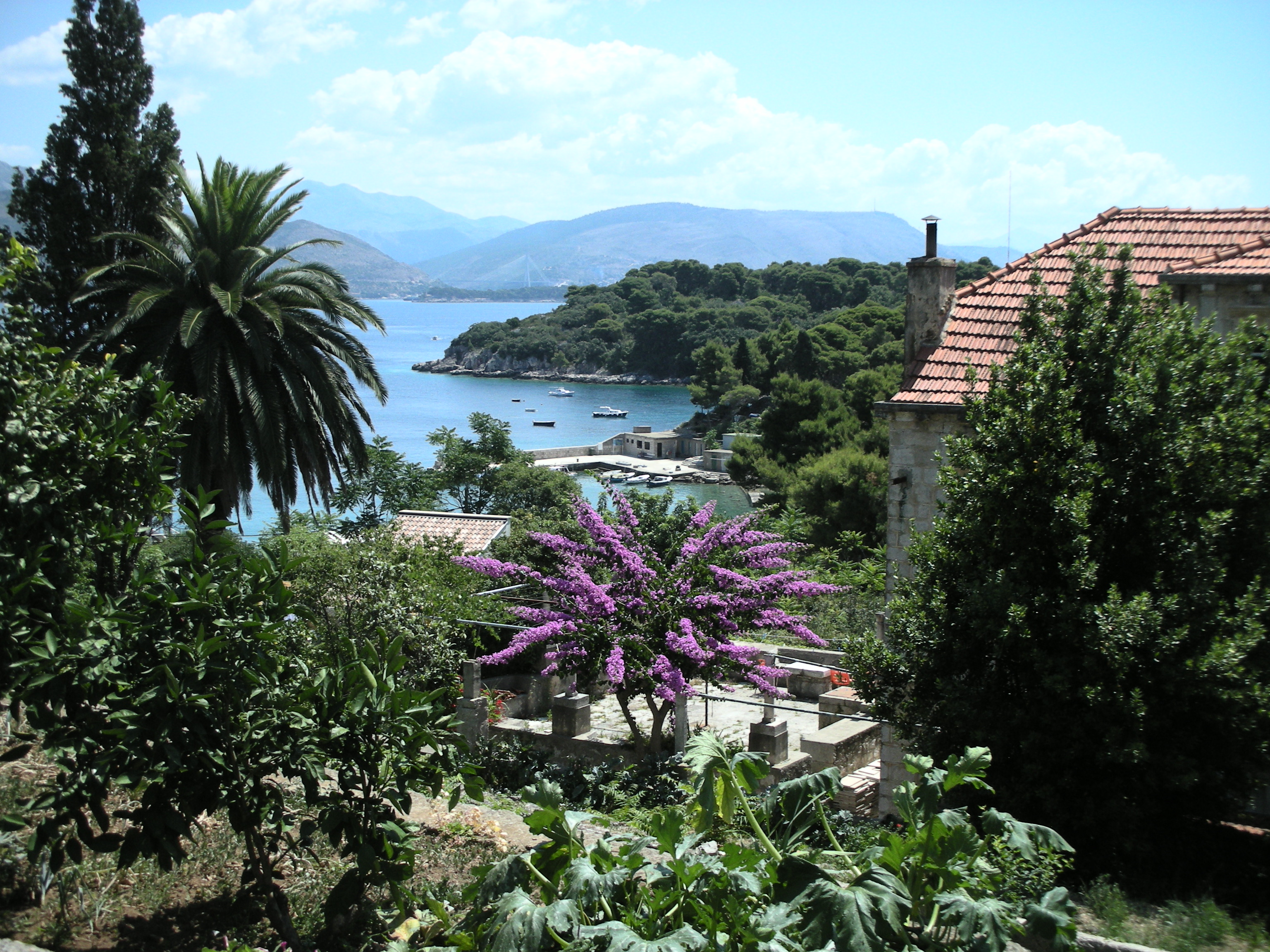
In 2006 my family was living on a small island off the coast of Dubrovnik (that is the view from our home in the photo above). About 150 people lived on the island, mostly the families of fishermen, who only spoke Croatian and maybe a little Italian.  The old city of Dubrovnik had a small cinema that sometimes played movies in English.  I recall when the latest James Bond film, with a new actor whose performance everyone was eager to review, started playing in this theater–in English with Croatian subtitles. “Casino Royale,” the movie was called.

Continue reading →

A Campesino Breakfast Revisited

About three weeks ago, I was on the Campesino Breakfast Tour when I had the chance to see a boa sleeping in the chicken barn. This morning, the collection and preparation of breakfast ingredients went by without such an exciting event. But since unlike last time today I had a video camera with me, I can share some of the audiovisual details of the breakfast tour that were lost last time. I still recommend reading the previous post for a more elaborate text description than that which you will find here.


When we left the fowl barn and headed to Doña Candida’s traditional Nicaraguan house,  Continue reading →

Certification of Sustainability

Unlike most of my other posts, practically all the hyperlinks in this post link to an aptly corresponding webpage instead of a picture I took. Also, please note that my previous post on the reserve at La Cumplida has been corrected. You can find the corrections in bold at the top of the post.

*

La Cumplida’s coffee farm is accredited by UTZ CERTIFIED and Rainforest Alliance. These two organizations are worldwide leaders in assessing and monitoring sustainable practices. UTZ is solely concerned with agriculture—coffee, cacao, and tea farms, mostly. The group states that through their standards, farmers see increases in productivity, efficiency, and quality:

Productivity

“In 2007, before being certified, my farm of 2.1 hectares produced 7,000 pounds of parchment. Now, in 2009, I have a productivity of 11,000 pounds. That represents an income increase.” (Cooperativa San José El Obrero, Guatemala)

Efficiency

“Before certification I fertilized 3 times a year with 80 grammes per plant, now I fertilize two times a year and apply 100 grammes per plant; with this measure I saved labor and fertilizers, while farm productivity has not been affected. Savings have been US $39 / ha”. (Cooperativa Anserma, Colombia)

Quality

The percentage of Class 3 & 4, which fetch better prices, has increased above 80% since certification, unlike 2006/2007 when they only produced 26.1% of class 4. (Rianjagi Coffee Farmers Cooperative Society (RFCS), Kenya)

Continue reading →

La Cumplida’s Private Reserve

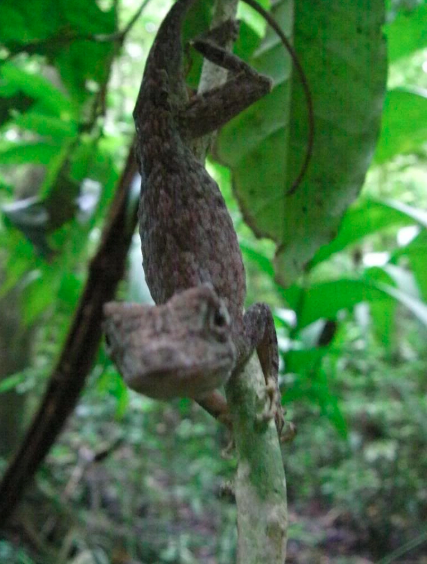
Author’s Note 19/7/11: The lizard pictured at the beginning of the post has been identified as a pug-nosed anole. The first group of stinkhorn pictures (paragraph 2) are of the species Phallus duplicatus, and the second group of pictures (last paragraph) are of Phallus indusiatus. The green mushroom linked to by the word “others” (paragraph 4) is Hygrocybe sp. and the grey/white ones are Psathyrella candolleana. Credit and thanks for mushroom identification goes to Milo Inman.

*

The untouched forest of the reserve at La Cumplida is a hilly cloud forest with few trails and many streams that served as much of our path through the trees. My guide, a local named Santos, and I started in the foothills outside of the reserve and entered the forest by climbing up some steep, muddy inclines.

The protected area amounts to 600 hectares, or 1,482 acres. Santos and I had walked for only about twenty minutes when I spotted the first attraction of the day: some stinkhorn mushrooms. Two were just a white line of pulp, but one was still not fully decomposed and looked as phallic as ever, having lost its veil.

Only around half an hour of hills later, Santos stopped me and pointed out a sapling in front of us. He said some words that I didn’t understand, so I tried looking more closely to decipher his meaning. At last I saw the outline of a faint figure sticking out of the tree’s trunk. I slowly approached and saw that a lizard, perhaps the length of my hand, was grasping the sapling and facing downwards, its scales a mottled variety of wood colors, like a camouflaged chameleon but clearly not of that species based on its head shape. The poor lighting in the forest didn’t allow for the best pictures, but I was glad to get a couple, especially these ones of the lizard curiously raising its head at the closely approaching camera lens.


We advanced further into the forest and saw only the dense and variegated foliage around us

Continue reading →

Sustainable School Sponsoring

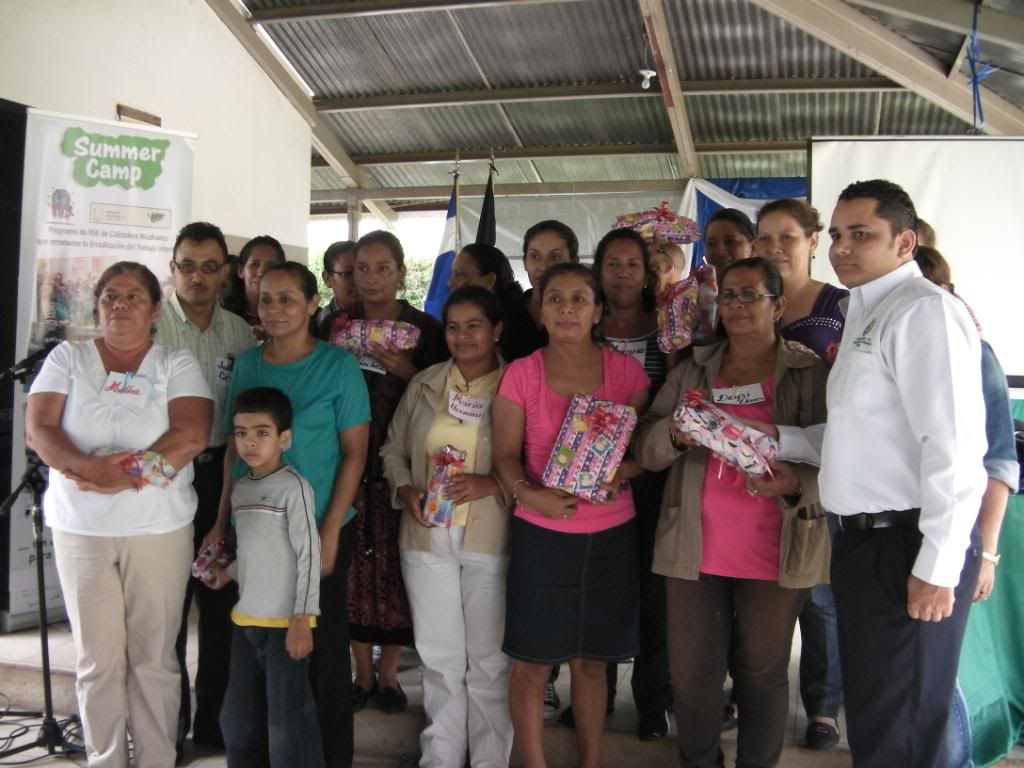
Last week, teachers from schools supported by Morgan’s Rock Hacienda & Ecolodge, Cafetalera Nicafrance, S.A., and Exportadora Atlantic S.A. met at finca La Cumplida to celebrate Teachers’ Day a little late and discuss the importance of education to Nicaragua’s future.

Morgan’s Rock sponsors six schools in the San Juan del Sur area; Cafetalera Nicafrance (essentially La Cumplida) helps eight in the Matagalpa area; and Exportadora Atlantic (EA) just recently picked up a school. In Spanish, the sponsoring is known as “godfathering/godmothering” depending on the name of the school (they are named after national heroes, martyrs, etc.). Each seat at the long tables was supplied with a folder, notepad, pen, and calendar provided by EA , as well as a schedule of the day’s activities and suggested readings printed by José Tomás Gómez Valdivia, who is in charge of the whole school sponsoring program under the Nicafrance Foundation, which all the previously mentioned companies are associated with.

Gift presentation to schoolteachers


Continue reading →

La Cumplida’s Harvest Diversity

Part of the La Cumplida farm diversification involves growing crops apart from coffee. I’ve already mentioned the tree cultivation and bananas, and here I can go into more detail about the wood production and other harvests.

Ferns cover many of the hills in the upper ranges of the finca. Sheltered under black netting to block out the sun, these billions of fronds are handpicked and bundled in different sizes. The vast majority is sent to Netherlands, but other European countries and the United States receive the ornamental plants as well. Why is Netherlands the main customer? Because the country holds the largest flower market in the world at Aalsmeer, has long been the production hub for the European flower industry, and is a major international floral supplier. Many bouquets contain not only blossoms but ornamental leaves as well, and these ferns work well in many arrangements.

Wilfredo led us through the fern fields and told us a bit about its cultivation. One of the problems they have while growing the ferns is fungal disease, which turns them yellow and brown as they die; fungicide and physical culling are necessary to control the spread. About every two months they have new fully matured fronds that can be harvested, bundled up, washed, and bundled again under bags. Then they are boxed and sent under refrigeration to their destination (if I remember correctly, at 7 degrees Celsius). Below is a short and simple video that includes some of this explanation and process.


Continue reading →

Where Your Espresso Might Come From

Pierre and I went on a tour around La Cumplida’s coffee plantation with Wilfredo. La Cumplida is a huge finca of over 1,600 hectares (this includes 700 ha. for coffee and 600 ha. for protected reserve) situated in the region of Matagalpa, which is very well known for its coffee production. First we went to the processing plant, which is under repair because some of the machines were being too rough on the coffee beans. Despite the fact that none of the machines were currently working, he walked us through the bean process: loading, skinning, washing, and reloading the beans. The drying and roasting takes place at another location. If we had been here any time from October through February, the machines would have been whirring and red beans would come by the truckload to be processed, since over 2000 coffee pickers would be hard at work in the hills, collecting beans.

Below is a video of some of the coffee work we watched. Wilfredo’s explanation of the deshijo is translated in brief three paragraphs below.


Continue reading →

Where They Simply Sell Wood

The Simplemente Madera store is full of furniture and wooden objects that are rarely purchased directly from the Managua venue, but more often selected as part of a furnishing package for a whole home. These furnishing contracts, which sometimes include interior design, are mostly for Nicaraguan houses and hotels, but also many projects in the US and Costa Rica, and normally last from one to six months, depending on the scale. Unless the project can fill one of their shipping containers, which are 20 ft2, Simplemente Madera doesn’t send furniture to the US. One of these containers can fit enough material to furnish a three-bedroom house, so the company is mostly concerned with high price-tag clients.

Simplemente Madera Group

What a US homeowner will normally do is send SM a blueprint of their house and select from a line of products in the SM catalogue (Mombacho is currently the most popular, with natural deformations in the wood). Then the designers at SM will fit the furniture to the house and the style and send the homeowner some sketches. Some people want a more hands-on approach and pay to bring a designer to their house in the US. Simplemente Madera designers also often make custom designs for clients according to their requests.

Simplemente Madera’s Workshop

Here is the second installment of the Simplemente Madera factory tour. Below is a video of the production line in the workshop–watch for the Ocean Green surfboard at the end!


Up next is a written and photographic swing by the Simplemente Madera store in Managua.

Drying Wood at Simplemente Madera

Pierre and I left Morgan’s Rock on Friday to go visit the Simplemente Madera factory outside of Managua. It is a huge facility that receives wood almost entirely from fallen forests on the Atlantic coast of Nicaragua that were destroyed by Hurricane Felix in 2007. We took a tour with one of the quality inspectors, who showed us around the plant and explained every process the wood went through from log to rocking chair (most of these steps are for another post). The following video covers the initial drying the timber must go through to make it the highest quality wood available. The best part of this process is that it is completely sustainable — it only uses open air and scrap wood! Please give the video’s subtitles some time to load, unless you speak Spanish.


Here is an additional picture of the scrap wood and a view of the six closed drying ovens, which are often rented by other woodworking companies to dry their wood, since nobody else in Nicaragua has the drying capacity of Simplemente Madera.

Spider Monkey Threats

On one of our walks through the forest, Pierre and I found another green-backed spider (see my previous post) that spewed some white droplets at us. Unless we had an unusual double coincidence of interrupting arachnid bowel movements, I now believe that the spiders meant to deter us with the liquid. Whether it was excrement, poison, or liquid silk material remains to be seen.

Later on the trail we reached the main road and were about to pass under a group of huge mango trees when several mangoes thumped loudly onto the ground in front of us after the branches crashed around a bit. We looked warily into the trees to see a group of fleeing spider monkeys, which are very timid and don’t enjoy being anywhere near humans. Through the camera’s zoom, I was able to spot a mother with her baby hanging on her back. She was bouncing up and down, shaking a branch to startle us away. Once her mate arrived next to her, she left, and about half a dozen other monkeys followed her, causing a further bombardment of unripe (hard and dangerous) mangoes to hit the road at our feet.

The hazardous fruit attracts all three Morgan’s Rock species of monkey (howler, white-faced, spider), so it is a good place to watch them enjoy the mangoes while making sure to not stand too close to the trees. With the addition of the muñeco trees that I wrote about in another post, the roads should be great places to spot the tree-bound mammals.

Colonial History & Volcanic Mystery

We left in the morning with Bismar and the guests, transported by the senior driver Inocencio. Our first stop was about an hour and a half away: a town called San Juan de Oriente but known as La Cuña de los Artesanos, or “Artesans’ Cradle,” because literally everyone in town works with crafts for sale to tourists or hotels. We entered one of the pottery shops and went downstairs into the workshop, where a young man was waiting to give us a short presentation on pottery. He explained about his family’s business slowly in Spanish and Bismar translated for the guests. Then he took his seat at a wheel and started shaping a small bowl, using several homemade tools—a bicycle spoke, for example—to straighten its edges. The expression on his face showed how much he enjoyed the work, which certainly looked fun even should one have to shape clay all day, every day. After a couple minutes, a small and perfectly round pot was on the table in front of us. He talked some more about clay and then said, “At this moment in the process, the clay is still very fragile,” and demonstrated by plunging his fingers into the side of the vessel, leaving a deep impression in it.

Leaving the wheel, he led us to a larger table where wall lampshades were being made. Tools like a polished beach pebble and a child’s plastic spinning top were used to spread and smooth the paint that was applied with a brush made of a hollow pen and the hair of the girls in the family. A small kiln sat smoking in the corner, baking about twenty of the lampshades. Once the guests asked a couple questions, we thanked the young man, whose unbefitting name it turns out was Stalin, and went up to, of course, the pottery store. Continue reading →

Scuba Fishing

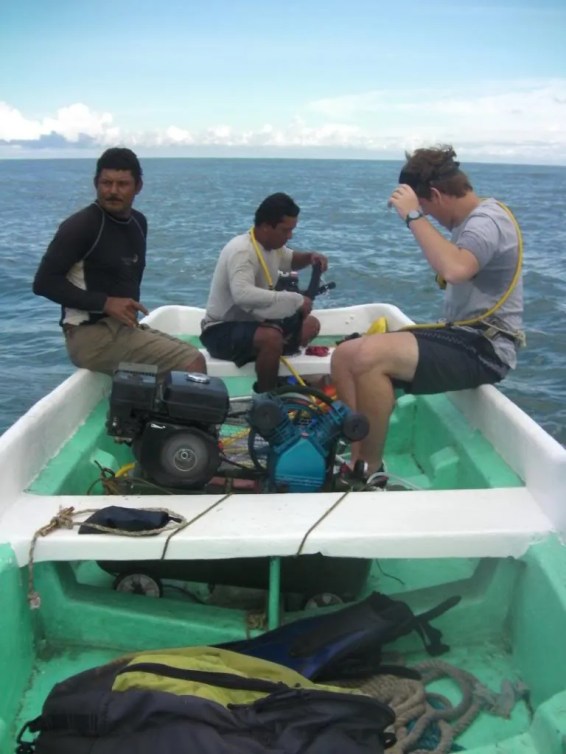
This morning Pierre and I got up early to go on a scuba fishing expedition with Jacinto and Juan. Using a kayak to cross the wide and deep channel the sea was cutting into the estuary, we headed to a spot where the waves were a bit calmer, and the fishermen came in a small motorboat to take us over to the Eco I. Unfortunately, it turned out that the smaller boat was to be our vessel for the morning, since the Eco I was out of fuel. A green air compressor machine sat in the middle of the boat, and the long air hose sat coiled at the bow with a couple pairs of flippers and snorkel sets.

Pierre and I installed ourselves at the stern and started putting on sunscreen. “The water visibility is a bit low today, but we will try to find some lobsters,” said Jacinto in Spanish. Juan drove the boat past Morgan’s Rock and close to the rocks on the next cove over. Then he handed the tiller to Jacinto and started pulling on some flippers, signaling for me to do the same. The two fishermen showed me how to operate the air regulator, which was the same sort found on a tank scuba set, and they helped tie the hose so that it fell over my shoulder and across my back.

Continue reading →

Arthropods and Sunsets

While walking on a trail today, Pierre and I came across a spider with a lime green back. As we approached it, it bared its behind at in our direction and dripped forth some dangerous-looking white liquid. They were very small droplets that didn’t spray towards us, but merely fell down to the dirt below the web. We paused to photograph this spider, keeping our distance in case what we had witnessed was just the priming of a more serious discharge mechanism, and then went on our way.

As I thought back on this spider I realize that we may have simply walked in on its moment of defecation, and incorrectly interpreted the droplets of excrement as an attack. A quick Ecosia search showed me that spiders’ poo is often white liquid that leaves a chalky residue, so I am starting to believe that what Pierre and I saw was not a direct assault but perhaps still a method of self-defense in some cases.

What we watched later in the day, however, was a clear attack. A millipede (which I incorrectly identify as a centipede in the short video I took) was beset upon by a fast-moving bug that darted at its writhing, myriapodous prey without mercy. Unfortunately, Pierre and I were on the way to Sunset Hill (see my previous post) so we had to leave at the risk of missing what we hoped would be a great view of the sunset.

When we got to the top of the hill, we were rewarded with the best sunset I’ve seen from the point so far out of the three times I’ve been up there. I think the better sunsets must be during the dry season, when there aren’t quite as many clouds covering the sun as it descends over the ocean horizon.

Kayak Surfing with a Friend

Today I met Pierre de Chabannes, a young Frenchman interning at the Ponçon’s La Cumplida farm in Matagalpa. A student at a French University, he is working on repairing and improving the current hydroelectric dam/canal system in place at La Cumplida so that the farm can produce enough electricity to supply the surrounding area in Matagalpa.

After showing Pierre around the ecolodge, we decided to go kayaking in the cove. We went out past Morgan’s Rock and then crossed over to the other side of the cove before returning to the coast, where we caught a wave onto shore and tried surfing a couple times. Eager to surf some more, Pierre switched his seat to the back of the kayak (we’d had them in the middle), where he thought it would allow him to control the direction better, as well as prevent the nose of the kayak from plunging into the water and causing a flip (which had happened to both of us already). Controlling the direction was also useful because we had both been pushed parallel to the wave we were riding several times despite out best efforts. When he switched to the back seat, Pierre surfed all the way to shore with little difficulty, so I soon made the same change. Continue reading →

Central American Pygmy Owl

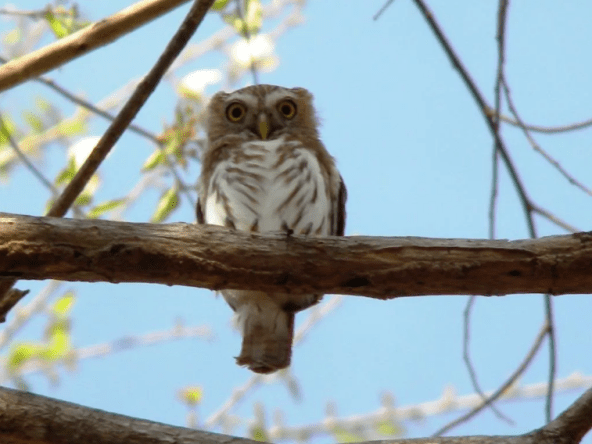
Today Harvey and I went on a nature walk with a couple guests from California. Interested in seeing birds, they had brought a pair of binoculars along, which we soon had an opportunity to use. We were walking along what seemed a deserted trail when Harvey suddenly motioned for us to stop and pointed up into the trees on our left. We saw nothing, and Harvey had to lead us along the branches with his finger to show the little fist-sized lump of white and light brown that was a pygmy owl. With the help of the binoculars and Harvey’s guidebook, we were able to identify it as a Central American pygmy owl. Without the binoculars it would have been impossible to distinguish between the three or four species of owl, since they are all roughly the same color and only differ in markings and patterns on their chest, head, and tail feathers. Although I couldn’t get a picture since it was too far away (still no zoom on the camera), here are some photos that Bismar took last summer, the season when trees’ foliage is much less dense and in some cases nonexistent.

It is winter (the rainy season) here now, and therefore very impressive that Harvey was able to spot the tiny bird through all the leaves without the help of a flashlight at night, which is when one usually sees the owls.

A Kipling Character at Morgan’s Rock?

It happened today.

I was on the Campesino Breakfast Tour with guests. We drove through the finca till we got to the Aguacate Farm, where the chickens, ducks, and cows are kept. Don Juan taught us how to milk a cow; the lactating mother was mooing with discomfort, eager to be relieved of her burden. Sitting on a one-legged stool that was tied to his waist, Don Juan expertly sent streams of white into a gray pail, and the guests crouched to do the same with early morning alacrity.

We filled up the pail, thanked Don Juan, and made our way to the chicken barn. Through the dim light and faintly unpleasant smell, about 180 chickens skittered about, clucking indignantly at the disturbance. A rake and shovel leaned against the wall, a wooden stick with little rawhide strings hung from a column, and a leather belt was wound around a rafter in the corner. The man who takes care of the chickens took Harvey aside and whispered something in his ear, then proceeded to lead the guests through the barn to show them the coops and water-troughs. While the guests were distracted, Harvey approached me.

And then it happened.

Continue reading →

Finca Work

I had more butterfly luck this morning when, exiting the trail from my lodgings onto a dirt road, I spotted a Hamadyas glauconome glauconome, commonly known as the Guatemalan or Glaucous Cracker, on a tree nearby. Although I didn’t know it at the time, the males of this species can create a cracking sound while flying. I had heard this sound from flying insects several times as I biked along the road during my stay here, but had never been able to identify the source. The specimen photographed here was a female, however, because once I got close enough to take the shot, it flew away silently. After breakfast, I was crossing the long suspension bridge that leads to the bungalows and one of the trees next to the railing, whose canopy was roughly level with the bridge, had flowers that had attracted another butterfly. Despite the length of time that the butterfly stayed at the flowers to collect nectar, I have not been able to identify it from the various photos I took, because it never opened its wings to show the markings that would give it away in a guidebook.

However, one animal I have been able to identify is a little lizard that I found while walking a trail. More specifically of the family Polychrotidae, or an anole lizard, the species I was lucky enough to encounter was the indigo-throated anole, Anolis sericeus. I have learned that all anoles have at least some ability to change color, they all have dewlaps, which are cartilaginous frills below the neck, and, like many lizard families, they can relieve themselves of their tail if sufficiently threatened. Fortunately my presence was only frightening enough for the anole to reveal its beautiful frill and, as I approached for a close-up, run off.

When I was done with my little hike, I headed to the finca, where I was to see the recently planted saplings and the cleaning of last year’s crop area. Continue reading →