Really, Cyprus?

100726_r19825_p646.jpgA couple of years ago a powerful essay by Jonathan Franzen in the New Yorker made us aware of and horrified about this practice.
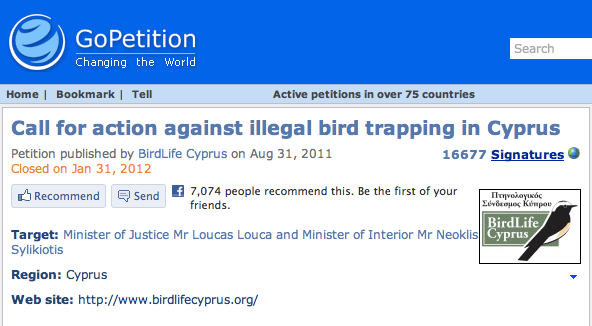
It is so full of disgusting detail related to this practice that, should you survive the nausea you will want to click the banner below and sign the petition.

Better late than never. Exactly six weeks after this petition was started, we have stumbled onto it.  Now, nothing to do but act:

Silent Spring At 50, Rachel Carson At 105

U.S. Fish and Wildlife Service Photo

The book is as important as ever. Its author, whom we pantheistically canonized once already in advance of this anniversary for the book, is worthy of some background reading. Click the image to the left to go to a post by the New Yorker‘s Archive Editor, which will link you to other pieces in the New Yorker by and about Rachel Carson:

“Silent Spring” has proved to be so important that Carson herself has been a bit overshadowed by it. When she finished “Silent Spring,” Carson was fifty-five. She’d had a lengthy, but nowadays easily overlooked, career as an award-winning, best-selling writer of natural histories—the sorts of books that are written, nowadays, by Richard Dawkins or Bill Bryson.

Conservation Measures With Serious Teeth

MEMORANDUM OF UNDERSTANDING ON THE CONSERVATION OF MIGRATORY SHARKS

After three meetings – the first in Mahé, Seychelles in December 2007, the second in Rome in 2008 and a third in Manila in February 2010 – the Memorandum of Understanding on the Conservation of Migratory Sharks was negotiated and signed. It commenced on 1 March 2010, the requisite number of signatures (ten) having been achieved in Manila at the end of the negotiations. Continue reading

Save Our Species (SOS) Needs Your Help

This slideshow requires JavaScript.

The IUCN released the most recent list of 100 Most Threatened Species last week.  Read it and weep.  Or get activated.  Look at what SOS is doing and see what you can do to make a difference.

11 Minutes Of Heroic Arctic Activism

From The Guardian’s website, in the Environment section, a bit of videography that puts the James Bond-type action films, which after all are merely entertainment without any deeper purpose, to a bit of shame:

Behind the scenes of Greenpeace’s Arctic oil protest Continue reading

Food, Storytelling & Art

Another session of Michael Pollan‘s course at UC Berkeley brings us back to the colorful, and colorfully clad, storyteller Peter Sellars, alluded to nearly one year ago.  Intensely bracing.  Give it the full 90 minutes it deserves (halfway through he begins making references to pre-vedic texts in India about food’s sacred role in life, and the importance of sharing it; at minute 56 he begins a very interesting discussion of Coca Cola in Kerala, and thereafter many references to wonderful phenomena in south India).

Socially Responsible Investing: An Ineffective Struggle or a Powerful Tool?

Barbara Krumsiek, President and CEO of Calvert Investments, has led the company for 15 years.

Two summers ago, I had the pleasure of working at Calvert Investments, a Bethesda-based socially responsible investing (SRI) firm. The words “socially responsible investing” would often raise eyebrows as I attempted to concisely describe to other hotelies at Cornell what exactly Calvert does. Socially responsible investing is broadly defined as a holistic approach to investing that considers both the economic and social/environmental returns of your money. Although SRI accounts for less than five percent of all general investment funds, it is a growing field with potential. Cornell’s business school has had some interesting takes on this asset class.

So what does SRI look like? There are many different approaches, so I’ll just describe what Calvert tries to do. From Calvert’s view, it is an extensive process of research, indexing, and investing. First, we perform research on firms that we potentially want to invest in or that our clients are asking us to invest in. The research is comprehensive and looks primarily at environmental, social, and governance (ESG) issues for a specific company. For example, imagine that we’re considering to invest in BP. Some of the research we might do would ask these types questions (again, these are hypothetical, and they only skim the surface):

  • Environmental factors: How many oil spills have there been in the past year? What environmental remediation plans are in place? Is in-depth environmental training provided for employees? Does the firm mine/drill in high-risk areas?
  • Social factors: Are workers paid a living wage? Does the firm employ child labor overseas? What human rights violations has the company committed?
  • Governance factors: What proportion of women make up the board of directors? Has the company been investigated for anti-competitive activities? Has the firm been investigated by the SEC for trading violations? Have there been attempted hostile takeovers?

Continue reading

Michael Pollan, Food Activist In Journalism Professor’s Clothing

Thanks to The Edible Schoolyard Project and UC Berkeley, Michael Pollan‘s course about the challenges and opportunities of our food system is offered for all of us to share in.  Course Description:

As the costs of our industrialized food system—to the environment, public health, farmers and food workers, and to our social life—become impossible to ignore, a national debate over the future of food and farming has begun. Telling stories about where food comes from, how it is produced—and how it might be produced differently—plays a critical role in bringing attention to the issue and shifting politics. Each week, a prominent figure in the debate explores: What can be done to make the food system healthier, more equitable, more sustainable? What is the role of storytelling in the process?

Fighting Fire With Fire

This isn’t the first time we’ve applauded local libraries taking a stand to protect their place in public service. But the particular example above is prime in terms collective action lassoing social media.  Kudos to Leo Burnett/Arc Worldwide agency for campaigning the hoax, and hurray for yet another library with the backbone to publicly roar.

Troy Public Library would close for good unless voters approved a tax increase. With little money, six weeks until the election, facing a well organized anti-tax group who’d managed to get two previous library-saving tax increases to fail, we had to be bold. We posed as a clandestine group who urged people to vote to close the library so they could have a book burning party. Public outcry over the idea drowned out the anti-tax opposition and created a ground-swell of support for the library, which won by a landslide.


Droning On About Conservation

In a world where funding for national parks and rangers isn’t always in the budget, conservationists have to look to technologies to help protect the millions of acres that some of the world’s most threatened species make their home.  The World Wildlife Fund has developed remote controlled planes that use simple enough technology to be launched by hand and be powered by rechargeable electric batteries.  Click the image above to go to the story in the BBC:

Conservationists in Nepal will soon start using special drones…developed by the global wildlife organisation, WWF. Continue reading

Grumpy, Bird-loving Awesomeness

What if every artist made a love pact with something, anything, in the natural world?  Mr. Goldsworthy, we noted after a recent post, had already made (to our eyes, a similar cairn included) such a pact a long time before his Australia work.  Mr. Franzen, as we shall highlight as often as we can here, has made such a pact with birds.  Walton Ford, in phantasmagorical manner, check. And this fellow, on the sands down under, too.  More!

Creative, Effective, Collective Action

Thanks to our friends at Colossal for pointing us here:

I can’t speak from personal experience about the political climate in Yekaterinburg, Russia but if we take this video from the ad agency Voskhod at face value it appears the powers that be neglected the city’s infrastructure one day too long. Continue reading

Ancient Activist Pastime

Click the banner above for this article in which Rebecca Solnit discusses urban agriculture, aka gardening, as a revolutionary act of enormous import for our modern times:

We are in an era when gardens are front and center for hopes and dreams of a better world or just a better neighborhood, or the fertile space where the two become one. There are farm advocates and food activists, progressive farmers and gardeners, and maybe most particular to this moment, there’s a lot of urban agriculture. Continue reading

“The Wheelchair Is A Portal…”

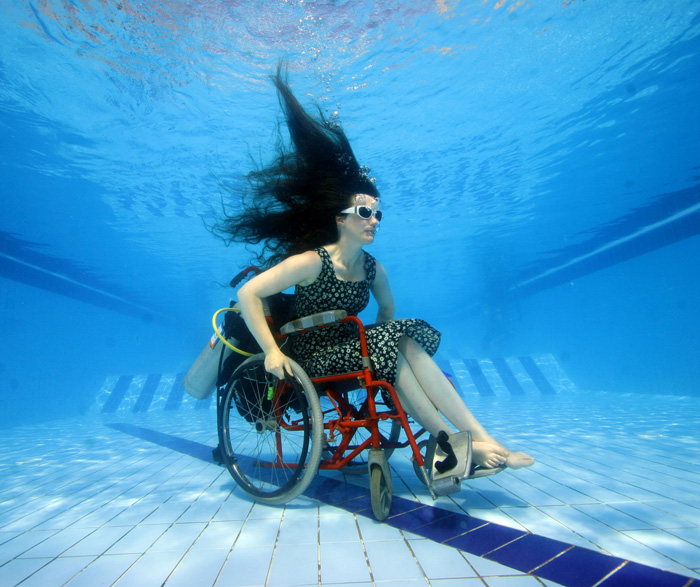
In coordination with the 2012 Paralympics British performance artist Sue Austin has revised her 2008 project “Portal” into “Creating the Spectacle!”, a piece that literally sends ripples across the divide between spectator, audience, galleries and stage.

The focus of the project has shifted from being about transforming preconceptions about the wheelchair to a more global perspective that we all have issues to transcend… Continue reading

Activist Art Collective

Click the image above for more information on the group’s current activities, but their founding mission and recent past actions seem promising:

…We aim to free art from the grips of the oil industry primarily focusing on Tate, the UK’s leading art museum, and its sponsorship deal with BP. Continue reading

Paul Watson, Sea Shepherd & The Rogue’s Gallery Of Nations After Him

A woman with a Sea Shepherd tattoo, the organisation of marine conservationist Paul Watson (not pictured). Photograph: Thomas Peter/Reuters

Quite a few of us contributing to this site have called Costa Rica home at one point or another and it is probably fair to say all of us admire and respect that country’s pioneering role in modern conservation schemes.  For some of us, it was literally the country that inspired us to do what we do.  But no country is perfect, and at least in one current affair Costa Rica seems to be playing the stooge.  Shame on Germany and especially Japan for their leading roles in this farce. Costa Rica’s official abandonment of its core values should not be winked at, even by those of us who otherwise love the country and its people.  Paul Watson deserves our attention and support (click the image above for his editorial in today’s Guardian, which has played its fourth estate role well in this affair):

I must serve my clients, the whales

I can do that far better commanding the Sea Shepherd fleet than I can defending myself from bogus charges by Japan