World Elephant Day

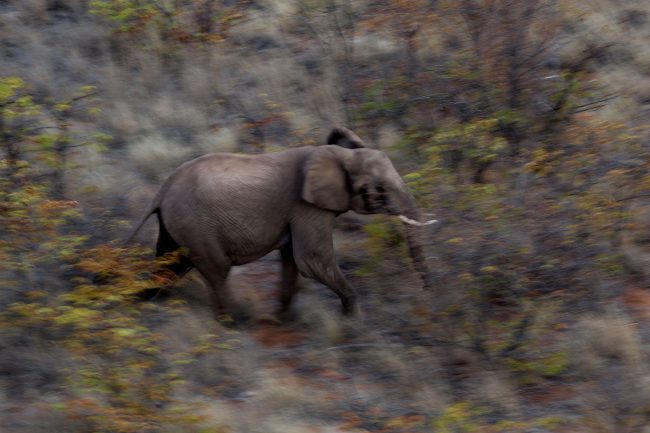
23 July 2018. Elephant Relocation from Venetia Limpopo Nature Reserve (South Africa) to Zinave Reserve (Mozambique). Picture: JAMES OATWAY

Our fascination with elephants is evident throughout the history of this site, and are heartened by actions taken toward increased conservation of these magnificent animals. Relocating large African mammals to new protected areas due to either habitat loss or overpopulation has successfully been done before, but the challenges continue.

Giants on the Move

Written by Patricia Sims, Co-Founder, World Elephant Day

Each year for World Elephant Day we put a lot of our elephant conservation attention toward the ivory poaching crisis threatening African elephants, and the tourism and captivity issues that the endangered Asian elephants face. Yet the larger conservation challenge of habitat loss for both African and Asian elephants is looming. Our increasing encroachment on elephant habitat throughout Africa and Asia is putting elephants at greater risk, resulting in human-elephant conflict issues, and the demise of elephant populations and the ecosystems that they, as a keystone species, maintain.

So what are the solutions? Can moving elephants – from one location where there isn’t enough space for them – to another location where there aren’t enough elephants, help solve this issue? At the heart of this critical elephant conservation conundrum is a partnership between the De Beers Group – the world’s leading diamond company – and Peace Parks Foundation, a leading not-for-profit organization focused on the preservation of large cross-border ecosystems. They have just completed the first phase of the largest and longest translocation of elephants ever recorded in South Africa. This translocation project is called “Moving Giants.

Continue reading

Virtual Immersion In Wilderness Via Live Feeds

Thanks to Rachel Riederer for this:

Bear Cam’s Captivating, Unedited Zen

Riederer-Bear-Cam.jpg

It’s innately satisfying to see a bear grab ahold of a salmon with its mouth and trundle off into the shallows with the fish still flapping in its jaws. Photograph by Jennifer Leigh Warner / Barcroft / Getty

One recent afternoon, I found myself spellbound by the brown bears of Alaska’s Katmai National Park, and spent longer than I care to admit watching them fishing and feasting on the sockeye salmon of Brooks Falls. Several bears stood in the water, facing the falls. They didn’t interact with each other much—at least not in a way that was legible to me—but quietly went about the business of fattening up for winter. I watched these Internet stars through a live stream popularly known as the bear cam, which provides a counterpoint to the hyper-produced prestige nature documentaries that use music, high-definition videography, and delicately placed cameras to turn wildlife activities into dramatic cinema. If “Planet Earth” is a Michael Bay production, the bear cam is not even a home movie—it’s CCTV. Continue reading

Adaptation’s Appetite

merlin_138614541_c4902893-8458-4d2d-ab11-fa10c796102c-jumbo

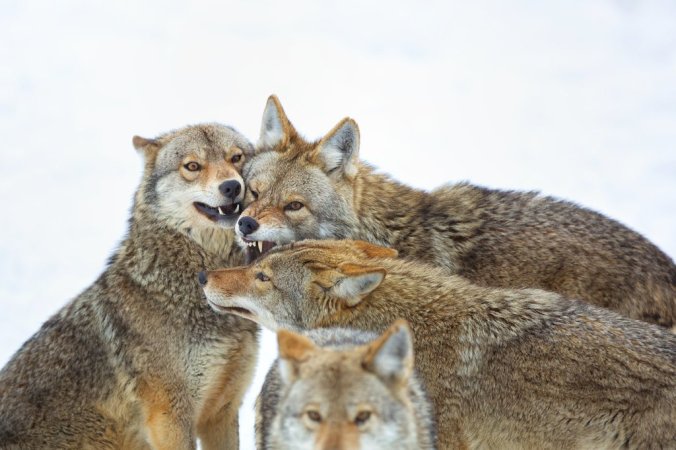
“They have to be one of the most adaptable animals on the planet,” said one ecologist who studies coyotes. Credit Perry McKenna/Getty Images

On this platform we have been in favor of celebrating conservation rather than doomsday. Science is key, but we also think entrepreneurship can be harnessed in the right direction, publicly and privately. There is not much to celebrate in the following story. The animals in the photo above, without any further details, could be granted wild beauty status. But context is everything. So we celebrate the writers who illuminate important scientific ideas, and their stories. Thanks to JoAnna Klein, who we have linked to many times (but missed this related recent story) for providing those details:

Coyotes Conquered North America. Now They’re Heading South.

New maps seek to update the historical range of our continent’s toughest canids, which have thrived as other predators experienced decline.

merlin_138614523_660b4fa1-90b1-49ed-8678-6322959a59e1-jumbo

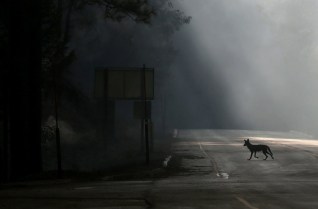
A coyote crossing U.S. Highway 120 near Groveland, Calif. Credit Justin Sullivan/Getty Images

Coyotes are excellent colonizers.

They breed fast, eat almost anything and live just about anywhere. You can find them in fields, forests, backyardsparks and even parking decks. They’re living in cities like Los AngelesNew York and Chicago. They’ve even made it to the Florida Keys and Long Island. In 2010, they crossed the Panama Canal. Now, the only thing keeping them from entering Colombia is a dense patch of forest called the Darien Gap. And camera traps have caught them heading that way. Continue reading

Us & Them Instead Of Us Versus Them

Thanks to Emily Buder at the Atlantic for this five minute recommended viewing. In the video above, by Nani Walker and Alan Toth, the question is:

Can Humans and Lions Get Along?

“Lions are really causing us havoc,” laments an African pastoralist in Nani Walker and Alan Toth’s short documentary, Living with Lions.  Continue reading

The Wisdom Of Wolves

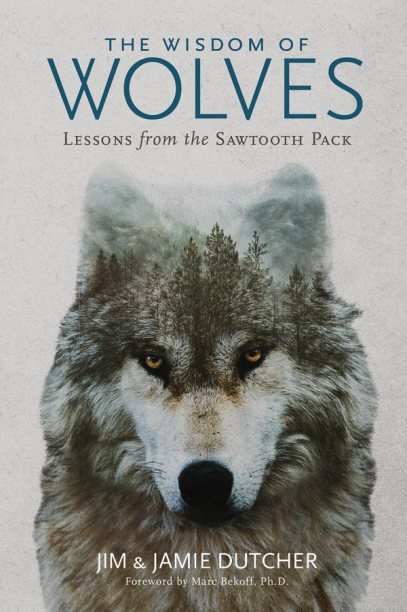
WisdomofWolvesCover.600x900.jpgWe first heard of the book here, so thanks to Public Radio station WNYC. However, in the blurb for the podcast interview with the authors, the link to the book went directly to Amazon. Must it forever more be so? Hope not.

So, click the image to the left to go to the actual source of the book, which seems a more worthy place to consider purchasing it, even though here too they give you the option to buy on Amazon. But there is a slight favoring of the publisher, National Geographic, in the purchase options. Here’s what they say:

CURIOSITY. COMPASSION. FAMILY FIRST.

After living among the wolves of The Sawtooth Pack for years, Jim and Jamie Dutcher present a new book, The Wisdom of Wolves: Lessons from the Sawtooth Packproviding groundbreaking observations of their unique experience.

As strong, and just as immediately recognizable as the ties that unite a human family, the emotional bonds shared among wolves are far more complex than ever realized, and now are detailed in this exceptional book. Continue reading

Animalism, Eel Episode


Thanks to the Atlantic’s Ed Yong for this four minutes of wonder:

It’s a remote control.
 It’s a tracking device.
 It can deliver shocks of up to 600 volts. You think the electric eel is shocking? You haven’t seen anything yet. In this episode of Animalism hosted by The Atlantic science writer Ed Yong, we investigate the subtle and sinister ways of the electric eel.

Instagram’s Hashtag Alerts to Highlight Animal Abuse

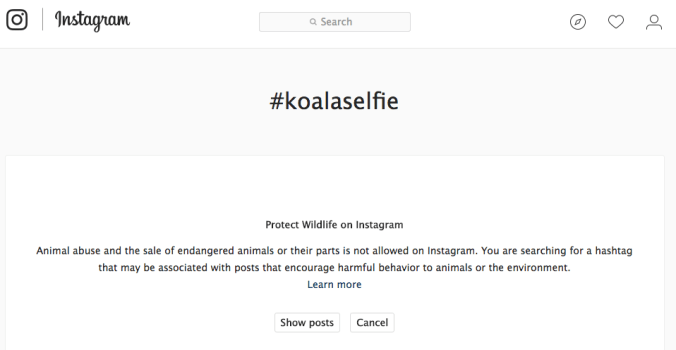
This is the message that now appears on Instagram if you search for a hashtag like #koalaselfie

I post on Instagram a couple times a month, but I often browse pictures on the app at least once a day. I can’t say that I’ve encountered photos like those described in the NatGeo article below, but I’m still thankful that Instagram is taking action to try to keep it that way, by pointing out to people using certain hashtags involving wildlife that the animals may be suffering behind the scenes:

Instagram is rife with photos of cute wild animals—including the exotic and endangered. A picture of someone hugging a sloth or showing off a pet tiger cub is just a click away on the massively popular photo-sharing platform, which serves 800 million users.

But starting [December 4th], searches for a wide range of wildlife hashtags will trigger a notification informing people of the behind-the-scenes animal abuse that makes some seemingly innocent wildlife photos possible.

Instagram will now deliver a pop-up message whenever someone searches or clicks on a hashtag like “#slothselfie.” The message reads, in part, “You are searching for a hashtag that may be associated with posts that encourage harmful behavior to animals or the environment.”

Continue reading

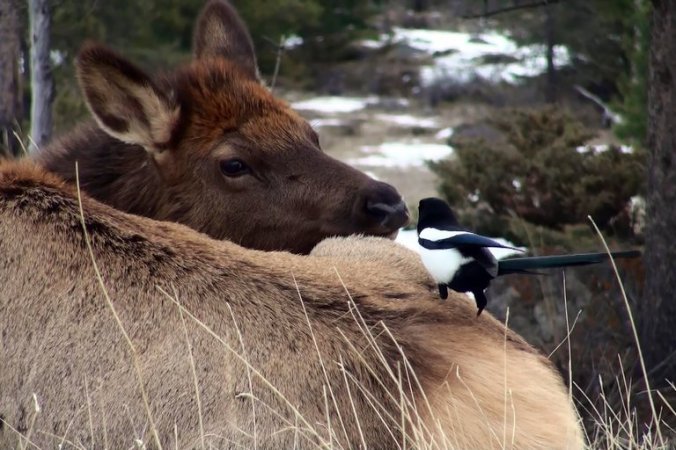
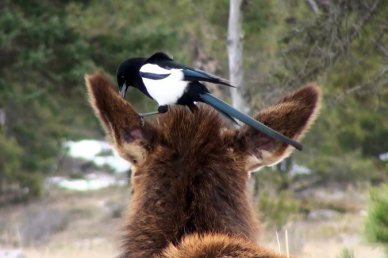
Magpie & Elk, Collaborating

merlin_130680086_37fe49c2-e83c-4b1d-87f9-afbbc6c6f808-master768

A magpie on an elk in Alberta, Canada, looking for winter ticks. Credit Rob Found

Thanks to the Trilobites feature on the New York Times website for this story of collaborative friendliness between species:

Chances are that’s a shy elk looking back at a bold magpie, in the photograph above.

merlin_130680083_3390ebbf-fde1-4f33-ba90-c09822dd4bab-master675

Scientists wonder if shy elk compensate for their bashfulness by accepting the grooming magpies. Credit Rob Found

They get along, so to speak, because the elk needs grooming and the magpie is looking for dinner. But they may have never entered into this partnership if it weren’t for their particular personalities, suggests a study published Wednesday in Biology Letters.

Let’s start with the elk. In Canada’s western province of Alberta, they’ve been acting strange. Some have quit migrating, opting to hang around towns with humans who protect them from predators like wolves. Others still migrate. Continue reading

Rewilding Europe, Alive & Well


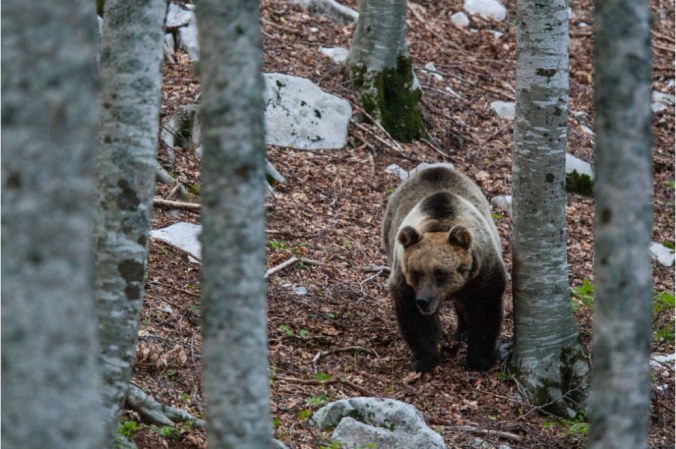
RewildBear

Salviamo L’Orso is committed to conserving the critically endangered Marsican brown bear (pictured here in its central Apennines habitat), and has already won many grants for its grassroots projects. Bruno D’Amicis / Rewilding Europe

It has been some time since we regularly featured news on the topic of rewilding. This announcement is as good a reason as any to revisit rewilding:

A Salviamo l’Orso project titled “Let’s take action for the Bear” was approved for funding by members of EOCA in early November, together with four other proposals from around the world.

With only 50 to 60 individuals remaining, all living in a relatively small area of the Central Apennines, the endemic Marsican brown bear (Ursus arctos marsicanus) is today critically endangered. The Salviamo l’Orso project, which comprises four conservation activities, will enhance the habitat of these magnificent animals and hopefully help them to expand their home range. Continue reading

Ant-Hunting Dogs

08TB-TOBIAS1-master768

Kyren Zimmerman and Tobias — a Labrador retriever who specializes in sniffing out the invasive Argentine ant — on Santa Cruz Island, in the Channel Islands National Park. Credit Gary Andrew/The Nature Conservancy

Ants are the masters of the planet we live on. There is no escaping that. But if these dogs can protect us from some of the more sinister ants, we have these trainers to thank:

A Very Good Dog Hunts Very Bad Ants

Tobias is a Labrador retriever with one job: sniffing out invasive Argentine ants wherever they hide. He’s really good at it, and with his help, a fragile island ecosystem may be spared a repeat inundation with the pests.

Santa Cruz Island is 25 miles off the coast of Southern California, part of Channel Islands National Park. The island’s rich, rugged environment — which includes more than 1,000 kinds of plants and animals, including the bald eagle and the island fox — is threatened by Argentine ants, one of the world’s most successful and wily invasive species. Continue reading

Bats & Social Mechanisms Of Learning

Bats.jpg

The social and vocal interactions of a colony of fruit bats competing for position in a sleeping cluster. By LEE HARTEN on Publish DateOctober 31, 2017. Photo by Mickey Samuni-Blank.

Yesterday’s topic touched on a taboo of sorts, but in the interest of furthering our understanding of one of the most remarkable organisms on the planet; today, likewise, thanks to Steph Yin for her note on creatures sometimes considered creepy but whose environmental services are remarkably valuable:

Teaching Bats to Say ‘Move Out of My Way’ in Many Dialects

I was raised by grandparents who spoke only Mandarin, so I did not speak English until I went to preschool in Philadelphia. There, guided by English-speaking teachers and surrounded by toddlers babbling in loose English, I adopted the new language quickly.

Young bats may not be so different. Continue reading

Pumas Are Not Such Loners After All

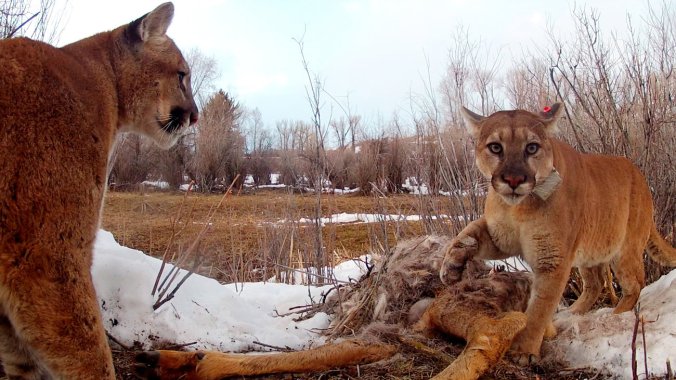
puma-1_wide-34b6cb9c5551bd1d1eab4ca1aaaeb7f7de9f3312-s1300-c85.jpg

Adult female with young male coming in (without collar) to her kill. Mark Elbroch/Panthera/Science

Thanks to National Public Radio (USA) for this latest news on one of our favorite species:

Supposedly solitary pumas actually hang out with their fellow big cats quite often, frequently coming together and hissing and snarling before settling down to share a delicious elk carcass.

That’s the startling discovery made by scientists who recently tracked 13 pumas — also called mountain lions or cougars — and set up cameras at kill sites. They recorded dozens of peaceful social interactions between these elusive felines. Continue reading

Conservation Via Valuation

When we consider that cat sightings play an important role in why our guests come to Chan Chich Lodge, this type of valuation is something we can get behind whole heartedly. Thanks again to the Anthropocene for this interesting piece of daily science. And thanks again to Panthera.org for their role in the research.

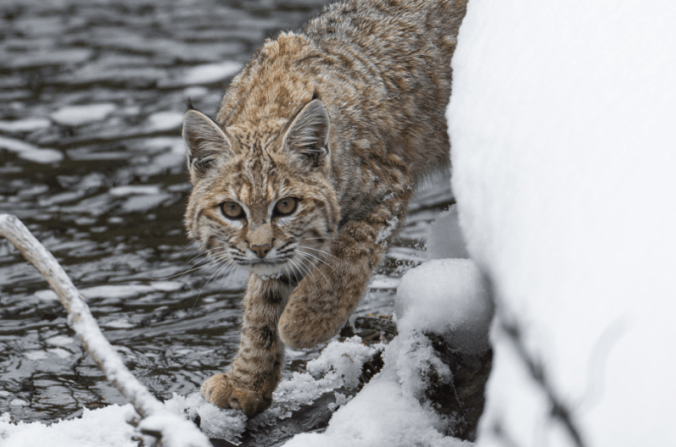
The lesson of the $300,000 bobcat

What is a bobcat worth? There’s a few ways of thinking about that question. One answer, of course, is that a bobcat’s value is intrinsic, their lives not something to signify with a price tag. Fair enough. But for the sake of discussion, and because there’s already a market for their hides, let’s run the math: in the state of Wyoming, a bobcat is worth roughly $300 dead and up to $308,000 alive. And in that vast difference is a tension — some would call it a flaw — in the way these marvelous cats, and many other species too, are presently managed in North America.

The calculations come from a study recently published in the journal Biodiversity and Conservation. Led by Mark Elbroch, a biologist with Panthera, the wild cat conservation organization, and also featuring researchers from wildlife advocacy group Wyoming Untrapped, the researchers totaled the revenues generated in 2015-2016 from selling trapping licenses in that state — $152,000 — and divided them by 1,160 bobcats killed, then added the average sale value of pelts. The final per-bobcat value came to $315.17.

Then Elbroch’s team turned to the example of a bobcat living along the Madison River in Yellowstone National Park, where his predilection for hunting waterfowl made him popular among wildlife lovers. They surveyed 46 photographers who traveled to Wyoming in winter 2015-2016 and the outfitters who guided them. Between outfitters’ fees, money spent on food, lodging and travel, and revenues from selling pictures, the bobcat generated $308,105, or a thousand-fold increase from his worth as a source of fur alone.

The researchers don’t argue that every living bobcat in Wyoming is worth more than $300,000.

Continue reading

Wildlife Protection And Unintended Consequences

15tb-wolves02-master768

A wolf from a den within Yukon-Charley Rivers National Preserve in Alaska. A study found that limiting the population of wolves outside the preserve affected those within its boundaries. Credit Drew Rush/National Park Service

Mention Alaska, and we are in. Wolves, ditto. An academic publication called Wildlife Monographs? You had us at Alaska and wolves:

Protected Wolves in Alaska Face Peril From Beyond Their Preserve

Within the 2.5 million acres of the Yukon-Charley Rivers National Preserve in central Alaska, wolves and other majestic animals are protected. But animals like wolves do not respect lines drawn on a map. And a recent study suggests that efforts to limit populations of these predators outside those borders is having negative effects on wolves living within the preserve. Continue reading

Maternal Instinct vs Species Survival

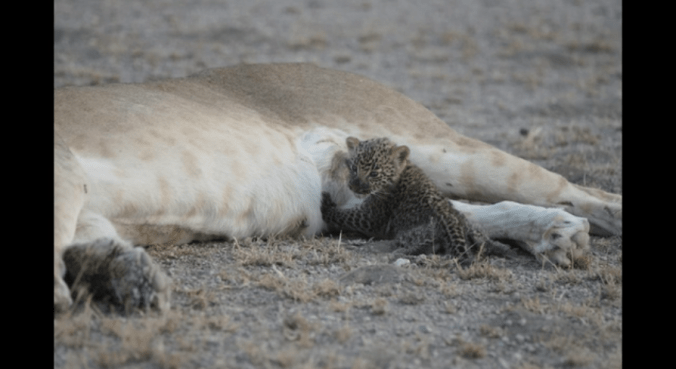
©JOOP VAN DER LINDE/NDUTU LODGE

The more time we spend at Chan Chich Lodge the more we see the seasonality of birth patterns in the wild. There clearly seems to be a “baby season”, that starts with the cats and moves down the food chain to their mammalian prey, as well as birds. Although no photo captures, several jaguar cubs were sighted earlier in the year, followed by dozens of fawns and baby collared peccary. Even the Gallon Jug Farm has welcomed 4 baby horses to the fold, with a fifth on the way…but we’ll talk about that another day.

This unusual news from Panthera.org, an important Big Cat Conservation NGO who uses our 30,000 acres as part of their Jaguar Corridor research, perhaps makes a little bit of sense within the context of those patterns.

We thank Susie Weller Sheppard for sharing these field notes.

Earlier this week, Panthera President and Chief Conservation Officer Dr. Luke Hunter received photos from our partners at KopeLion with some astonishing content: the first-ever evidence of a wild lioness nursing a leopard cub.

Taken on Tuesday by a Ndutu Lodge guest in Tanzania’s Ngorongoro Conservation Area, the images show a 5-year-old lioness, known locally as ‘Nosikitok,’ suckling a leopard cub estimated to be just 3 weeks old. Continue reading

The Fairest Of Fair Tigers

1103.jpg

A rare ‘pale tiger’ discovered in the wilds of Tamil Nadu state in India. Photograph: Nilanjan Ray

We have heard and read plenty about pale ale, which is often associated with India, but this is the first we are hearing of a pale tiger, in India or elsewhere:

Exceptionally rare ‘pale tiger’ photographed in the wild

Animal spotted by photographer in jungles of southern India may be the fairest known tiger living outside captivity

A rare “pale tiger”, whose fur conservationists say could be the fairest of any in the wild, has been photographed in southern India. Continue reading

Understanding Tapir

04tb-mammal-master768

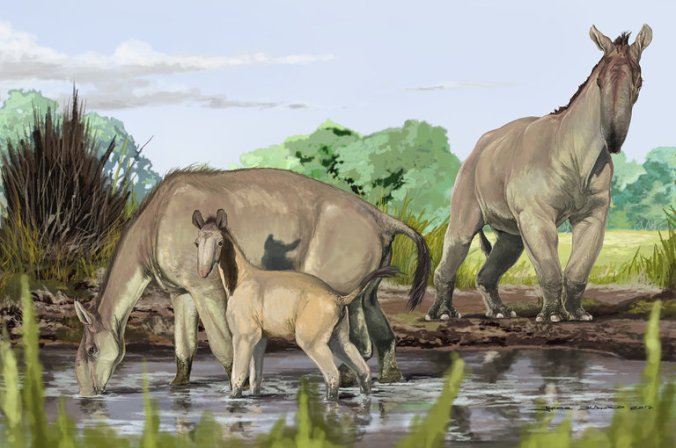
Fossils of Macrauchenia patachonica, as depicted in this artist’s reconstruction, baffled Darwin. The odd mammals disappeared about 12,000 years ago. Credit Jorge Blanco

I am sure I remember seeing these in my childhood collection of books with pictures of prehistoric creatures. Like many boys, the saber-tooth tiger was a favorite, which may explain my preoccupation with the big cats at Chan Chich Lodge. When you favor cats, you get to know their diet, so creatures like these in the image above were also among those I was fascinated by, which would explain why the tapir I have seen in the forests surrounding Chan Chich are among my lifetime favorite wild animal sightings. Thanks to Steph Yin for this story:

Strange Mammals That Stumped Darwin Finally Find a Home

It looked like many different animals and, at the same time, like no other animal at all.

From afar, you might think it was a large, humpless camel. Tall, stout legs ending in rhino feet carried a body weight potentially equal to that of a small car. Its neck stretched like a giraffe’s before giving way to a face resembling a saiga antelope’s. From this face extended a fleshy protuberance, similar to a mini elephant trunk or a tapir’s proboscis. Continue reading

Mobula Rays Jumping Again

Back in August, I shared a short video of this behavior that didn’t do the phenomenon justice. Now, with a couple months of filming opportunities behind me, I’ve been able to put together a much more satisfying compilation of jumping behavior footage:

My previous video of mobula rays jumping Continue reading

Night Vision

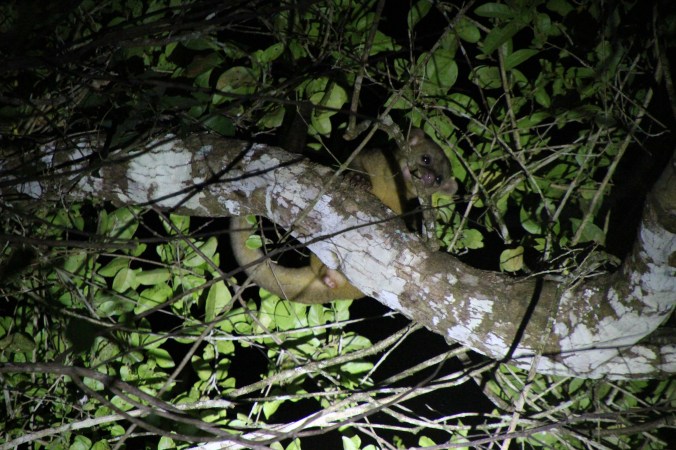
IMG_5769

After my first few nights at Chan Chich, I quickly learned that the jungle activity changes a bit in the night time. Bats swoop through the air, the sounds of howler monkeys reverberate off of the trees, and cane toads hop across my path.

So of course, when the opportunity arose to go on a night ride I was eager to see what would be in store for me. While I knew it would be foolish to hope for a jaguar sighting, I set out taking comfort in the fact that at least my chances would be higher than if I had stayed in for the night. What I didn’t count on, however, was my inherently poor ability to spot wildlife in the darkness.

Continue reading

Rabbit Returning

Released_NEC_TomBarnes_USFWS1-1260x708.jpg

Zoo-bred New England cottontail being released. Photo © Tom Barnes / USFWS

Thanks to Ted Williams at Cool Green Science for this story:

Recovery: Second Chance for Yankee Cottontails

Stunned but delighted is how Dr. Robert McDowell, Director of Wildlife at the University of Connecticut, sounded when I arrived at his office to learn about New England cottontail rabbits.

Finally someone other than himself was interested in these vanishing natives. We pored over skulls and skins and vainly patrolled early successional woods for live specimens. McDowell seethed about the mindset of state fish and game bureaucrats: we can’t waste time on a few native rabbits when we have so many look-a-like non-natives and when license buyers want more pheasants, ducks and deer. Continue reading