High Line Skyline

An aerial shot looking down on the Washington Grasslands section of the park, with Rashid Johnson’s artwork Blocks and Yutaka Sone’s Little Manhattan visible, both 2015 Commissions.

Railroads were one of the most significant early forces of change to the landscape of North America.  They not only moved freight and people but they participated in opening up the newly formed National Parks to visitors with the creation of the now iconic grand hotels.

Some of the railway’s original train tracks were marked and put back in their original locations. You’ll see them throughout the park today. Photo by Rick Darke

But as roads began to rival rails the network underwent a steady decline, and fewer and fewer resources were being put into their maintenance.

Fast forward a century–give or take a decade–and we find railroads, or at least rail corridors, going back to one of their greatest historical traits; as a pathway to nature.

In the 1980s the U.S. Congress passed an amendment allowing the use of soon-to-be-abandoned rail lines for hiking and biking trails.The highly successful “Rails-to-Trails” program has lead to nearly 1,012 rail-trails in the U.S. with a total trail mileage of more than 11,000.

Not just a U.S. phenomenon, there are similar programs in Canada, Mexico, Europe and Australia, to name a few.  (Tasmanian Trail anyone?) Continue reading

Moving Through Space, Time, and Culture

Hundreds of years of studying physics has told us that the journey through time is linear, and only goes one way. Laws of gravity aside, travelling through space need not be linear – any course can be taken as we move through our lives. These videos were created on a journey through 1056 hours of time and 38,000 miles of space – but the cultures witnessed and experienced by the travelers  are innumerate.

[vimeo 27246366]

Continue reading

Happy Go Lucky

Aesop’s fables are full of opportunities for the modern reader, re-teller, or listener to imagine different interpretations.  Thanks to the efforts of these folks we can easily access those fables and make what we will of them.  A favorite of ours, for its versatility, is this one:

One fine day in winter some Ants were busy drying their store of corn, which had got rather damp during a long spell of rain. Presently up came a Grasshopper and begged them to spare her a few grains, “For,” she said, “I’m simply starving.” The Ants stopped work for a moment, though this was against their principles. “May we ask,” said they, “what you were doing with yourself all last summer? Why didn’t you collect a store of food for the winter?”

“The fact is,” replied the Grasshopper, “I was so busy singing that I hadn’t the time.”  “If you spent the summer singing,” replied the Ants, “you can’t do better than spend the winter dancing.” And they chuckled and went on with their work.

Continue reading

Flattering Mother Nature

The Art and Design worlds are constantly giving us examples of our interpretive abilities when it comes to nature.  In fact, the very roots of Art go back to those expressions. But if “Imitation is the Sincerest Form of Flattery” then scientists and engineers are also following the adage that “form follows function” in ways that have the potential to direct us out of some of our environmental problems.

Lindsey Doermann writes about how an elephant’s trunk, water strider’s legs, woodpecker’s beak, peacock’s feathers or a beetle’s back (to name a few) are inspirations toward conservation focused engineering.

Continue reading

Sculpteur Par Excellence

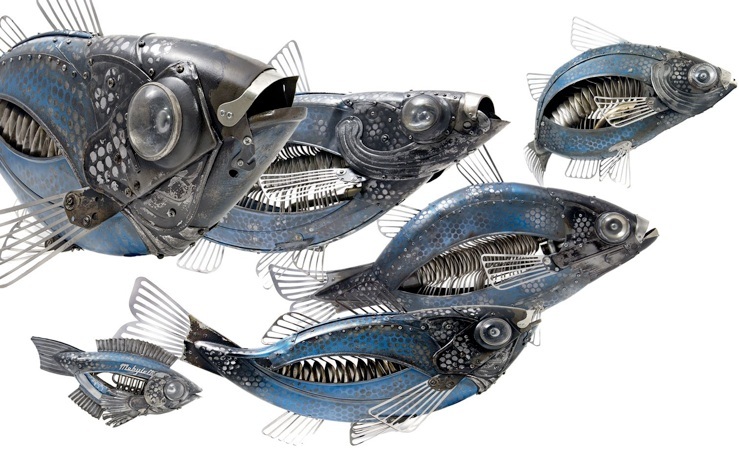
If you were as amused as we were by this animation, and especially if it gave you hope related to beautiful, if not organic, marine ecosystems of the future, then this display of sculpture is probably for you.  Edouard Martinet’s lovely and lovable marine life is rivaled by his entomological wonders, which you will see at his entry page but be sure to dig deeper to find the other lovelies.

From Sea to Sand

There seems to be no limit to the spirit of creativity!  Art often represents a “call and response” relationship to the natural world.

Water is elemental.  Earth and wind follow.   Are these the mechanics of life?

Honey, Hope & Future Cod

Milo’s post yesterday is of special interest to various initiatives we support related to food.  We will have much more to say on bees (and honey), but for now, it gets us thinking. Combined with Seth’s recent post, touching on the subject of overfishing (do read Mark Kurlansky’s books related to food, in addition to Cod), provide a reminder to stop and take a breath.  In a world full of challenges that daunting, how do we keep our wits about us?  How do we remain, fundamentally, hopeful?  An answer, but not necessarily with explanation, can be found sometimes in art (defined as you choose).  If we do not solve the tragedy of the commons with fisheries, might we still hope for a beautiful future for marine life that looks something like this?

Copyrights & Creativity

After a bit more investigation, without even getting any lawyer friends involved, it becomes clear that there is plenty of thought going into the question of how Alan Lomax might own some of Jay-Z’s stuff.  This simplifies the history for us: