Vatican’s Small Steps Toward Gender Equality

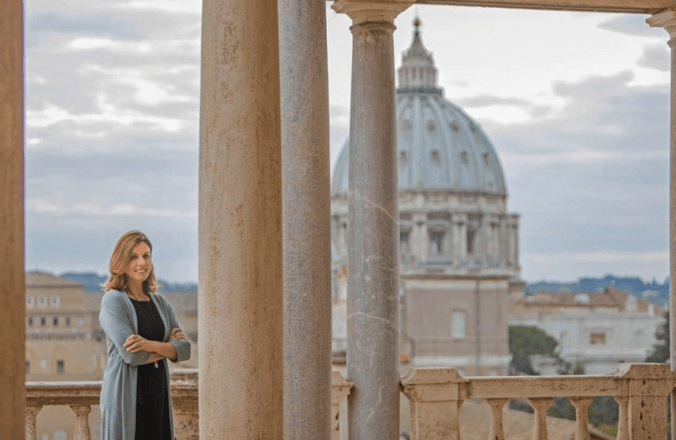
Barbara Jatta will oversee an institution that is one of the Holy See’s major sources of funds with about $311 million in gross revenues a year. PHOTO: VATICAN MUSEUMS

Barbara Jatta will oversee an institution that is one of the Holy See’s major sources of funds with about $311 million in gross revenues a year. PHOTO: VATICAN MUSEUMS

Without religious affiliation, we’ve applauded the current pope’s embrace of environmental protection and other progressive leaning policies. In a current political atmosphere where gender often overrides qualification, we appreciate this appointment all the more.

Pope Francis Names New Female Director of Vatican Museums

ROME—The Vatican Museums, one of the world’s pre-eminent art collections, announced Tuesday that Barbara Jatta, an Italian art historian and longtime Vatican official, will become its new director, making her the first woman to hold one of the most prestigious jobs in the art world.

The appointment by Pope Francis, which is effective Jan. 1, will also make Ms. Jatta the most prominent female administrator at the Vatican. The pope has spoken about expanding the roles of women in the Catholic Church, but most high Vatican offices are reserved for cardinals and bishops, who must be men. (Margaret Archer, a British sociologist, was named president of the Pontifical Academy of Social Sciences, an advisory body to the pope, in 2014.)

The Museums, which include priceless masterpieces including the Sistine Chapel frescoes by Michelangelo, regularly appear among the world’s top 10 museum complexes by attendance, with over six million visitors in 2015. The collections include 70,000 objects, dating back from antiquity through the 20th century. Continue reading

Organic, If Not Natural, Beauty

harvest5

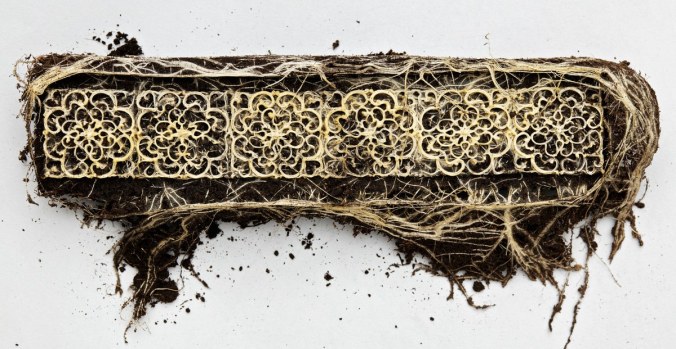
German artist Diane Scherer creates low-relief sculptures made from plant roots. DIANA SCHERER

Thanks to Wired for this bit of intrigue:

Artist Teaches Roots To Grow In Beautiful, Alien Patterns

by MARGARET RHODES

THE HUMAN RACE has a long history of bending nature to its will. The results of this relationship can be devastating—but they can also be strikingly beautiful, as German artist Diane Scherer skillfully proves with her low-relief sculptures made from plant roots.

Harvest2.jpg

Scherer grows these works of art by planting oat and wheat seeds in soil, and then carefully, meticulously, warping the growth pattern. DIANA SCHERER

Scherer grows these works of art by planting oat and wheat seeds in soil, and then carefully, meticulously, warping the growth pattern. She prefers to train her roots into geometric patterns found in nature, like honeycomb structures, or foliate designs reminiscent of Middle Eastern arabesques. Continue reading

New Directions In Art

shed1

flexn

Flexn artists, photo by Sodium for MIF 2015

We had not heard of Flexn until this week, when they were mentioned in a podcast with the phenomenal Peter Sellars (alluded to once previously in these pages, and linked to another time directly). Now we want to know more. And it looks like one way to learn more will happen at The Shed. Back in August, when we first heard about The Shed, it was a quick glance at the future. Now we have more detail, thanks to this early release of a profile in next week’s New Yorker:

ALEX POOTS, PERFORMANCE ART IMPRESARIO

How will the director of New York’s ambitious experimental cultural center change the city?

By Calvin Tomkins

Every so often, it seems, visual artists are stricken by the urge to perform. The “happenings” movement in the nineteen-sixties—young painters and sculptors doing nonverbal theatre—was explained as a response to Pollock, de Kooning, and other gestural Abstract Expressionists: it was the gesture without the painting. Continue reading

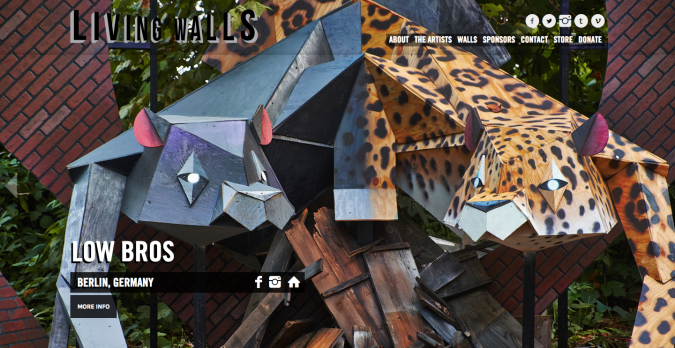
Living Walls

As Kochi is awash with participating artists putting finishing touches on their Kochi-Muziris Biennale works, it’s exciting to see art flourishing in other cities on a regular basis.

Atlanta’s Living Walls seeks to promote, educate and change perspectives about public space in local communities via street art.  Dozens of international artists participate in an annual conference on street art and urbanism that began in August 2010 in the city of Atlanta. Continue reading

Birds of a Feather

The fact that we’re rather “into birds” should come as no surprise to anyone giving even a quick perusal of this site. In addition to the birds themselves, we enjoy highlighting those who photograph them, those who paint them, those who study them, as well as those who craft them.  Continue reading

If You Happen To Be In Tokyo


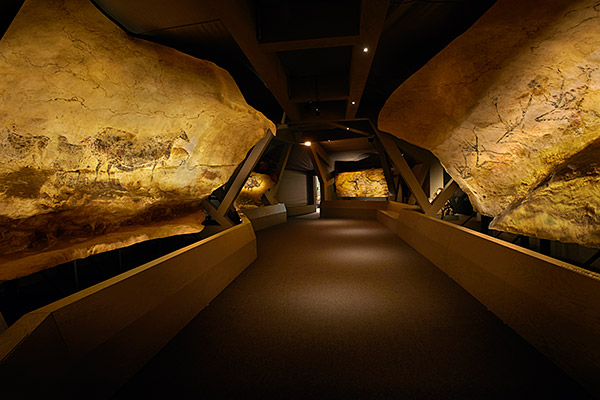
© SPL Lascaux international exhibition

© SPL Lascaux international exhibition

It’s the rare few who will have the opportunity to enter the original Lascaux Cave, but thanks to the foresight of the French government and the hard work of dedicated scientists and artists, an exact replica was opened in 1983 that gave visitors a chance to experience the amazing archaeological site. Nearly 20 years later additional replicas have begun to tour the world.

A few days ago we posted about Judith Thurman’s receiving a Medal of Chevalier in part for her inspiring writings about the Chauvet cave. It was a happy coincidence that the traveling exhibit had just opened in Toyko’s National Museum of Nature and Science.

The National Museum of Nature and Science, the Mainichi Newspapers, and Tokyo Broadcasting System Television, Inc. will hold a special exhibition, “Lascaux: The Cave Paintings of the Ice Age”, from Tuesday, Nov. 1, 2016 to Friday, Feb. 19, 2017. About 20,000 years ago, dynamic pictures of animals were painted on the walls of caves found in southwestern France, the Lascaux Caves. Continue reading

The Best Use We Have Ever Heard Of For A Taco Bell

30dealers1-master768-1

From left, Emma Fernberger, associate director of the Bortolami Gallery; the dealer Stefania Bortolami; and the artist Tom Burr in the former Pirelli Tire Company building in New Haven, where Mr. Burr plans an installation as part of the gallery’s “Artist/City” initiative. Credit Christopher Gregory for The New York Times

We do not bother complaining about fast food on this platform, but we are happy to pass along this story about re-purposing a fast food site:

Art Dealers Move Out of the Gallery and Into a Taco Bell

By

Stefania Bortolami still recalls, with cathartic exultation, the moment she decided to display her art in a slower, smaller way. It was May 2015, and Ms. Bortolami, the owner of the Bortolami Gallery in Manhattan, was at the art fair Frieze New York — her sixth such gathering of the year. Continue reading

Public Art Pulling More Than Its Own Weight

Screen Shot 2016-10-22 at 12.00.43 PM.jpg

Thanks to Anthropocene:

Art That Delivers Clean Water & Power

An international competition challenges designers to show that clean energy production and dazzling public art can be one and the same

Since 2010, the Land Art Generator Initiative (LAGI) has sponsored site-specific design competitions, soliciting ideas for public art that generates clean power. Its 2016 contest was the most ambitious yet. It called on designers to conceive of art installations that generate both clean power and water for the city of Santa Monica, California. Continue reading

Bookstores Are Just A Small Notch Below The Library In Our Pantheon Of Cultural Institutions, But They Are There

eckstein-bodhi-1200

Bodhi Tree—Los Angeles, California

We liked it the first time around, and appreciate his extension:

DRAWING THE WORLD’S GREATEST BOOKSTORES

By

It was a little more than two years ago that I walked around New York, drawing pictures of the city’s endangered landmark bookstores.  Continue reading

Ornitographies – Making Visible the Invisible

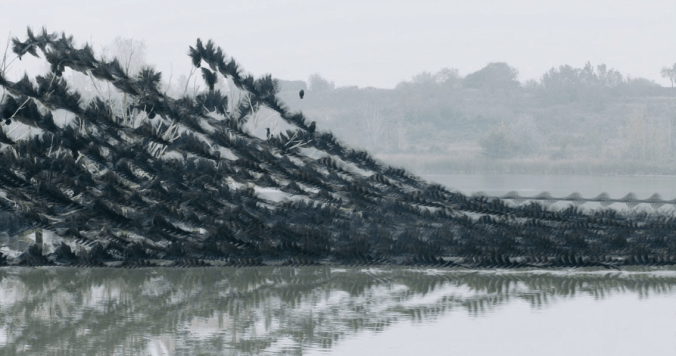
Great cormorants, Ibars Swamp, Catalonia (Courtesy of Xavi Bou)

Great cormorants, Ibars Swamp, Catalonia (Courtesy of Xavi Bou)

Birds are photogenic in their own right, but this creative capture of their flight by artist Xavi Bou is both innovative and etherial. A geologist and photographer by training, Xavi’s love of birds goes back to childhood.

Xavi Bou focuses on birds, his great passion, in order to capture in a single time frame, the shapes they generate when flying, making visible the invisible.

Unlike other motion analysis which preceded it, Ornitographies moves away from the scientific approach of chronophotography used by photographers like Eadweard Muybridge and Etienne-Jules Marey. Continue reading

Beadwork Worthy Of A Genius

scott-intwined-neckpiecehi-res

Political beadwork.

We enjoy this time of year when the John D. and Catherine T. MacArthur Foundation “Genius” grants are awarded, since they invariably make for great reading, and usually great viewing or listening as well. Here is another one, thanks to Quartz for this summary and short profile to accompany the images of this recipient’s work:

Photos: The jewelry and sculptures about racism and sexism that earned Joyce J. Scott a MacArthur “genius” award

Lila MacLellan

A beaded necklace is an unlikely place to find a narrative about race, history, and slavery, says Lowery Sims, curator emerita at the Museum of Arts and Design (MAD) in New York. But that surprise factor is part of the allure of Joyce J. Scott’s art. “Technically it’s breathtaking, it’s intimate, it’s intricate—but it’s also a very powerful statement about the world and some of the issues we face as human beings,” Sims says. Continue reading

Save Your Screen Time, Kochi!

The Kochi-Muziris Biennale 2016 “main stage” doesn’t start until December, but Kochi is already throbbing with activity – from the Piramal Art Residency at Pepper House to introductions to this year’s participating artists on the KMB Facebook page.

Interested in film and video? The Signs Festival 2016 begins in less than a week at the Kochi Town Hall on September 28th.

SiGNS, the pioneering festival in India for digital videos featuring national level competition for documentaries and short fiction for the prestigious John Abraham National Awards. John Abraham Awards was instituted in 1999 by the Kerala Region of Federation of Film Societies of India  Continue reading

Light Dance

Light, Darkness. Movement, Stillness. Sound, Silence.  The contrast and flow of these opposites make the heart race.

White Canvas is only one of the innovative projects created by the interdisciplinary artistic team that makes up COCOLAB. Continue reading

2016 Cornell Council for the Arts Biennial: Abject/Object Empathies

With fewer than 90 days to go until the 3rd edition of the Kochi-Muziris Biennale we admittedly have biennales on our mind. We thank one of our 2012 design interns, Chi-Chi Lin, for bringing this one to our attention.

The Cornell Council for the Arts (CCA) is a campus wide organization that promotes collaboration and artistic experimentation to inspire innovative and challenging projects by students, faculty, departments and programs from all disciplines. The focus of the 2016 CCA Biennial 

is on the cultural production of empathyThe upcoming biennial will address the ways in which feeling is form and explore how the objects, buildings, clothing, machines, languages, and images we construct are shaped by our intentional or implicit emotional, interdependent relationship to others. Whether by framing a connection that already exists or by providing the condition for new connections, what we create can either merely extend our own personal desires, goals, and directives, or can alternatively function as a bridge between who I am and who you are so that aesthetic experiences are interdependent, collaboratively generated and inherently reciprocal. Continue reading

The Land Art Generator Initiative

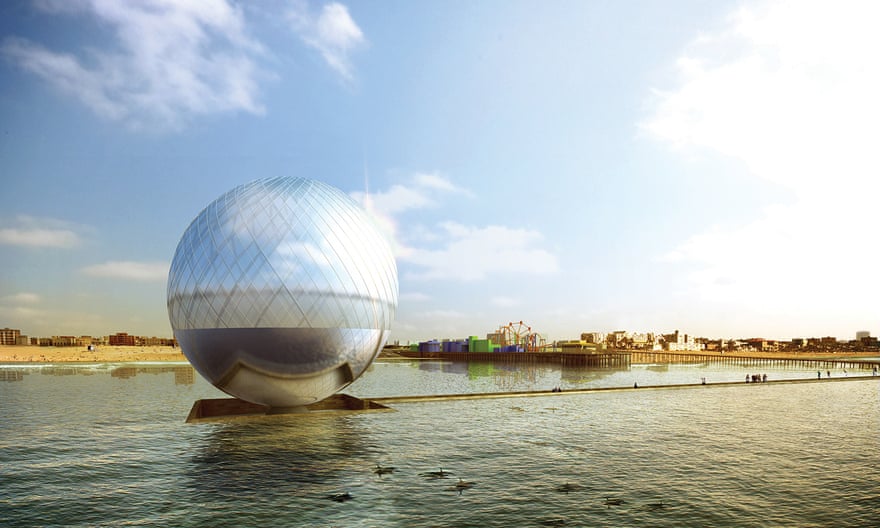
The Clear Orb is a proposed glass desalination dome 40 meters in diameter, lined with solar cells to generate power to pump seawater. Inside the orb, the sun’s heat would distill the saltwater through evaporation and condensation. The project could generate 3,820 megawatt hours of electricity and 2.2m liters of fresh water a year. The underbelly of the orb is covered in fins that can turn wave action into electricity. Artists: Jaesik Lim, Ahyoung Lee, Jaeyeol Kim, Taegu Lim from Seoul, South Korea. Photograph: Land Art Generator Initiative

The Clear Orb is a proposed glass desalination dome 40 meters in diameter, lined with solar cells to generate power to pump seawater. Inside the orb, the sun’s heat would distill the saltwater through evaporation and condensation. The project could generate 3,820 megawatt hours of electricity and 2.2m liters of fresh water a year. The underbelly of the orb is covered in fins that can turn wave action into electricity. Artists: Jaesik Lim, Ahyoung Lee, Jaeyeol Kim, Taegu Lim from Seoul, South Korea.
Photograph: Land Art Generator Initiative

In recent months we’ve seen some interesting competitions blending technology with art and aiming to improve the world in some way, like lionfish hunting, wildlife crime controlling, and milk tea brewing. But a biennial public art contest organized by the Land Art Generator Initiative, featured last week in The Guardian, might be the most impactful in terms of scale and long-term inspiration – although the anti-poaching stuff is pretty good too. Alison Moodie writes (and make sure to follow her first link!):

These ideas illustrate the possibility of marrying aesthetics with renewable energy and water technology and educate the public about the challenges of addressing climate change and feeding a growing population.

Continue reading

Of Salt and Stories

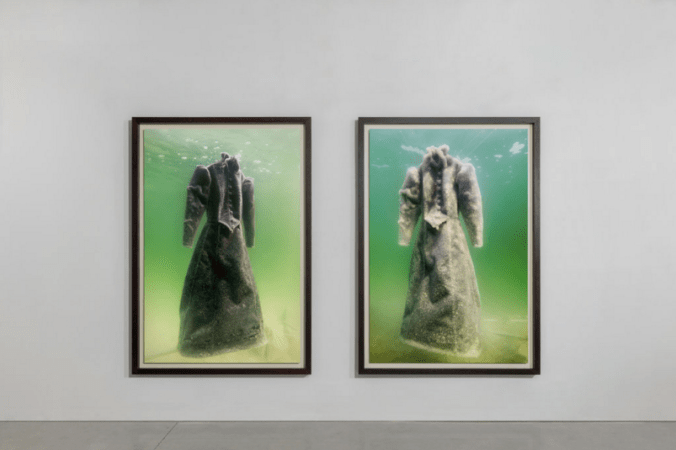
“Salt Crystal Bridal Gown III” (left) and “Salt Crystal Bridal Gown VI,” both 2014. Courtesy of the artist and Marlborough Contemporary

“Salt Crystal Bridal Gown III” (left) and “Salt Crystal Bridal Gown VI,” both 2014.
Courtesy of the artist and Marlborough Contemporary

It starts with a story. Written by Russian playwright S. Ansky in the early 20th century, The Dybbuk is an expressionistic drama about a young bride possessed by the malicious spirit of a dead suitor, and subsequently exorcised.

Jerusalem-born artist Sigalit Landau took inspiration from the story and her powerful connection to the Dead Sea, an otherworldly place she grew up visiting frequently with her family, and that she has incorporated into her art for years. Her “Salt Bride” installation at London’s Malborough Contemporary, enlists the work of the sea itself, in which a traditional black Hasidic gown (a replica of the costume worn by the bride in The Dybbuk, as portrayed by legendary actress Hanna Rovina) is submerged into the sea’s hypersaline waters. The salt crystals accumulated naturally over the net-like weave of the dress, left submerged over a period of 3 months, during which the process was photographed as an organic time-lapse. “Over time, the sea’s alchemy transforms the plain garment from a symbol associated with death and madness into the wedding dress it was always intended to be.” Continue reading

Comic Heroes Promote STEAM

steam-comics-01_custom-178e12d22e5a23c61e43f2d12b77fd95c322801d-s800-c85

Moon girl and Spiderman. Image from Marvel

Comic superheroes is a curious topic to cover here, but relevant with the development of Marvel’s new comic series of STEAM Variants. Five of Marvel’s heroes are stepping to into a new role and tackling new challenges in science, technology, engineering, art, and math (hence STEAM, sometimes referred to as STEM, which lacks the art component) with the intent of inspire young readers to explore their passions in those disciplines.

“We plan to continue to motivate our fans to explore their passions in the fields of science, technology, engineering, art, and math and present these disciplines through some of our favorite young heroes who are doing just that — following their dreams and preparing for the challenges that await them ahead,” David Gabriel, Senior VP for Sales & Marketing of Marvel Comics said in a statement.

Continue reading

Guilty As Charged

Caplan-Bricker-Austrian-Food-Performance-Artists-1200

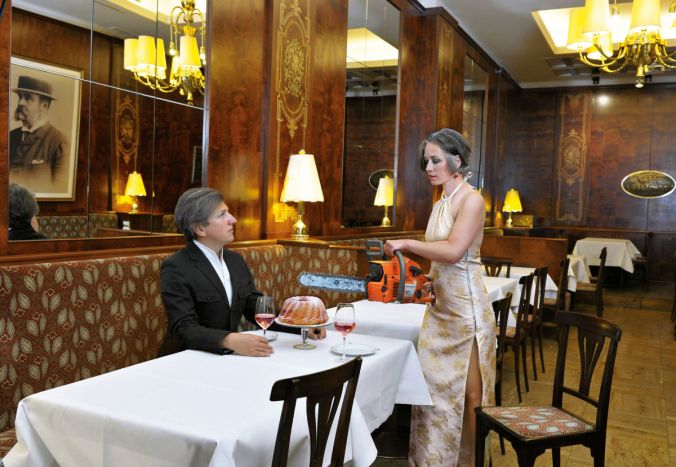
The Austrian performance artists Sonja Stummerer and Martin Hablesreiter, a.k.a. Honey and Bunny, want to make us reëxamine the culinary mores that we take for granted. PHOTOGRAPH COURTESY SONJA STUMMERER AND MARTIN HABLESREITER

I have been on the road for most of the last six weeks and have been consumer of the posts on this site, rather than contributor, for the entire stretch since we got distracted by a hurricane. That’s okay. Other contributors have carried the ball forward well, and before I forget I want to share one recent item I read elsewhere that seems a fitting counterpoint to Jocelyn’s most recent post.

That topic has a kind of ick factor I cannot articulate while at the same time is clearly a topic we are going to need to deal with more and more. I am certainly guilty of avoiding the topic, and must overcome the ick thing. Clearly linked to the lab/food topic is the issue of food waste, which we address on a regular basis here.

We need more diversity in our approach to these tough topics to avoid the feeling of being overwhelmed; antidotes to the ick/tough factor to make the topic more palatable, so to speak. We are so serious in our earnestness that we no doubt add to the weight of the topic, and I speak guilty as charged on that too. It may be that “playful” is an appropriate alternate approach from time to time, as this item suggests:

THE WASTEFULNESS OF MODERN DINING, AS PERFORMANCE ART

Many of us reflect, at least occasionally, on how our gastronomic habits affect the health of the planet. We regret that our takeout dinners come in a Styrofoam container inside a paper bag inside a plastic bag, with white plastic utensils in their very own plastic sheaths. We feel guilty when we order too much food at a restaurant and resign half an entrée to be scraped into the trash. But the pull of convention is most often stronger than these feelings. We eat in the manner we’ve grown accustomed to eating.

The sly and playful Austrian performance artists Sonja Stummerer and Martin Hablesreiter want to make us reëxamine the culinary mores that we take for granted. Continue reading

The Shed, New York City

Shed.jpg

When we first learned about the High Line it was at a moment in time when we were designing a hotel in a historic section of a south Indian harbor town, with pedestrian zones intersecting with vibrant merchant and other urban realities; the High Line served as an inspirational benchmark for thinking about public spaces creatively.

Just now, for a new project, a colleague referred us to the Rockwell Group’s hospitality practice to see an example of another relevant benchmark, and while exploring their website we came across the project they are engaging in with the designers of the High Line, giving us a new objective for the next visit to New York City:

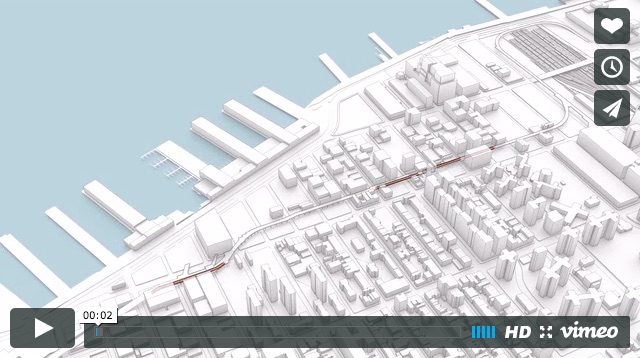
Currently under construction on the far west side of Manhattan where the High Line meets Hudson Yards, The Shed will be housed in a 200,000-square-foot, six-level structure designed by Diller Scofidio + Renfro in collaboration with Rockwell Group. The radically flexible design of the performative structure can physically and operationally accommodate the broadest range of performance, visual art, music, and multi-disciplinary work. Continue reading