Smithsonian Features Recycled Trash Sculptures

Image courtesy National Zoological Park

The plastics used in these colorful and eye-catching sculptures being shown at the Smithsonian’s National Zoo weren’t recycled in the way outlined yesterday, but rather were found by artist Angela Pozzi and her volunteers along the West Coast beaches that they traveled, picking up waste to raise awareness at a later date through their traveling art exhibit, “Washed Ashore: Art to Save the Sea.” The seventeen sculptures of marine wildlife are bombastic and full of character. Sabrina Greene reports for the Smithsonian Insider:

“The exhibit at the Zoo appears to be a wonderful success,” Pozzi says. “I have seen dozens of visitors stopping and looking closely, then entering into discussions and then really thinking about the marine debris issue. Besides raising awareness, one of our goals is for the public to start taking ownership of the problem and reevaluating their own plastic usage. We hope to spark positive changes in consumer habits. Every piece of plastic in our exhibit that we have picked up off the beaches, every single bit of it, was once purchased by somebody.”
Continue reading

Demolition, Conservation & Creative Destruction

Puppet2

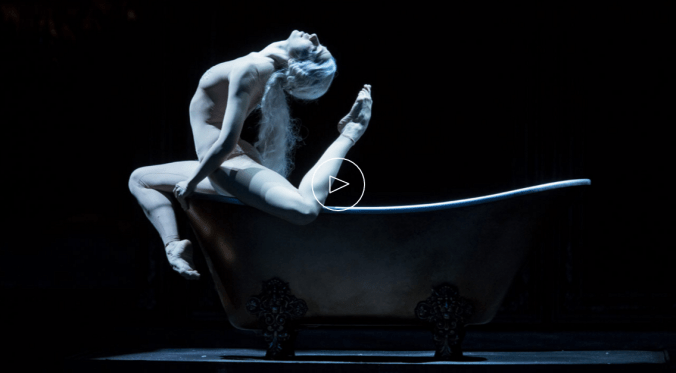
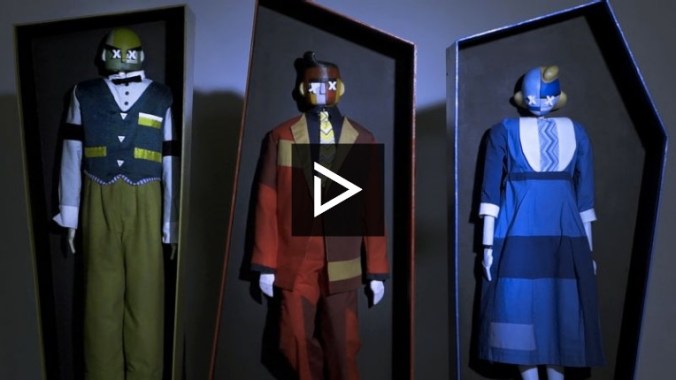
THE STAGE LIFE OF A PUPPET Watch as Dan Hurlin’s puppets from “Demolishing Everything with Amazing Speed” come to life.

Dance is not one of the art forms I have ever immersed myself in, so I only occasionally read articles by a Dance critic. Joan Acocella, however, is also a great book reviewer and I know I should always at least glance at what she publishes. This was one of those times when I was pulled in, and could not stop reading (or watching; click above to go to a short video based on the subject of her review).

Her brief description of a series of puppet shows captures my attention, in spite of my not having seen a puppet show in decades. First, it has to do with lost and found heritage being valorized by a talented artist–a variation on what we call entrepreneurial conservation. And the mix of written and video presentation of the review is a fine example of the rapid paced march of an old school, paper-based magazine to the drum of its new digital platform, something we can appreciate as the same happens in our sector (travel and hospitality). In that sense even the title of the work being reviewed, “Demolishing Everything with Amazing Speed,” echoes the Schumpeterian notion of creative destruction.

FORGOTTEN FUTURIST PUPPET SHOWS

Dan Hurlin stages Fortunato Depero’s unproduced plays at Bard SummerScape.

In 2013, Dan Hurlin, a performance artist and puppet artist, was working at the American Academy in Rome when he stumbled on evidence that during the First World War Fortunato Depero (1892-1960), one of the Italian Futurists, had written four puppet plays that were never produced. Where were they? Hurlin travelled to Depero’s home town, Rovereto, at the foot of the Italian Alps, to examine the man’s archive. “I sat at this big table, wearing those white cotton gloves they make you wear,” Hurlin remembers. Continue reading

Art In The Name Of Environment

9778_f52b43f6e0e444510cf55c5869d8d06b

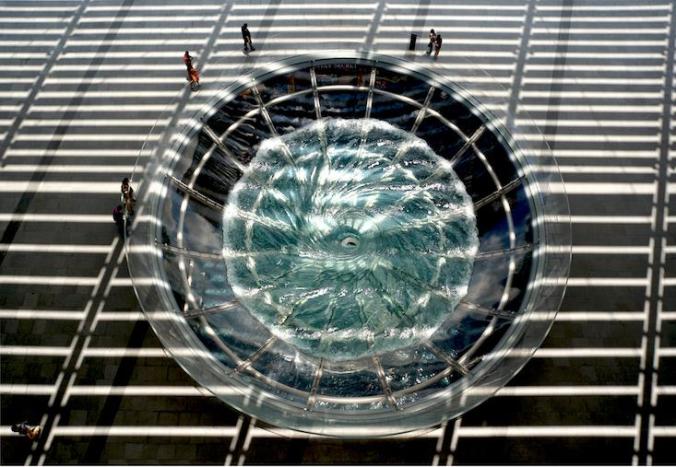
RAIN OCULUS: In Marina Bay Sands, Singapore, a large whirlpool—functioning as both a skylight and a rain collector—forms inside a 70-foot diameter acrylic bowl and falls 2 stories to a pool below. Kahn, collaborating with Moshe Safdie, completed this artwork in 2011. Photo courtesy of Ned Kahn

Nautilus has brought our attention back to a subject that, on last look made us uncomfortable, but now our fascination and wonder are back where they belong:

The environmental artist Ned Kahn, a MacArthur Foundation “genius grant” awardee, gravitates toward phenomena that lie on the edges of what science can grasp—“things,” he tells me over the phone, “that are inherently complex and difficult to predict, yet at the same time beautiful.” The weather, for example, has, because of its chaotic yet orderly nature, “fascinated me for my whole career,” he says. For almost the last 30 years in particular, he’s been creating dynamic installations that he thinks of as “observatories”: Since they frequently incorporate wind, water, fog, sand, and light, he states on his website, “they frame and enhance our perception of natural phenomena.”

Take his most recent project, the “Shimmer Wall”. Composed of over 30,000 tiles, it will be a 1,100-foot long façade of a new building, home to the “Ocean Wonders: Sharks!” exhibit, set to open this year at the New York Aquarium (over $80,000, toward a $100,000 goal, has been donated for its construction). It will house over 100 species of animals, including but not limited to a variety of crustaceans, sharks, fish, rays, and turtles. “They were struggling with the façade and someone on the design committee knew about my work and approached me,” says Kahn. “That led to the idea that we’re doing a skin for the aquarium inspired by fish skin, shark skin, scales. I’ve been doing a number of faceted, fragmented, kinetic artworks influenced by scales—that move with the wind and, when you step back, you get an idea of how the wind affects it.” Continue reading

Libraries, Phaidon Style

ssanantonio-ricardo

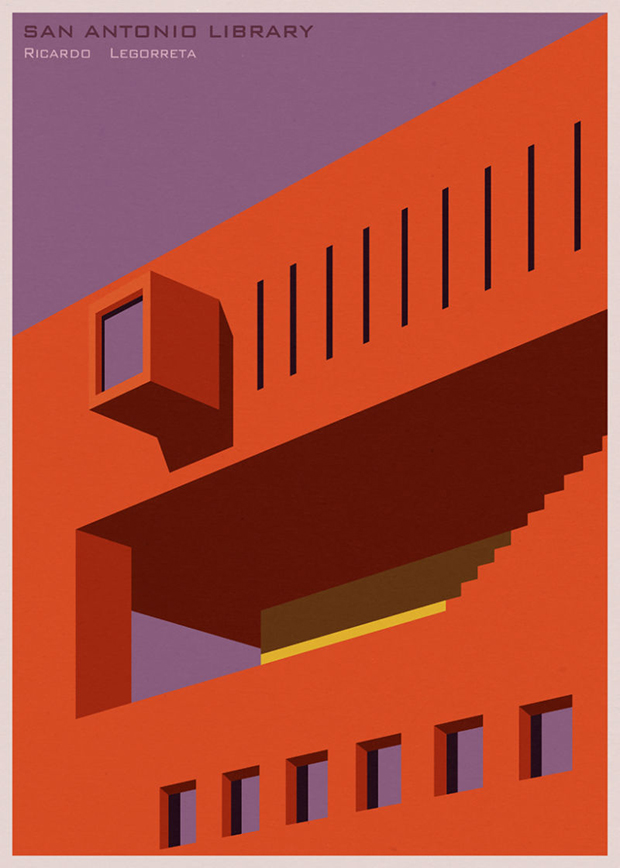
Ricardo Legorreta’s San Antonio library, Texas, as illustrated by André Chiote

Phaidon has produced a book to meet our library fancy:

The world’s best libraries look even better as posters

See how architect André Chiote has illustrated buildings by Norman Foster, Oscar Niemeyer, Rem Koolhaas and co

When successful architects are tasked with designing important city or national libraries, they rise to the challenge. These practices, which often spend much of their time on overtly commercial work, seem to come to life when they put their civic-minded hats on. Continue reading

If You Happen To Be In ’s-Hertogenbosch, the Netherlands


Literally, “The Duke’s Forest”, ‘s-Hertogenbosch is a fortified historic city in the North Brabant Province of the Netherlands. Aside from being a lovely area with a beautiful church, the city is best known for it’s most famous Medieval citizen, the religious artist Hieronymus Bosch, known for his bizarre paintings of demons and human-animal-machine hybrids meant to invoke the “evil of mankind”.

While his apocalyptic,  fantastical work may have rather dour origins, it’s gone on to inspire the amazing exuberance of the the Bosch Parade since 2010.

A wondrous armada of vessels and objects inspired by the work and ideas of Medieval painter Jheronimus Bosch. Artists from all disciplines (art, theatre, dance, music, architecture) collaborate with groups of enthusiastic amateurs and volunteers to create this artistic, water-borne parade. This spawns not only a creative floating parade by and for the city, but also an extensive creativity network throughout the city. Continue reading

Bees, Art, Action

Terence-koh-slide-W63E-master768

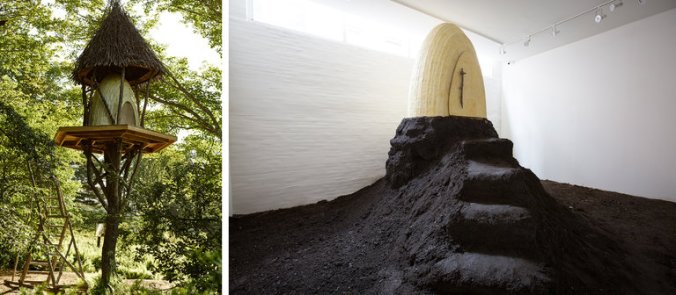
The artist Terence Koh recently installed a single-occupancy “bee chapel” upstate, left; at right, the chapel has been reconstructed in a modified form at Andrew Edlin Gallery on the Bowery.Credit From left: Stewart Shining; Olya Vysotskaya

The New York Times has a story currently that would interest anyone aware of the crisis related to bees and other pollinators; it helps if you also see art as a worthy tool of engagement for addressing complex major challenges facing the planet, and humanity; have a read either way:

An Art World Provocateur Returns to New York With an Unexpected Subject: Bees

By

“Good afternoon,” the elusive artist Terence Koh said over the phone earlier this week. He’d called to discuss his new show, which opened at Andrew Edlin Gallery over the weekend. “I’m inside the bee chapel. I’m lying down and looking straight up at the ceiling. They’re really busy today because it’s sunny.”

The Beijing-born, Canadian-raised enfant terrible was once the poster boy of aughts excess — a decade ago, he gold-plated his own feces and sold them at Art Basel for about a half-million dollars; he also once, rather infamously, told T, “I am the Naomi Campbell of the art world.” But the past few years have brought a different turn: He discontinued his gallery representations and, in 2014, moved to a mountaintop in the Catskills. The relocation was widely construed as a ceremonial retirement of sorts, but Koh insists the opposite: “I never had any intention of quitting the art world, I just moved to a different part of the world,” he says. “It was something that happened naturally.” He has since lived peacefully in what he describes as a personal Eden dusted with goldenrod and apple trees. In the branches of one, he built a hut and called it a “bee chapel,” which would become the titular heart of his new exhibition. Continue reading

The Medium Is The Message

o-COLUMNS-570.jpg

Charcoal has often been used by artists as a tool for sketching, but now this:

Floating Charcoal Sculptures Explore The Complex Relationship Between Man And Nature

Priscilla Frank
Arts Writer, The Huffington Post

Charcoal is a natural substance derived from the geological process of burning trees. The light black residue that remains, though created by nature, has a distinct architecture to its rough sides and sharp edges, reminiscent of the shapes made, consciously, by man.

Korean artist Seon Ghi Bahk uses this unorthodox artistic material to explore the complex and interwoven relationship between nature and human civilization. While Western culture has the tendency to view our natural surroundings as either a tool of human civilization or a pleasant backdrop for our daily lives, Bahk paints, or rather sculpts, a more nuanced picture.

Continue reading

If You Happen To Be In San Sebastian

bilbleadsanseb

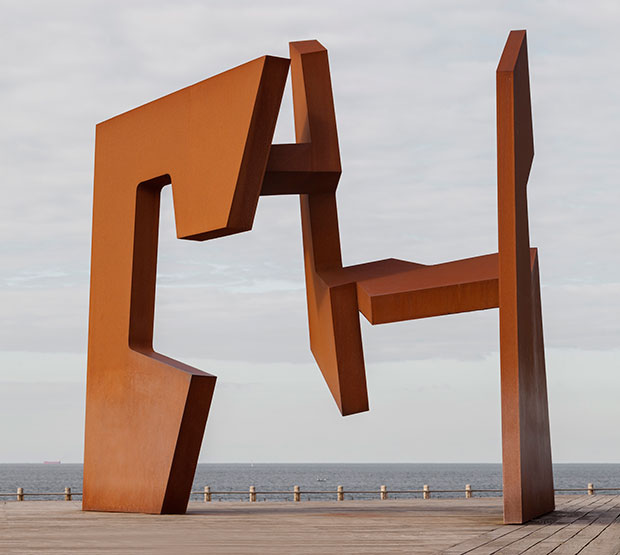
Construcción Vacía, San Sebastián, Spain by Jorge Oteiza

Phaidon, the great book company, shares this news from one of our favorite places in Spain:

Given its political backdrop, the quest for artistic freedom in Spain has perhaps been necessarily more tumultuous than elsewhere. Jorge Oteiza and Eduardo Chillida’s Grupo Gaur took the fight to the dictatorship in 1966, casting off the vestiges of costumbrismo (folkloric realism) at the same time. For this reason, sculpture retains an elevated status in the country not least in the seaside town of San Sebastián, near Bilbao. The resort is an art nouveau gem, with stately belle époque facades and a nose for a party. Continue reading

Octopus Painted with Its Own Ancient Ink

Image of the completed octopus ink drawing. Photo by Esther van Hulsen, via ThisIsColossal

Octopuses are impressive animals, given their incredible intelligence, impressive sight, and, of course, number of limbs. Now, we’re learning that the pigment in their ink, which has been known to preserve well when fossilized, can still be used today for illustrative purposes. In fact, an English paleontologist did it in the 19th century, and more recently by Esther van Hulsen! More from Kate Sierzputowski at This Is Colossal:

Dutch wildlife artist Esther van Hulsen was recently given an assignment unlike her typical drawings of birds and mammals from life—a chance to draw a prehistoric octopus 95 million years after its death. Paleontologist Jørn Hurum supplied Hulsen with ink extracted from a fossil found in Lebanon in 2009, received as a gift from the PalVenn Museum in 2014.

Continue reading

If You Happen To Be In Helsinki

Last year while doing one of our favorite work “responsibilities”, two of our team spent some time with guests at Xandari Harbour. The family happened to be from Finland, and one member of the family happened to be a composer of film scores and ballets. We’ve kept in touch, and they recently shared this amazing production of the Little Mermaid by the Finnish National Opera Ballet.

The blend of ballet, contemporary dance, unusual costuming and staging with 3D technology all merge to create an amazing staging of a creatively interpreted classic.

Click here or the photo for the evocative trailer…


If You Happen To Be In Atlanta

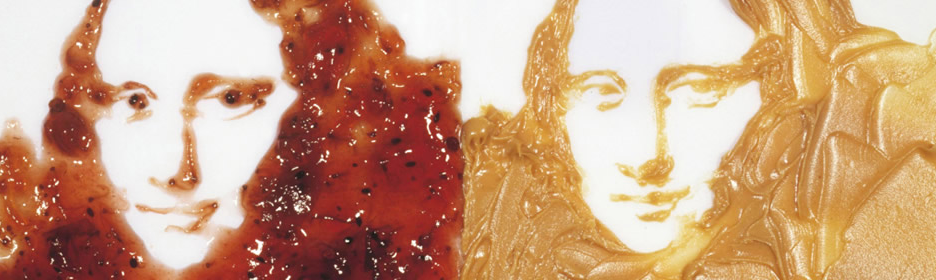
Vik Muniz Double Mona Lisa (Peanut Butter and Jelly), from the After Warhol series, 1999 Chromogenic print Galerie Xippas, Paris Art © Vik Muniz/Licensed by VAGA, New York, NY

It’s easy to be a fan of Vik Muniz’s work on so many levels: his visual wit redefining materials as medium for art; his entrepreneurial use of art to bring attention to disenfranchised communities; the collaborative spirit clearly evident in so many of his works… I, personally, love his cheeky reproductions of the world’s iconic artworks, rendered in the most banal of mediums.

A mid-career retrospective, currently mounted at the High Museum of Art Atlanta covers the full range of his work from grand to microscopic scale, using diverse media—including food, dust, string, sugar, magazine clippings, and literal junk.

On view through August 21, 2016.

If You Happen To Be In New York City

Screen Shot 2016-04-21 at 5.28.08 AM

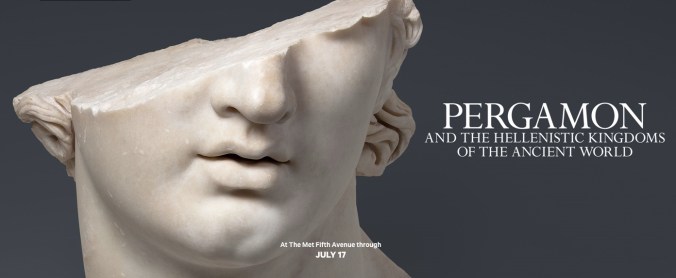
History can be dry, except when in the hands of masterful story-tellers. Which reminds us of James, and other scholars who have graced these pages in recent years with practical stories of the past linked to our present day lives. The value of this Pergamon exhibition (click the image above to go to the museum’s description of the exhibition) catches our attention because this review, which exemplifies the sort of interpretation that allows history to jump into our present tense:

…This tidal wave of wealth sloshed all around the eastern Mediterranean during the three centuries that followed, the era known today as the Hellenistic Age. It soaked the shores of the half-dozen new kingdoms carved out of Alexander’s conquests…

Read the description of this exhibition below, in the words of the Met’s curators, to get a renewed sense of the important role museums play in our civic lives.

The conquests of Alexander the Great transformed the ancient world, making trade and cultural exchange possible across great distances. Alexander’s retinue of court artists and extensive artistic patronage provided a model for his successors, the Hellenistic kings, who came to rule over much of his empire. For the first time in the United States, a major international loan exhibition will focus on the astonishing wealth, outstanding artistry, and technical achievements of the Hellenistic period—the three centuries between Alexander’s death, in 323 B.C., and the establishment of the Roman Empire, in the first century B.C. Continue reading

Processed Views

Although a previous post that embraced the sculptural qualities of food had a far more lighthearted intent, the juxtaposition of Carleton Watkins’ classic photographs and Barbara Ciurej and Lindsay Lochman’s irreverent dioramas has to be viewed with a certain level of irony. The iconic photos of America’s great national parks brought a sense of the country’s vastness home.

The pioneering nineteenth-century landscape photographer Carleton Watkins visited Yosemite during a time of rapid industrialization in the American West, but you’d never know it from the majestic tranquility of the rivers, mountains, forests, and rock faces he depicted. In her book “River of Shadows,” Rebecca Solnit, chronicling the life of another influential photographer of the time, Eadweard Muybridge, whose studies of high-speed movement helped to pioneer motion-picture technology, wrote that Watkins’s landscapes “looked like the true world everyone sought but no one else could locate among the mining booms, railroad building, land grabs, mobs, and murders” of the period. And yet Watkins’s images—which provided many people back East their first views of Yosemite’s idyllic splendor—were, in some sense, an advertisement for the possibilities of the West, and the vast untapped resources that American corporations of the eighteen-sixties and seventies were rushing to exploit. Continue reading

New Egg Art

In the past I’ve shared some of my egg-based artwork, known in Ukrainian as pysanky, that’s for sale at the Xandari Resort gift shop in Costa Rica, including a sped-up video of the process. But my painstaking handiwork, with wax and dye, can now be replicated to some extent by a machine called the Eggbot, which is an open-source robotic machine that can draw on eggs or other spheroids. Most often it uses pens but it can also even work with an electric-heated “kitska” or wax stylus similar to the flame-heated ones that I use.

The video above displays the various works of an Eggbot used by Jiri Zemanek at Continue reading

Spiral Jetty: Art that Informs

Photo by George Steinmetz, September 2002

In 1970, artist Robert Smithson built a massive sculpture as a piece of land art, or an “earthwork,” that is normally found just below the surface of the water of Great Salt Lake at Rozel Point. In drought conditions, the art piece, titled Spiral Jetty, becomes visible, often with salt encrustations that decorate the basalt spiral formation. Great Salt Lake, in addition to being salty, is also home to microorganisms that live or even thrive in extremely salty conditions and produce pigments that give them a red to orange color, which becomes visible in the water at times. Chau Tu reports for this week’s Science Friday written piece:

Great Salt Lake is known as a terminal basin, meaning its water has no outlet. “Water escapes through evaporation, and everything else stays there,” says Jaimi Butler, coordinator of the Great Salt Lake Institute. At the time the sculpture was built, the water level of the lake was particularly low. But by 1972, the water rose again to near-average levels, submerging the artwork.

“Smithson anticipated that the lake would rise and fall, the residue of salt crystals causing the black rocks to glisten white whenever the water level dropped,” the New York Times Magazine wrote in 2002. And indeed, that very year, regional droughts caused the jetty to reappear “for the first prolonged period in its history,” according to the Dia Foundation, which now owns the sculpture. (The Great Salt Lake Institute partners with the Dia Foundation and the Utah Museum of Fine Arts to oversee the Spiral Jetty.)

Continue reading

Ornithological Epicenter

There is grandeur in this view of life, with its several powers, having been originally breathed into a few forms or into one; and that, whilst this planet has gone cycling on according to the fixed law of gravity, from so simple a beginning endless forms most beautiful and most wonderful have been, and are being, evolved.

– Charles Darwin, Origin of Species, 1859

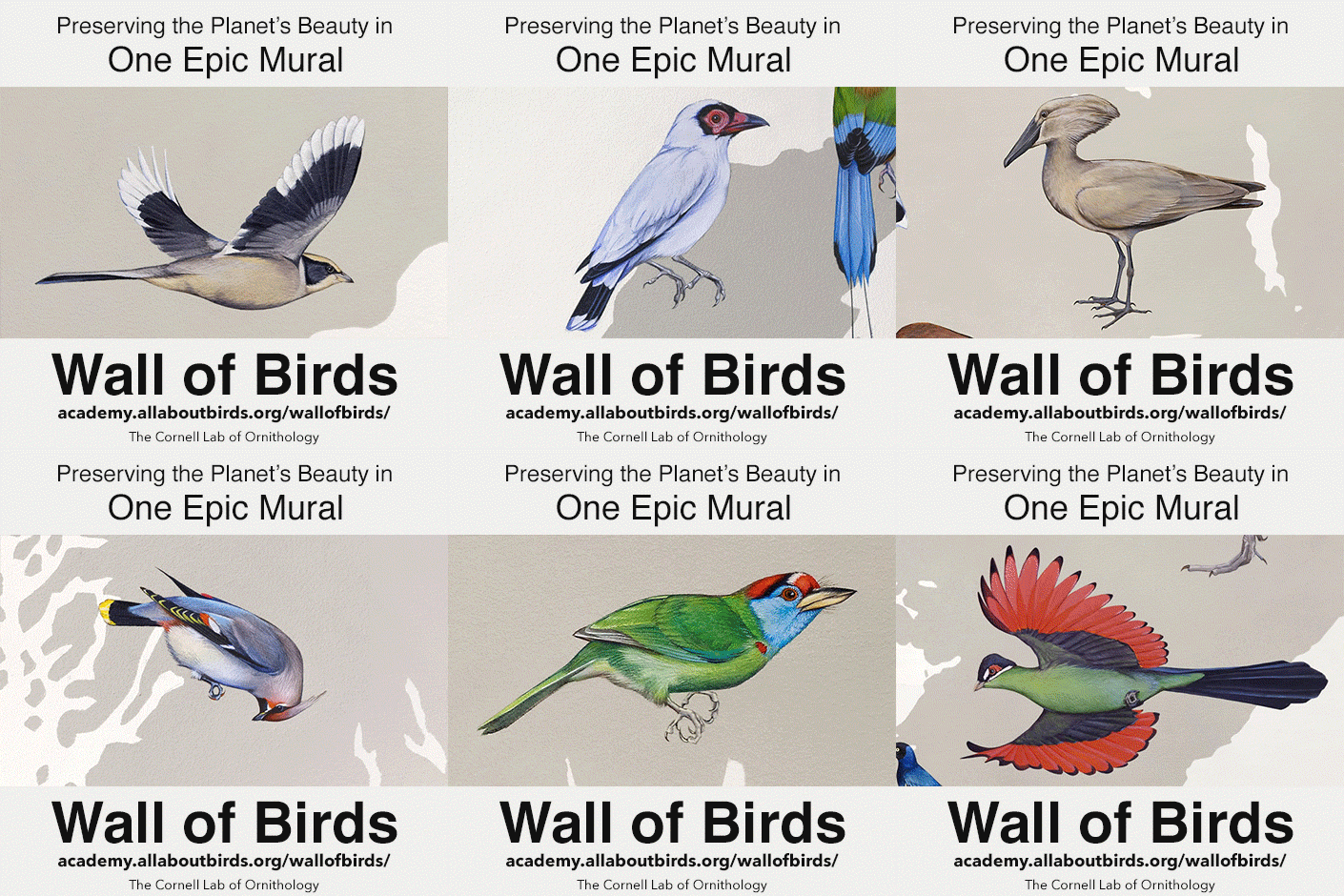
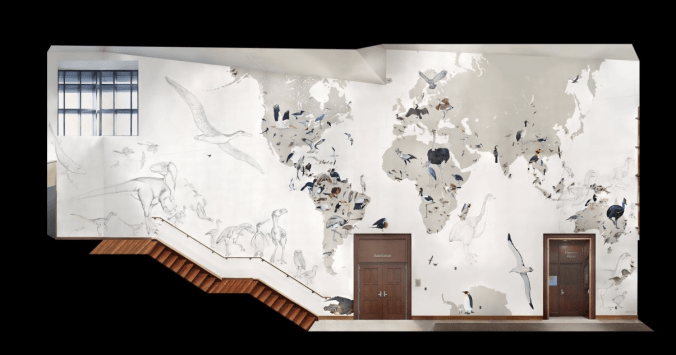
The Cornell Lab of Ornithology has long been a leading presence in the study, appreciation and conservation of birds. From citizen science programs, to eBird, to research collaboration with the the National Geographic Society, the Lab has helped to educate the public about the environmental importance of birds. The Wall of Birds, titled “From So Simple a Beginning,” from the Darwin quote above, celebrates the world of birds, showcasing biodiversity and evolutionary change, by featuring species from all surviving bird families alongside several extinct ancestors.

The scale of the mural is mind-blowing! The world map covers the largest wall of the Lab’s visitor center, with life-sized birds from each of the 243 taxonomic families of the world, placed in their geographical endemic locations. Check out the scale of the flying albatross in the lower left of the mural! The pale, gray scale depictions of the extinctions and ancestors adds to the complexity of the mural.

Continue reading

If You Happen To Be In New York City

141-690

When the exhibition space re-opens, under new management, this is one of the empty spaces that will be filled, and this post on the New Yorker website makes us think it would have been interesting to see the spaces empty, before:

On Friday, March 18th, the Metropolitan Museum of Art invites the public into the Met Breuer, better known for the past fifty years as the Whitney. (The Met is leasing the building for eight years, while its modern and contemporary wing undergoes a radical transformation.) Fun fact: the Whitney might not have existed at all if the Met had accepted Gertrude Vanderbilt Whitney’s offer, Continue reading

If You Happen To Be in Dubai

http://www.artdubai.ae/

Collaborative relationships are beautiful things. Most of human endeavors lend themselves to collaboration, and art is no exception. The stereotype of solo artist in studio is an old one, but in truth inspiration rarely occurs in isolation, and art doesn’t develop in a vacuum. Collaboration and community between artists, artists and patrons, or artists and those who appreciate art has existed in some form ever since the first charcoal marks on cave walls. Continue reading

When Collaboration Is Everything, It Can Be Awesome

06MIT1-master1050-v3

“Sandcastle No. 3,” drawn on a single grain of sand, part of a Vik Muniz series from 2013.CreditVik Muniz, via Sikkema, Jenkins & Co.

We like it, for what should be obvious reasons:

At M.I.T., Science Embraces a New Chaos Theory: Art

Continue reading

If You Happen To Be In London

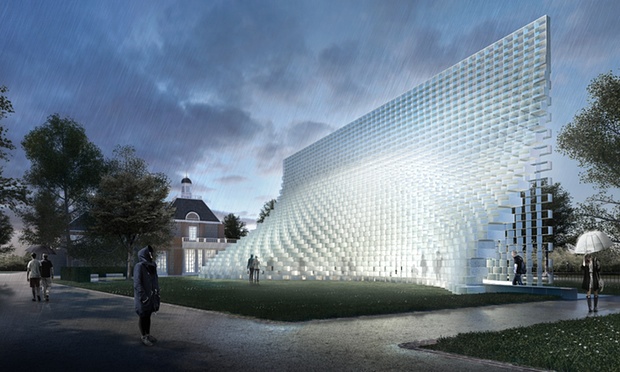
Serpentine pavilion ‘unzipped’: first look at Bjarke Ingels’ design

The Danish architect offers a sculptural space ‘like a mountain of ice cubes’ stretching across the London gallery’s lawn, to be complemented by four radical summer houses

2826.jpg

‘Cartoonish gyrations’ … Bjarke Ingels Group (BIG) architectural impressions of the 2016 Serpentine pavilion.

The humble brick wall, that most London of architectural elements, is the inspiration for this year’s Serpentine Gallery pavilion, according to designs unveiled today. But in the hands of the Danish architectural conjuror Bjarke Ingels and his firm BIG, it won’t be any old brick wall. It’s a wall that will be stretched open and hollowed out, its oversized fibreglass bricks stacked up to form a paraboloid enclosure that will taper high above the park, transforming from a bulging cave to a slender screen as it undulates across the lawn.

Continue reading