Camera Traps, Unite

This slideshow requires JavaScript.

Sharing technology, data, knowhow.  Pooling resources in the common interest across regions of the tropical world for the sake of biodiversity conservation.  Take a look at what TEAM is doing. A six minute video appears on the Guardian‘s website, providing much-appreciated coverage:

One million images of wildlife in 16 tropical forests around the world have been captured by the Tropical Ecology Assessment and Monitoring (TEAM) Network. Since it began its work in 2008 to monitor changes in wildlife, vegetation and climate, cameras in the the Americas, Africa and Asia have photographed more than 370 different species including elephants, gorillas, chimpanzees, large cats, honey badgers, tapirs and tropical birds Continue reading

Collaboratively Clean City

Jose Beceiro, the Director of Clean Energy Initiatives eat the Chamber of Commerce in Austin, Texas notes the role of collaboration in his city’s remarkable economic development:

As one of the first smart-grid-powered communities, a revolutionary technology incubator, and the host of a conference promoting clean energy investment; Austin, TX has proven itself a leader in the clean technology sector, and the region is poised to continue making significant strides in building a strong clean  Continue reading

If You Happen To Be In Chennai (Or These Other South Indian Cities)


header-new-800

Recently the New Yorker posted news that was music to the ears of all banjo-lovers.  Most baby boom-aged Americans know who Steve Martin is, but many did/do not know he is a seriously talented banjoist–he does not just use the instrument as a comedic prop. A smaller subset of Americans know who Edie Brickell is (not just that she is Mrs. Paul Simon), but they remember her music with the New Bohemians with intense affection.  She disappeared for a while, but she is back, and back with Steve Martin of all people:

Of the rushing river of records heading toward us, there are two I’d like to mention, one imminent and one on the horizon: “Love Has Come for You,” by Edie Brickell and Steve Martin, which arrives in April…Brickell and Martin’s record is a banjo-and-singer collaboration, a form without many footprints…

Anyone who loves banjo is almost by definition a lover of collaboration, which is why we pay attention to this particular instrument more than most. This got us thinking: What is Béla Fleck up to these days?  If you do not know who he is, and you at least like the banjo, you should find out by clicking the banner above. And to our delighted surprise, he is playing gigs near us in south India over the next few weeks.  After the jump below, you can see the schedule, and also you will get a sense of what we mean by banjo collaboration. Continue reading

Guyana’s Jaguars

Jaguars once roamed widely from the south-western United States to Argentina, but have lost nearly half of their natural territory and have disappeared altogether from some countries. Photograph: Mauricio Lima/AFP/Getty Images

Jaguars once roamed widely from the south-western United States to Argentina, but have lost nearly half of their natural territory and have disappeared altogether from some countries. Photograph: Mauricio Lima/AFP/Getty Images

Bravo to Panthera for its achievements in the couple of years since we first learned about it in this 60 Minutes segment.  And thanks to the Guardian‘s ongoing coverage of such important topics:

The lushly forested nation of Guyana on Thursday joined a regional pact to protect jaguars, the elusive spotted cat that is the biggest land predator in the Americas but has become vulnerable as expanded agriculture and mining carves away at their fragmented habitat. Continue reading

Land Fillharmonics

From the collaborative film Waste Land about the catadores (trash pickers) of Jardim Gramacho to the new documentary Trashed, there are film makers and organizations talking about the growing and overpowering problem of waste. Waste Land talks about the transformation of trash into art. The documentary film Landfill Harmonic is about “people transforming trash into music; about love, courage and creativity.”

With the ethos of reuse and recycle there are those who grab the creative spirit along with our attention with programs like the Paraguayan Sonidos de la Tierra (Saving Children Through Music) and Favio Chávez, director of the orchestra of recycled instruments on the Catuera Landfill on the banks of the Paraguay River. Continue reading

Hit Record

I like Joseph Gordon-Levitt.

“I feel like, Socrates, or something,” said actor Joseph Gordon-Levitt while looking out at the crowd framed by the round and columned architecture of Bailey Hall.

That’s why, several months ago, when I learned he was coming to do a show in Bailey Hall at Cornell, I committed to waking up early and facing the failing web servers to buy two of over a thousand tickets that were to sell out in less than half an hour, making the show the fastest to sell out at Cornell in a while. And I only bought two because that was the limit per student — by the time I got through to the webpage only balcony seats were left. Continue reading

Collaboration Across Architecture & Art To Tell Stories About A Place

We pointed to an earlier conversation in this series.  This one is about one architect’s view on story-telling.  For architects, and anyone working with architects, this man’s concise but clear statement of purpose and method is an eye-opener.

Caleb Crain & Collaborations (Literary, Historical, Cetaceous) That Feed The Mind

Several of us at this site have been fans of the historically-inclined long form journalism of Caleb Crain since reading this book review several years back.  It started there with whales (for us), but certainly did not end there (for him).  Click the image above to go to the reading of Moby Dick Chapter 4, or here to read more about the concept of this collaborative “program” that he is participating in:

In the spring of 2011, artist Angela Cockayne and writer Philip Hoare convened and curated a unique whale symposium and exhibition at Peninsula Arts, the dedicated contemporary art space at Plymouth University, under the title, Dominion. Inspired by their mutual obsession with Moby-Dick Continue reading

Young Explorers

I recently discovered that National Geographic offers grants to researchers, conservationists, and explorers between 18 and 25 years old to pursue projects around the world in archaeology, filmmaking, biology, adventure, and exploration, to name a few fields. These Young Explorers Grants, which generally range between $2000 and $5000, can often be a perfect catalyst for more or future funding for people trying to fulfill a lifelong research dream or experiment with a concrete fieldwork idea — after all, having National Geographic’s name on your list of supporters is pretty impressive, and a sign of great potential!

This morning, I attended a workshop given by several members of the National Geographic team hosted by Cornell University and sponsored by the Lab of Ornithology, The North Face, and other groups, which gave an overview of NatGeo’s mission as well as quite specific examples of research possibilities from past and current Young Explorer Grantees. Continue reading

Pre-Space Spelunking

Caves.  What have they done for us lately?  According to an article in Phys.Org, for astronauts they do amazingly important things, like providing:

…a taste of working as a safe and effective team during long spaceflights. In particular, they can hone their leadership and group skills while working in a typical multicultural team found on the International Space Station. Course designer Loredana Bessone explains the similarities of caving and working in space: “The ‘cavenauts’ have to adapt to a completely new environment. Working and living underground is both physically and mentally demanding.”

Community. Collaboration. We get it. This team spelunked for six days together and the video of their experience (after the jump) is worth six minutes, especially for any adrenaline junky. Continue reading

Community, Collaboration & Swiss Fun

While a group of graduate and undergraduate students from Singapore, Korea, the Philippines and the USA were in Kerala generating content for the stop motion summary of their internship experience, another group of students in Lausanne were just finishing their own stop motion fun.  Watch to the end to see the “making of” segment, which is just as fun as the finished product.

Bees, Honey & Collaborative Rooftops

Among the various projects Raxa Collective asked of its Design Team of interns the last few months, one key idea was how to make a rooftop more green.  A future post by Rania will show some of the recommendations, but for now this article (click the headline image to the left to go to the source):

Caroline Birchall, founder of the Bee Collective, works at Natural England on landscape ecology in the capital. She says there is a huge amount of green infrastructure such as green roofs and rain gardens, which enable water to be absorbed rather than run off, that is being put in place to combat climate change and which could be made more suitable for bees and other pollinators.

Communitarian Is As Communitarian Does

Thanks to one of most thoughtful, witty writers at The Atlantic or any other similar publication, a glimpse of an unsung hero who has community and collaboration written all over his accomplishments (toward the end of the linked item, click further onward to a profile of this amazing fellow from a few years back):

The profile also reminded me what a thoroughly decent and public-spirited guy Tim Berners-Lee is. Sometimes people who do great things turn out to be jerks, but he definitely isn’t such a case. One other thing Tim Berners-Lee isn’t is fabulously wealthy–and finding out why he hadn’t taken the road to riches (and that he almost had) was for me one of the more interesting outcomes of this reporting project.

Calling All Collective Activists

A deeply disturbing story, one among seemingly countless opportunities for any of us to jump in and build an opposition, brought the above organization to our attention.  Gold and copper, not to mention jobs, and concession revenues in a developing nation, are all important.  Up to a point.  But so is the marine ecosystem that will suffer the consequences.  The mining company and its shareholders gain if the operation is profitable; plus the livelihoods of all those working on the technology and the mining jobs to carry out these operations; plus what the PNG government earns; and then some.  It sure looked valuable enough to whomever was involved in granting the concession.

But who did the calculation on the other end of this equation?  The ecosystem valuation side.  Click the image above to see in detail (download the report) what is at stake and what might be done about it, as also reported here in The Guardian:

Nautilus alone has around 524,000 sq km under licence, or pending licence, in PNG, Tonga, New Zealand and Fiji. Continue reading

Full Circle

One minute ago, I opened my laptop to begin writing this blogpost, seated at gate 3 in Cochin International Airport.

One hour ago, I was in line waiting to enter the airport without a print out (evidently, an iPhone picture of my flight itinerary is not the same idea).

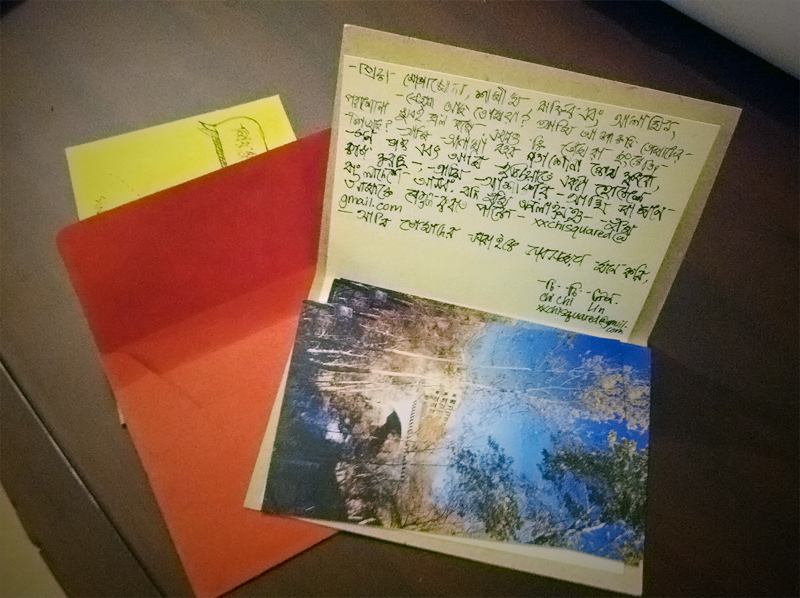
Two hours ago, I was frantically transcribing my “I miss you” letters in Bangla onto elephant dung paper as I ate my last dinner with the interns. It was chicken and “Indian-style salad.”
Transcribed Letters

Transcribed letters, thank you to Marfy (the F&B Management trainee from Panigram) for the translation!

Three years ago, I was in the same position. I was in South Asia, I had just finished an internship at an eco resort, and I was already contemplating how I would come back. I sat in Bangladesh’s major international airport thinking about how my past two months at Panigram (which, coincidentally is being developed and will be operated by La Paz Group, the organization responsible for Raxa Collective) were so wonderful, enriching, eye-opening, and everything in between and that I had to come back to see the boutique resort completed.  Would it be just an emotional return? Maybe getting a tattoo in Bangla script? Would I come back for my “I’m done with undergrad” senior trip?

Spending two months in Bangladesh with three hotelies afforded me everlasting friendships and a fondness for South Asia. Jonathon and I, specifically, tag-teamed each other around the world. We would meet in exotic cities all around the globe, any city was fine, just not Jessore, Bangladesh. We had a pact for that: “we’re going back to Panigram together, okay?”

Continue reading

A Summer in Muir Woods

Guest Author: Robert Frisch

In the summer between the first and second years of nearly every MBA program, students are tasked with finding themselves a three-month internship.  Some advise trying to round out your resume by focusing on your weaknesses.  Others say to shoot for a well-known company that will lend you credibility.  For me, I knew that I wanted to spend my time doing something that I love and feel passionate about.   A position in the realm of sustainable hospitality, land conservation, or eco-tourism was what I was looking for.  I had a few interviews for a sustainability position in a hotel real estate investment trust (REIT), talked to a conservation focused management firm based in India, and a for-profit land conservation company based in Chile.  I would have never guessed it, but I ended up accepting a position as a summer consultant to the National Parks Service in San Francisco. Continue reading

A Learning Laboratory (Stop Motion Video!)

Yesterday, Jonathon, Siobhan, Milo, and I moved into one of the new Raxa Collective properties under development. As the four of us huddled silently under our covers, the backwaters of Kerala’s nighttime accompanied Jonathon’s ghost stories…

Instead of spooky tales, though, today I want to share with you another story Jonathon narrates, Raxa Collective presents “A Learning Laboratory.” It’s a short video, Jonathon (narrator), Sunnie (illustrator), Siobhan (director), and I (producer) put together with the help of all the staff and summer interns to highlight some of the best anecdotes of how Raxa Collective’s Cardamom County ecolodge has acted as a “learning laboratory” for its staff, international trainees, and summer interns.

Enjoy!

Golden Rule Loops

the fourth instalment of the “valtari mystery film experiment” is by icelandic directors arni & kinski. their video for rembihnútur focuses on meditation:

the much needed changes in the world will happen through changes within each and every one of us. we all want and need love. this film is a celebration of sigur rós’s music and the benefit it is having in the elevation of consciousness that is happening with humankind. people are finding strength in love, care, and respect for themselves, each other, and the world we live in.

more information is here

Top 3 Words to Avoid When Talking Shop with Architects

We are working in Cochin and sometimes I feel like I am speaking two different languages. I’m not talking about struggling with mixing English and Malayalam. I’m not talking about scratching my head each time I encounter an Indian head shake/nod (“Wait- was that a yes or a no?”). I’m talking about the client’s language vs. the architect’s language.

This internship really is a “living laboratory.” I am getting a chance to sit on the client side and discuss ideas with the architects that will push Raxa Collective’s vision forward. Crist and Amie have worked with the design team side by side on each project and I am starting to understand how they think, how to make sure my drawings, renderings, and presentations can be clearer, and more. Sitting in on these design meetings in which the architect and clients discuss, propose, discuss, present, discuss, discuss, and discuss some more, I realize…

It’s like talking shop at an auto repair.

Continue reading