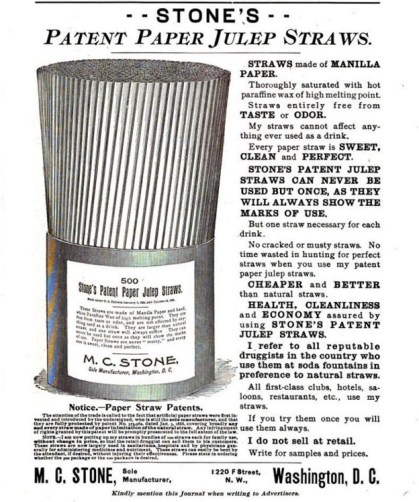
A typical Stone straw ad from a newspaper in 1899 (Google Books)
When we arrived in south India mid-2010 our toolkit was full of fifteen years worth of entrepreneurial conservation initiatives, starting in Costa Rica and followed by work in the Galapagos Islands, Chilean Patagonia, Montenegro, Croatia and Siberia. It took us a year to understand all the important ways India differed from everything we knew from elsewhere. Then Amie started targeting the elimination of plastic from our hotel operations, starting with bags in the gift shops. She might have been a latter-day Doña Quixote, tilting at packaged water bottles. All tourists had been instructed by guide books and travel agents to insist on these, and it was not as simple as deciding we knew better.
I might have been a latter-day Sancho Panza, with a front row seat to the action and as occasional contributor to solution-sourcing. But nevermind the literary allusions. We did eliminate plastic bottles, and then moved on to straws, both in India and back in Costa Rica. We are still working on straws, which oddly enough are more puzzling than disposable water bottles. Alexis Madrigal, as always, has our gratitude for this illuminating history and perspective that helps stoke our motivation:
Disposable America
A history of modern capitalism from the perspective of the straw. Seriously.
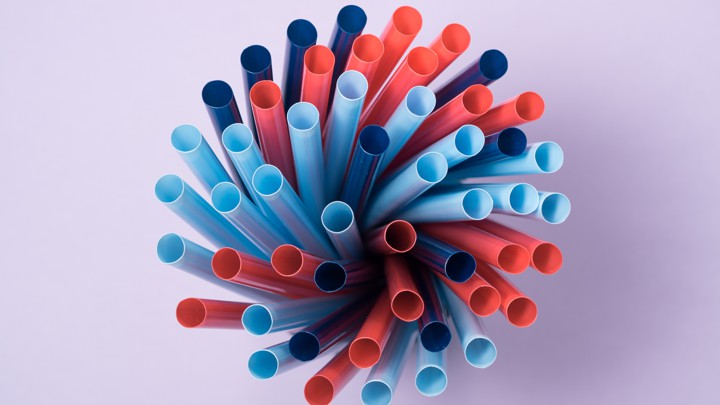
MIRAGEC / GETTY
A straw is a simple thing. It’s a tube, a conveyance mechanism for liquid. The defining characteristic of the straw is the emptiness inside it. This is the stuff of tragedy, and America.
Over the last several months, plastic straws have come under fire from environmental activists who rightly point out that disposable plastics have created a swirling, centuries-long ecological disaster that is brutally difficult to clean up. Bags were first against the wall, but municipalities from Oakland, California, (yup) to Surfside, Florida, (huh!) have started to restrict the use of plastic straws. Of course, now there is a movement afoot among conservatives to keep those plastics flowing for freedom. Meanwhile, disability advocates have pointed out that plastic straws, in particular, are important for people with physical limitations. “To me, it’s just lame liberal activism that in the end is nothing,” one activist told The Toronto Star. “We’re really kind of vilifying people who need straws.” Other environmentalists aren’t sure that banning straws is gonna do much, and point out that banning straws is not an entirely rigorous approach to global systems change, considering that a widely cited estimate for the magnitude of the problem was, umm, created by a smart 9-year-old. Continue reading



























 Organikos