You’ve Seen Bird Cams – How About a Salmon Cam?

Resolution is low, probably due to poor internet where the fish is and where I am, but you can see a coho, just like they say you might when watching the cam!

Resolution is low, probably due to poor internet where the fish is and where I am, but you can see a coho, just like they say you might when watching the cam!

We’ve shared various of the “bird cam” projects here before: websites, often run by universities like Cornell’s Lab of Ornithology, that host a live-streaming video of a nest somewhere so that people around the world with internet can tune in to the parent or chicks’ activities at any time of day. In some circles, similar videos of cats are also available. Now, not necessarily for the first time but at least the first I’ve heard of personally, there’s a live-streaming site of a real-life stream owned by The Nature Conservancy (I’m surprised their blog writers didn’t pun their way into that one). Matt Miller and Chris Babcock write about the new Salmon Cam:

Welcome to Salmon Cam, where you can enjoy the underwater happenings of a California salmon river throughout the day, on your computer or device.

The Salmon Cam is located in a tributary creek on The Nature Conservancy’s Shasta Big Springs Ranch. The camera is powered on in daylight hours (currently between 7 am and 7 pm Pacific time). Throughout the season, it will provide a view of migrating Chinook and coho salmon and steelhead trout.
Continue reading

Chan Chich Field Notes: Black Howler Monkey

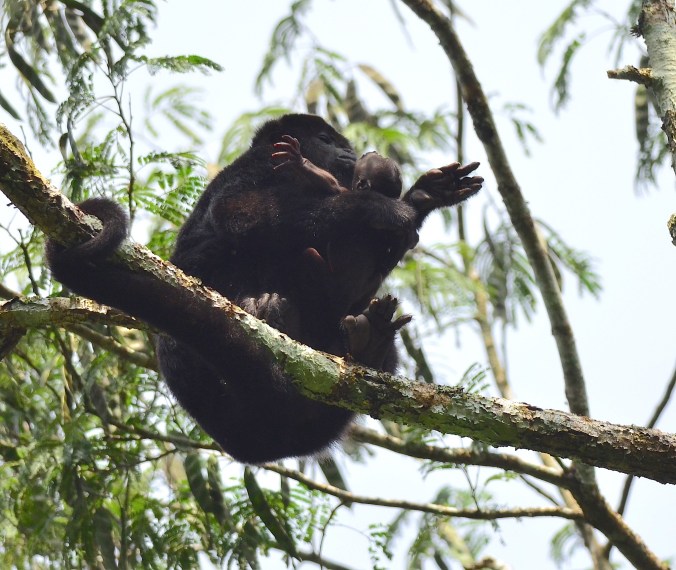
Female howler monkey with newborn by Emil Flota - La Paz Group

After my morning shift I went for my usual walk with my camera on Sylvester Village Road, looking at the beautiful surroundings and listening to the sounds of the forest. I heard something very unusual, which was a little frightening when I realized the sound was coming from above me. I looked up just in time to see a howler monkey giving birth. It was a very emotional moment, and when I finally felt calm enough to lift my camera I caught the mother bringing the baby up to her face on film.  Continue reading

Panthera onca

video taken by author on August 5th

Chan Chich is known for being pretty much the best place in Belize to spot a jaguar (scientific name, Panthera onca) in the wild, given the Lodge’s huge amount of protected land (30,000 acres) adjacent to hundreds of thousands of acres similarly preserved, or under government conservation that together form the international Jaguar Corridor Initiative.

The word Panthera comes from the ancient Greek pánthēr (πάνθηρ), which essentially means “predator of everything,” and is a scientific genus comprised of the five big cat species in the world: snow leopards, tigers, lions, jaguars, and leopards. The latter four of these are the only cats that can roar, given morphological differences in their bones and throat.

Continue reading

Restorative Justice, Environmental Case Study

1500.jpg

I am linking to this with a long series of links to rewilding stories in mind. Thanks to the Guardian for occasional environmental rags to riches stories:

How millions of trees brought a broken landscape back to life

After 25 years, the decision to site the National Forest amid derelict coal and quarry workings has borne spectacular fruit

by John Vidal

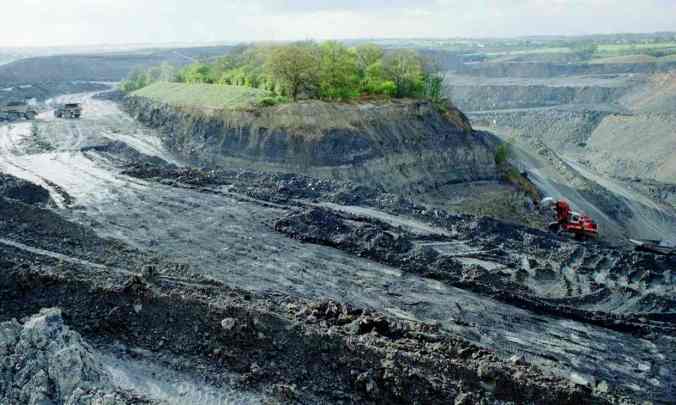
Twenty-five years ago, the Midlands villages of Moira, Donisthorpe and Overseal overlooked a gruesome landscape. The communities were surrounded by opencast mines, old clay quarries, spoil heaps, derelict coal workings, polluted waterways and all the other ecological wreckage of heavy industry.

The air smelt and tasted unpleasant and the land was poisoned. There were next to no trees, not many jobs and little wildlife. Following the closure of the pits, people were deserting the area for Midlands cities such as Birmingham, Derby and Leicester. The future looked bleak.

Today, a pastoral renaissance is taking place. Around dozens of former mining and industrial communities, in what was the broken heart of the old Midlands coalfield, a vast, splendid forest of native oak, ash and birch trees is emerging, attracting cyclists, walkers, birdwatchers, canoeists, campers and horse-riders.

Continue reading

Bill McKibben Deserves Better

07mckibbenSUB-master768.jpg

We frequently have linked to articles about, and to messages by, this man whenever we see them. It is not surprising to read this, but it is important that we are all aware of this additional price he pays for the actions he takes on behalf of the environment:

MIDDLEBURY, Vt. — THERE are shameful photos of me on the internet.

In one series, my groceries are being packed into plastic bags, as I’d forgotten to bring cloth ones. In other shots, I am getting in and out of … cars. There are video snippets of me giving talks, or standing on the street. Sometimes I see the cameraman, sometimes I don’t. The images are often posted to Twitter, reminders that I’m being watched.

In April, Politico and The Hill reported that America Rising Squared, an arm of the Republican opposition research group America Rising, had decided to go after me and Tom Steyer, another prominent environmentalist, with a campaign on a scale previously reserved for presidential candidates. Using what The Hill called “an unprecedented amount of effort and money,” the group, its executive director said, was seeking to demonstrate our “epic hypocrisy and extreme positions.” Continue reading

Blue Ventures, Belize

Screen Shot 2016-08-04 at 6.41.54 PM.jpg

We have been introduced to Blue Ventures by Phil Karp, and want to share their website far and wide:

We rebuild tropical fisheries with coastal communities

Blue Ventures develops transformative approaches for catalysing and sustaining locally led marine conservation. We work in places where the ocean is vital to local cultures and economies, and are committed to protecting marine biodiversity in ways that benefit coastal people. Continue reading

Corpse Flower Diaries

Photograph by Kathy Willens/AP

I first became aware of the amazing Amorphophallus titanum 4 years ago during a “bloom watch” of a Kenneth Post Lab Greenhouses specimen at Cornell University.  At the time the concept of a “Greenhouse Cam” was completely new to me, and I followed it, and the science behind the study of the plant, with fascination. Despite the rarity of the flower, a handful have bloomed within the past several years, the most recent being at the New York Botanical Garden.

All that said, the Corpse Flower by nature is the botanical version of a “comedic straight man” in the set up of story-based jokes. (For example, the scientific name means “giant misshapen phallus”.) Continue reading

Turns Out the Red Wolf is Part Gray, Part Coyote

John Woodhouse Audubon – Red Texas Wolf – Google Art Project via WikiMedia Commons

Last time I recall linking to a story with gray wolves, it was in the context of rewilding. And though I haven’t written about the red wolf before, it’s another North American species that is protected under US federal law in the Endangered Species Act. But new genetic research published last week on the DNA of North American wolf genomes is showing that the red wolf is in fact a hybrid species; a mix of gray wolf and coyote. The same goes for the Eastern gray wolf, another protected species. Carl Zimmer reports for the New York Times:

The finding, announced Wednesday, highlights the shortcomings of laws intended to protect endangered species, as such laws lag far behind scientific research into the evolution of species. Continue reading

USA National Park, Feisty Leadership Outlier

Lake Superior Presque Isle Royale National Park Michigan in USA Great Lakes no not people nobody isolated low angle horizon

Lake Superior Presque Isle Royale National Park Michigan, USA, Great Lakes

We like the idea of a leader of a national park with a “feisty nature,” since sometimes that is exactly what it takes for conservation to succeed, either in the public or the private sector; so this profile from the BBC, in its ongoing appreciation of the National Parks Service’s 100th anniversary, is the kind of story we are especially happy to share:

…Isolated and iconoclastic, Isle Royale National Park is something of an anomaly among US National Parks, with its territory spread over 200 islands and outcroppings emerging from the frigid waters of Lake Superior, part-way between the US state of Michigan and Canada.

Isle Royale’s former Superintendent, Bill Fink (no relation to me), is an iconoclast himself, almost as if the qualities of the archipelago rubbed off on him during his four years running operations there from 1990 to 1993. Continue reading

A Defining Moment In Papua New Guinea

Screen Shot 2016-08-01 at 9.05.37 AM.jpg

Interesting to see, in one publication we depend on for interesting news and commentary related to community and conservation around the world, a bookend to the item just published in another publication we turn to frequently:

Defining Moment: a photographer’s snap decision in the face of danger

Wylda Bayron traveled solo around Papua New Guinea for 18 months. What she found was a nation fraught with violence but also filled with striking beauty Continue reading

Indigenous-Outing

160808_r28495-1200

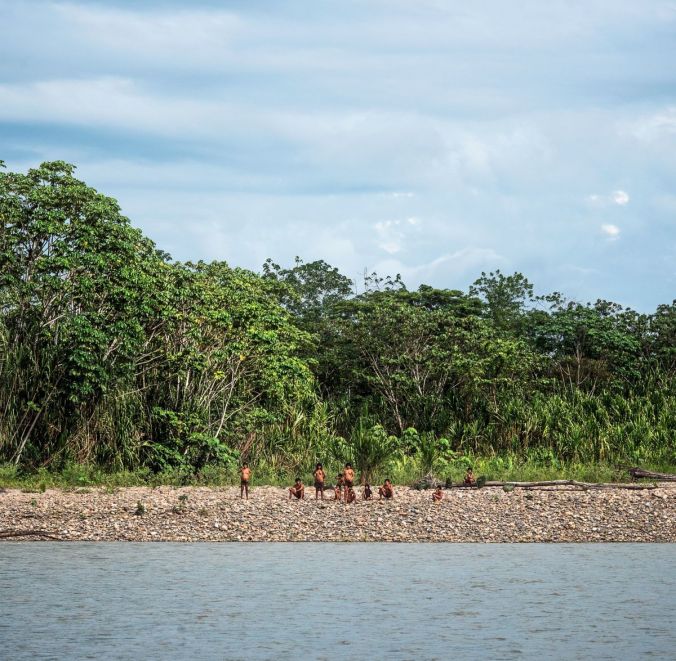
Mr. Anderson’s work is often, like his colleague Elizabeth Kolbert’s, unusually thick in detail, and often kind of heavy. This item is heavy, detailed, but fascinating. His writing is often without illustration yet this piece is reported with abundant and excellent photography. Read a snippet below to get a sense of the interior of the article:

AN ISOLATED TRIBE EMERGES FROM THE RAIN FOREST

In Peru, an unsolved killing has brought the Mashco Piro into contact with the outside world.

By Jon Lee Anderson

…The Ministry of Culture’s team gathered a few months ago in Cuzco, high in the Andes, where a van was loaded with provisions. The leader was an anthropologist named Luis Felipe Torres, a slim man in his early thirties with an aquiline face and the unassuming manner of a professional observer. He was joined by Glenn Shepard, an American ethnobotanist. A youthful-looking man of fifty, Shepard had lived for a year in the nineteen-eighties among the Matsigenka people, who shared territory with the Mashco; he had learned their language and returned many times since. Shepard worked at the Emílio Goeldi Museum, an Amazonian-research center in Brazil, but he travelled to Peru frequently as an informal adviser to Torres’s department.

Continue reading

National Park Service Service

lead_custom-7aa8c94bf10d83452c0788e0437655e91158e9c4-s1400-c85.jpg

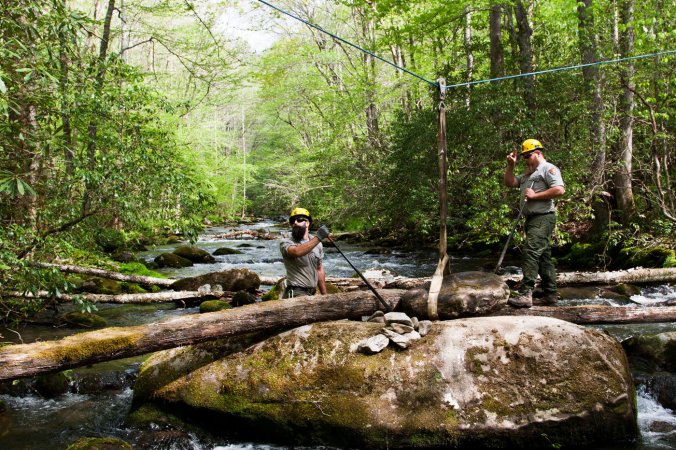
Brad Metler (left) and Mason Phillippi position a rock that will serve as an abutment for a small footbridge across the Oconaluftee River to an old cemetery in Great Smoky Mountains National Park. Both men work for the park’s trail crew, which maintains more than 800-miles of trail in the park. Nathan Rott/NPR

Thanks to National Public Radio (USA):

Life In The Park: Finding Meaning In Park Service Work

There’s a popular refrain among National Park Service employees, one that doubles as a reminder, of sorts, after a long, wearisome day: “We get paid in sunrises and sunsets.”

For many park employees, the pay is seasonal and not great. The hours are long. The question is usually the same (“Where’s the bathroom?”). And no matter how many pamphlets you pass out, instructions you give or “Attention!” signs you put up, people still wander off trails, carve their names in trees and get too close to the bears. Continue reading

Biodiversity, Conservation, Questions

natural-history-collection1.jpg

From Conservation, a provocative question answered in the summary of a scientific investigation:

IS BIODIVERSITY THE ENEMY OF NATURE?

It’s easy to use a word so often that its meaning is taken for granted. Nuances are lost, conceptual freight laid aside, assumptions unexamined. Take biodiversity: just a few decades old, the word is now ubiquitous, a default frame for thinking about nature — and that’s not necessarily a good thing. Continue reading

A Tiger’s Tale Redux

Photo credit: Sudhir Shivaram

Photo credit: Sudhir Shivaram

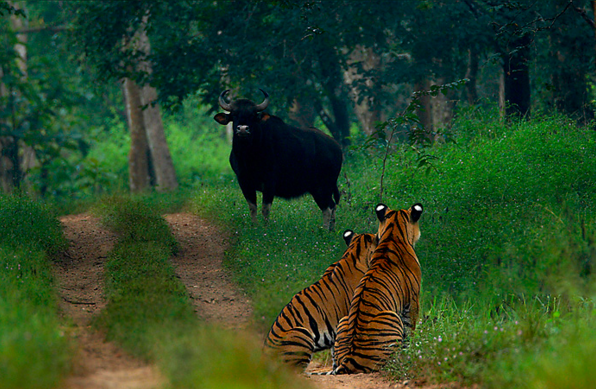
International Tiger Day is my excuse to remember this post from three years ago, as a continued reminder of the importance of doing whatever we can to save these amazing creatures in the wild.  Meeting wildlife photographer Sudhir Shivaram, and some talented participants of his master bird photography workshop, (many of whom now contribute to this site), has consistently given all of us a window into wildlife viewing that few of us have the privilege to enjoy.

I actually write this from Chan Chich Lodge in Belize, a location that offers the amazing opportunity to be in the habitat of “new world” cats such as jaguar, puma, ocelot, margay and jaguarundi. We’ll write about what we’ve seen so far and what the fantastic staff has shared with us in separate posts – as here we want to honor the tiger. Continue reading

Mountain Lions to Save Drivers and Deer from Collisions

Image: ©Brother Magneto/Flickr

It’s strange news, but a great sign of innovation that both helps a large keystone mammal come back from reduced population numbers and cull a troublesome species that is creating more and more road hazards every year. Brandon Keim reports for Conservation Magazine:

What’s one simple, inexpensive way to make driving safer?

Letting big predators live.

If mountain lions returned to the eastern United States, say researchers, their predatory habits would literally get white-tailed deer off the road, reducing collisions between drivers and deer by 22% over the next 30 years.

Continue reading

Bad News for a Few European World Heritage Sites

Protections have been weakened for Russian natural areas like the Western Caucasus. © WWF-Russia / Sergey Trepet

Last time we mentioned UNESCO World Heritage Sites, it wasn’t good news either, when many Sites were listed as “in danger.” The places newly at risk, according to the World Wildlife Fund (WWF), are often in the way of logging enterprises, often by the very governments who should be protecting the internationally recognized areas.  From the WWF:

The UNESCO World Heritage Committee today expressed concern over three sites facing severe pressures from harmful industrial activities, but failed to take bold action to protect them.

At the meeting, WWF objected to a sharp logging increase in the Polish portion of Bialowieza Forest World Heritage site, which also spans part of Belarus. The forest is one of Europe’s oldest, and is home to the most wild European bison, as well as lynxes and wolves. The government of Poland has argued that logging is necessary in order to combat a bark beetle infestation, a claim Polish scientists reject.

Continue reading

What Can Be Done with eBird Data?

Brighter colors indicate higher relative abundance. © Cornell University

The Western Tanager is a species I have yet to see, but which will be unmistakeable once I do, with the male’s red-and-orange head and bright yellow body contrasting with black wings striped with white bars. Based on the animated map above, I expect to spot some of them down in Baja California Sur by September or October, and I look forward to it. As I’ve written here before in the case of another moving map, citizen science makes this sort of illustrative prediction of a species’ moving presence possible, and it’s one of the reasons why I contribute to eBird as often as I can.

A paper titled “Using open access observational data for conservation action: A case study for birds” was published in the scientific journal Biological Conservation by a team of researchers at the Cornell Lab of Ornithology, several of whom I was just down the hallway from when I worked there. Although I haven’t gotten through their findings yet myself, Victoria Campbell chose nine interesting examples of how eBird data created tangible conservation in several countries.  Continue reading

Big Butterfly Count Coming Up in UK

Photo from bigbutterflycount.org

Starting this Friday and continuing through the first week of August, the largest survey in the world for butterflies and day-flying moths will take place in the United Kingdom. We’ve featured lepidopterists and citizen scientists here before, including today and for last year’s event, which involved over fifty thousand people counting more than half a million lepidopterans.  It’s great to see such a simple yet complete chart/app to ID the more common butterflies that people may encounter –– I would have really appreciated something like that for Costa Rica! Read more about the project below:

Why count butterflies?

Butterflies react very quickly to change in their environment which makes them excellent biodiversity indicators. Butterfly declines are an early warning for other wildlife losses.

That’s why counting butterflies can be described as taking the pulse of nature.

Continue reading

Expeditions In The Interest Of Science (Secondary Discovery, Nature’s Majesty)

p03xtfz4

The survey crew inventories the park for butterfly habitats (Credit: John McLaughlin)

This BBC article, featuring butterfly hunters in the very northwestern-most spot in the lower 48 of the USA, reminds us of an expedition we tracked not long ago:

Equal parts academic and mountain man, wildlife biologist John McLaughlin has scaled mountains and traversed snowbound passes to identify more than 40 butterfly species.

It’s best to bring an ice axe when counting butterflies in North Cascades National Park. Located on the Canadian border in the US state of Washington, the park is renowned for its jagged peaks, limited trails and annual snow pack.

“Before my census crew could learn to identify over 40 butterfly species,” John McLaughlin recalled, “they had to know how to safely traverse snowbound, steep passes and – if necessary – to self-arrest using an ice axe.” Continue reading

Rethinking Fish

5120

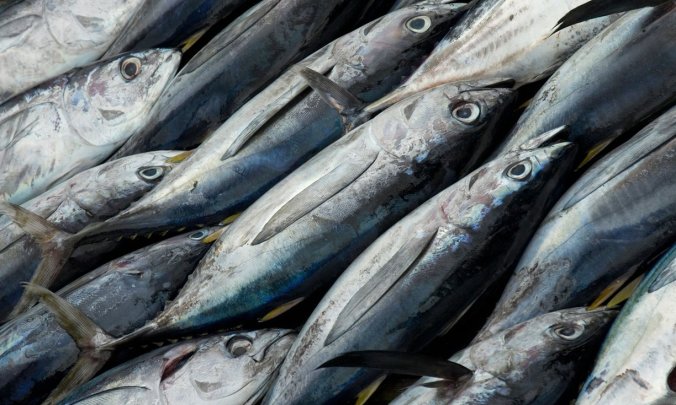
More than 40% of popular species such as tuna are being caught unsustainably, UN FAO says. Photograph: Alamy

Articles like this have me thinking about the meal I had last night, which had not one bit of animal protein in it, and wondering whether I could happily resist adding my own weight to the immensity of the food problem, especially with regard to fish:

Global fish production approaching sustainable limit, UN warns

Around 90% of the world’s stocks are now fully or overfished and production is set to increase further by 2025, according to report from UN’s food body

Continue reading