Our school programming puts students at the center of the movement to restore oysters to New York City waters. Explore our Billion Oyster Classroom program, currently in 70+ New York City schools, and high school at the Harbor School.
Every week or so since we started this platform in 2011 we have had too many opportunities to highlight water-based ecological challenges and they seem to outnumber solutions. But it has been our goal to balance the highlighting, neither hiding our head in the sand nor claiming false equivalence between bad news and good.
Given all the challenges facing our oceans and waterways we are always heartened to hear of another initiative that involves collaboration between enterprise, youth and civic organizations. Click the image above or the one to the right to see what the Billion Oyster Project is doing in this regard. Thanks to National Public Radio (USA) for bringing this initiative to our attention:
Oysters On The Half Shell Are Actually Saving New York’s Eroding Harbor
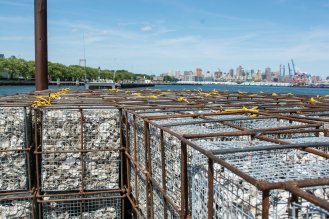
The shells are trucked over to Brooklyn’s Greenpoint neighborhood and once a month are brought en masse to Governors Island in the heart of the New York Harbor. Billion Oyster Project has collected more than 1 million pounds of oyster shells so far. Courtesy of Agata Poniatowski
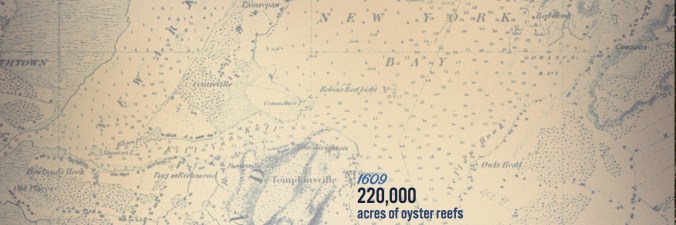
Across New York City, more than 70 restaurants are tossing their oyster shells not into the trash or composting pile, but into the city’s eroded harbor. It’s all part of Billion Oyster Project’s restaurant shell-collection program.
The journey from trash to treasure begins after an oyster half shell is turned upside down and left on an icy tray. Once discarded, it joins hundreds of thousands of other half shells collected in blue bins and picked up (free of charge) from restaurants five days a week by Billion Oyster Project’s partner, The Lobster Place, a seafood supplier. The shells are trucked over to Brooklyn’s Greenpoint neighborhood and once a month are brought en masse to Governors Island in the heart of the New York Harbor, just yards away from both Brooklyn and Lower Manhattan. There, rolling shell hills sparkle in the sun while “curing” out in the elements for one year, a process that rids them of contaminants.
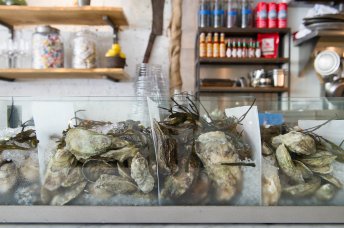
Oysters at Zadie’s Oyster Room, one of the New York City restaurants participating in Billion Oyster Project’s shell-collection program.
Courtesy of Morgan Ione YeagerThe shells then get a final cleaning and are moved to Billion Oyster Project’s hatchery at the Urban Assembly New York Harbor School, a public high school on Governors Island that offers technical and vocational training in the marine sciences. In an aquaculture classroom’s hatchery, student-grown oysters produce larvae in an artificially induced springtime environment. In one to two weeks, each larvae grows a “foot” — a little limb covered in a kind of natural glue — and then is moved to a tank full of the “cured” restaurant shells, which serve as anchors for all of those sticky feet. This phase is critical: If larvae can’t find a place to attach, they die. One reclaimed shell can house 10 to 20 new live oysters, depending on shell size. Continue reading


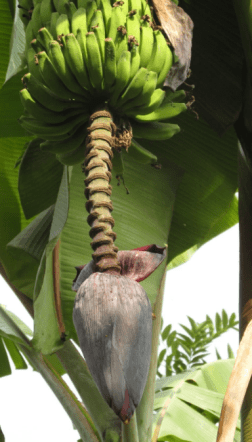 There are a variety of bananas trees outside my window at different stages of growth from baby to blossoming to bunches hanging low with the weight of near-readiness.
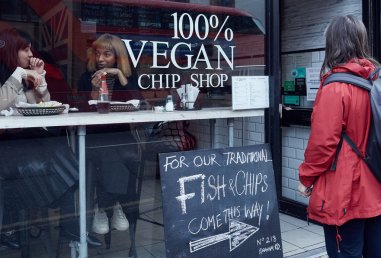 LONDON — A newly opened restaurant in an East London neighborhood is aiming to make waves by serving what looks like the perfect presentation of fish and chips, that quintessential British dish: a piece of glistening plump batter, chunky chips, mushy peas and a slice of lemon.















 Organikos