Gold’s Glitter Gratifies

17TH-TRAVANCORE_COINS.jpeg

Travancore Coins from Beena Sarasan’s Collection. Photo: Special Arrangment

A couple of  my recent posts appreciating the perspective of a capable Western observer on the topic of India, combined with my family’s pending celebration of Thanksgiving in a foreign land (as per our tradition), got me thinking: what news item in India since living here am I most grateful for.

No hesitation.  It has to do with the aftermath of a discovery in July. The discovery happened not too far from where we live, in the foundations of a Hindu temple.  The descriptions were remarkable on their own, in part just because of the difference between journalistic style in the culture where I grew up (fourth estate and all) versus India’s journalistic flourish:

…gold, jewels, and other treasures were unearthed in the vaults of the temple. Several 18th century Napoleonic era coins were found, as well as a three-and-a-half feet tall gold idol of Mahavishnu studded with rubies and emeralds, and ceremonial attire for adorning the deity in the form of 16-part gold anki weighing almost 30 kilograms (66 lb) together with gold coconut shells, one studded with rubies and emeralds… Continue reading
The Colorful Point

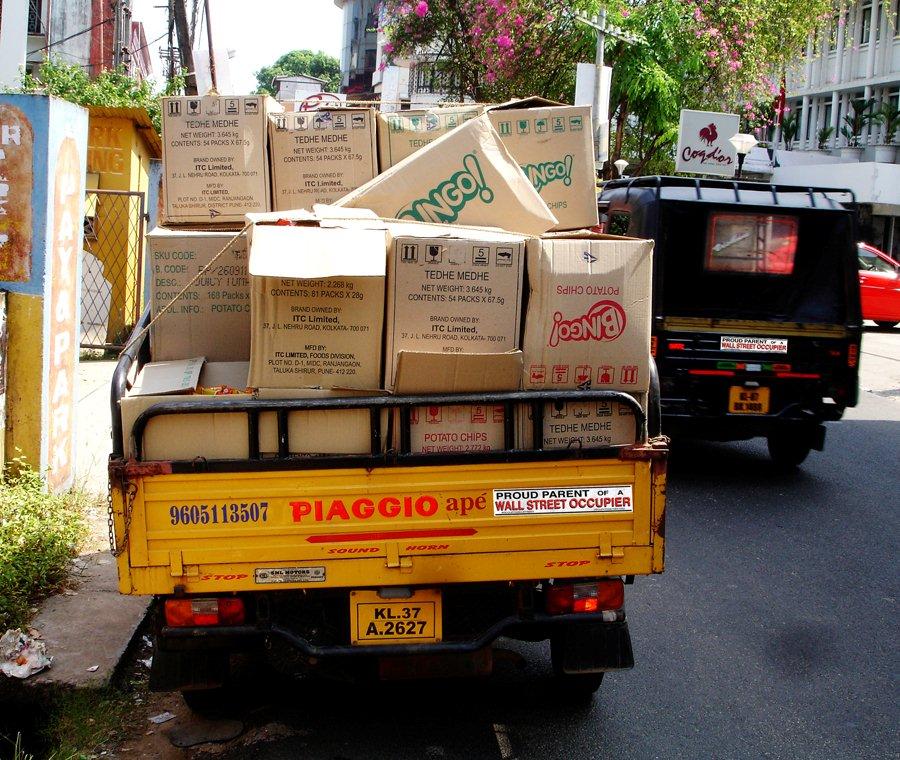
Despite the innumerable benefits of living abroad and the rich experience of new foods, cultures and lifestyles, the thrill of a gift box from family cannot be described.  As time passes the requests have changed, but the comfort foods of Girl Scout cookies and organic macaroni and cheese still count for something to the teenager in our family.

The snap shot above shows the range of contents in a recent box. Continue reading

Portland’s Food & the Local Ideal

Having posted an item or two in the past about food, I am newly inspired to indulge my interest; inspired by a recent visit to Portland, Oregon. It was my first time to this city, a city that seemed to care more about its food than any other city I’d been to. (A bold statement I qualify with the varied ways in which a people can “care” about its food.)

Good food is a social backbone of many a metropolis.
They cultivate their gardens of superstar restaurants, or food trucks, whatever the case may be. The big and advanced cities have their bevies of bloggers and critics, evaluating the experience that comes with each bite. Each person I’ve met in each town I’ve been to, no doubt, cares to a certain extent about their food, but only in Portland did I feel the caring resemble something like the way a person cares about family. Like a pet-owner, plant-keeper, or passionate professional, the people of Portland appeared to feel invested in their food as an essential way of being good not only to themselves, but to some “other.” Continue reading

Strengthening Helpers’ High

Lately, I have been pondering altruism, one’s unselfish devotion to the well-being of others often without regard to personal well-being.  I admit I am befuddled by the concept.  It challenges theories of evolution and even caused Charles Darwin to question his own theory of natural selection—how could these acts of self-sacrifice exist in a world full of the fittest habitants, that possess only an incentive to survive and reproduce?   Regardless, I find it very encouraging to witness such selfless behaviors from my fellow mankind.    This behavior takes many forms in many aspects at many different times.

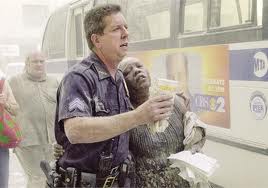
For instance, I reflect on the aftermath of September 11, 2001.  This date was one of the earliest times in my life when I acknowledged altruism’s existence.  I remember people gathering in tribute to the dead, celebrities organizing benefit concerts to raise money, and yellow ribbons streaming across nearly every home and shirt lapel signifying compassion for lost lives.  After Hurricane Katrina swept through the Gulf Coast, citizens all over the nation offered their support; my family even opened our home to refugees for a few weeks.  Similarly, this year’s September flooding of the southern tier of New York and the recent damaging snow storms of the East Coast have brought out the kindness and generosity of neighbors.  From the Flight 93 passengers to storm rescuers, altruism spurs many questions: Why are some people willing to help even at their own expense?  Why do some feel the urge to help more strongly than others?  Can altruism be learned or is it innate? Continue reading

Glassy Eyed

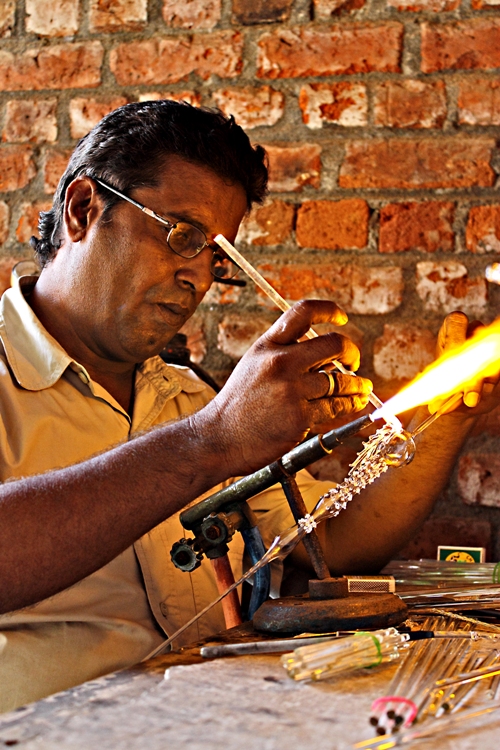
While in Chennai about a week ago, I visited a cultural center, somewhat like a living museum, about an hour outside the city. Dakshinchitra, the name of the display, means “picture of the South” – and it lives up to its name. In addition to being a window to the past, the center, supported by an NPO, supports local artists who set up small stalls on the premises, selling their crafts directly to the buyer, eliminating dealers and price-cranking middlemen. One such artist is Mr. V. Srinivasa Raghavan – a glass blower born and bred in Tamil Nadu.

While I at first felt that the blowtorch-wielding artist was out of place in the century-old surroundings of the compound, I was soon thinking back to my historical education, remembering that glass was being manipulated as far back as the Roman Empire. The means in this case justifies the ends – perhaps the trade’s Continue reading

Progress Back And Forth

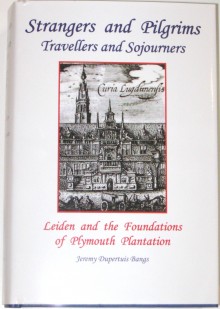
We have noted before the intriguing coincidences that link the “old world” to the “new world”–not least the desire to establish trade with what is now Kerala and the accidental discovery of somewhere else; and other links in both directions.  “Old” and “new” become fuzzy qualifiers when considering “modern” European travelers of the 15th century sailing to “ancient” India and instead encountering people we now call Pre-Columbians.  Seth has posted on the environmental impacts of people from that so-called old world as they settled in the new world and brought their definitions of progress with them.  Now, thanks to an article in Smithsonian Magazine our attention is brought to a book and a man who broaden our horizons back to the old world from which those people came. Continue reading

The Tale of Two Pomegranates

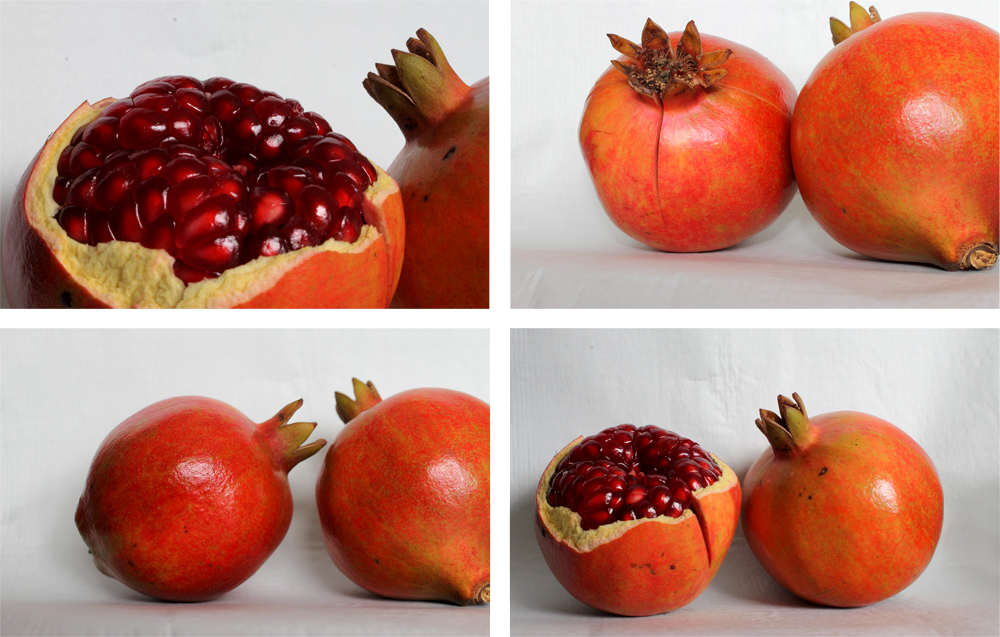
The color red defines the current fruit season in India.  (Bananas don’t count because they are always in season, and yes there are indeed red bananas…)  The fruit stalls are piled with apples and pomegranates.  What lacks in variety is made up in abundance, as well as the flair for display.

But this season pomegranates reign.  Native to Iran (culturally Persia), the fruit traveled through India, mostly in the north of the country (Pune is famous for pomegranate production), but also in our southern state of Kerala.  The Middle East, Mediterranean and southern Europe were also fertile ground for the Punica granatum, and when the Spanish brought it to the “New World” it completed the global circuit nicely. Continue reading

So, San Jose

But how is it? It’s certainly not a beauty compared to other bigger cities. The Google Earth image above provides a kind of accurate representation of the first impression–not much to feel at first glance.  But this city has its own very charming sides, and I enjoy being here.  Continue reading

From Halloween To Día De Los Muertos

On the fringes of our intent at this site, where culture is sometimes king, sometimes queen, and sometimes jester: a pause to refresh our memory of what many of us consider a not-so serious cultural artifact.  The traditions associated with October 31 in the USA represent a rich co-mingling of sacred, sacrilegious and purely commercial interests; in Mexico and elsewhere those of November 1 or so represent mostly sacred, family-focused interests.  But both share, at least in recent times, an orientation toward humor and its ability to soothe fears.  In that specific path of tradition, the following seems just right for the transition from October 31 to November 1:

Bend It Forward

This slideshow requires JavaScript.

Over ten years ago South African designer Marisa Frick-Jordaan literally wove together two of her apparently disparate passions : Socio-economic development and contemporary craft and design.  A BA Honors degree in Politics and Fine Arts at the University of Natal and a Fashion Design Diploma at Natal Technikon was followed by 6 months at the Cité Internationale des Arts, a residential arts cooperative in Paris, similar to London’s Cockpit Arts.

A long time interest in African art forms took her from a clothing line that incorporated Zulu beadwork to a telephone wire weaving project that blends traditional craft with avant-guard, award winning design.  Weaving is an ancient art around the world and in addition to the use of grasses, the decorative use of wire in Southern Africa dates back hundreds of years. Color coated copper telephone wire came with modernization and the rural to urban migration created access to these new industrial materials. Continue reading

“Horoscope not matching, that lady…”

A few weeks ago I wrote about the importance of the astrologers‘ input in choosing a life mate.  Yesterday I asked a member of the family whether the young man had chosen a bride yet.  The title of this post was his simple response.

So, back to the drawing board, as the saying goes….

Don’t Tread On Me

Humans’ ecological footprint has been increasing while the Earth has remained the same size. Especially in the last three centuries, the impact of human populations on surrounding landscapes and resources has grown enormously. In the United States, the footprint’s swelling can be explained in large part by the change from subsistence to profit-minded production. The colonists who brought European ideas and techniques to America instigated this shift, which began in the late seventeenth century and has arguably continued till the present. The abundance of resources in early America, and the fact that they could be so easily exploited, facilitated this change towards a profiteering mindset. It is with this observation in mind that I can suggest that the fertile nature of early America contained the seeds of our profit-oriented attitude of today, leading to an ever-growing ecological footprint.

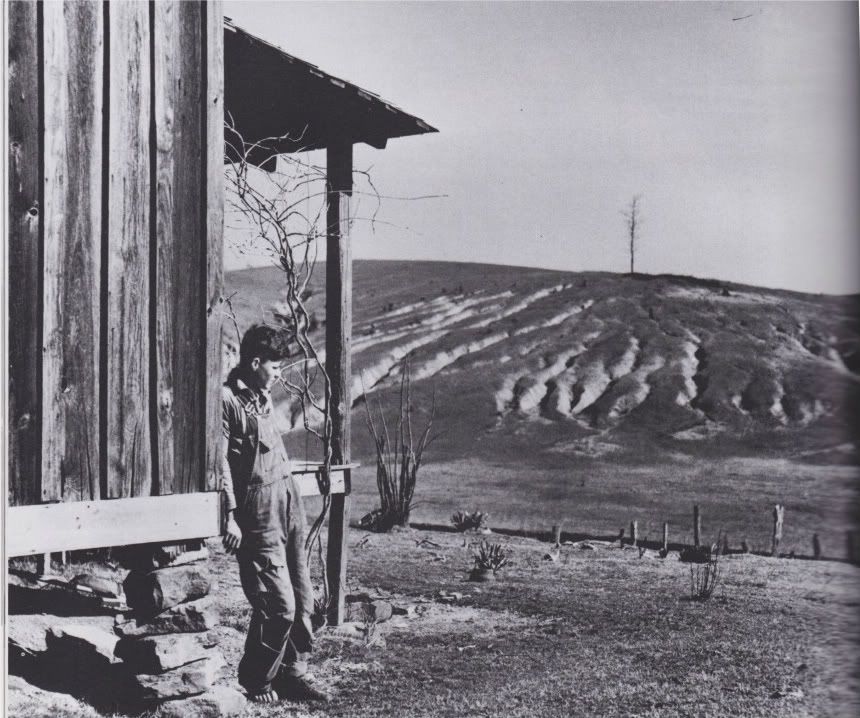
Arthur Rothstein “Soil erosion, Alabama, 1937”

Men such as Gifford Pinchot and John Muir realized the dangers of the attitude towards excess and, in order to avoid exploitation of American forests and mountains, attempted to Continue reading

How the Wind Rose Turns

A recent trip to Thekkady showed me that the North East Monsoon will soon be upon us.  The state’s equatorial tropical climate is dictated by its privileged position between the Arabian Sea and the Western Ghats, with the South West Monsoon providing respite from the summer heat and the North East Monsoon providing displays of lightning worthy of the Diwali season.

As the winds pick up it made me think about our time in Croatia, a country where the winds have mysterious names that don’t appear to coincide with points on the compass.  Like eddies, one of those inanimate natural phenomena that seem to take on animated characteristics, the named winds seem to possess characteristics far greater than the mere direction of their source. Continue reading

Galapagos Crafts

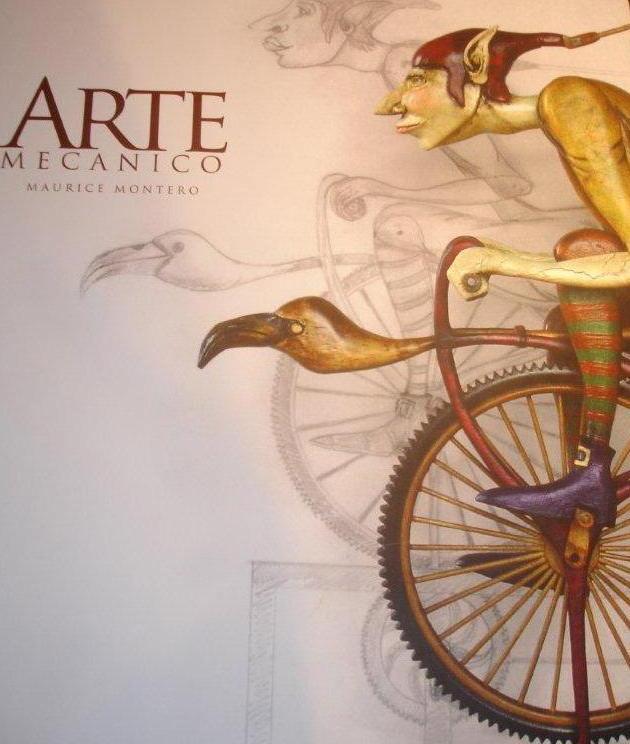
Another change visible in the Galapagos Islands circa 2011, versus 2oo3, is the quality of the craft on display in at least one shop in Puerto Ayora.  I have always been interested in artisan craft, but especially so in the last 15 years.  My first exposure to the intersection between ancient traditions and modern methods was in Guatemala in the mid-1990s, where an Austrian artisan was working with Maya communities on the re-establishment of production of finely carved ceremonial masks.  Not long after that, I saw the same thing in Ecuador, where a Swiss artisan was working with the tagua nut (aka vegetable ivory) to create remarkable carved curiosities.

Now, in Galapagos, I see that an Ecuadoran artisan has documented his work in this book, showing a series of hand-made, all-wooden mechanical devices.  While he is not based in the islands, his work is on display and somehow resonates especially well there.  I took these short videos while visiting the gallery showing his work:


Olives In October

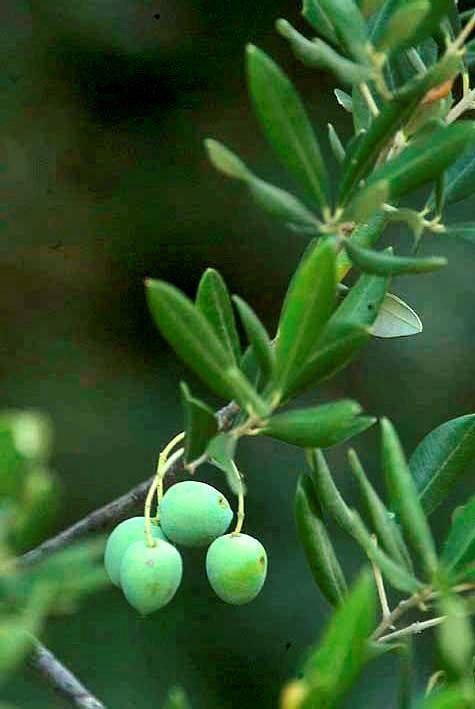
October is the month for harvesting olives in Croatia. I thought about this recently when cooking in my Kerala kitchen as I opened a jar of imported olives, knowing in advance that they would never hold a candle to the  quality of artisanal food. When we lived in Paris one could buy olives by the kilo at the marché, with numerous varieties to choose from. But here in southern India I have to settle for rather industrial Spanish imports at the table and memories of unparalleled flavor in my mind.

In reality, there are two harvests—one for olives that will be cured, and one for olives that will be pressed for oil. On smaller islands the frenzy of activity is much more evident for the latter—perhaps because fewer people cure olives anymore. The island people found me to be quite the curiosity. Here I was, a newcomer, trying to do all the traditional things that most young people were attempting to abandon.

There was no commercial production or agriculture on Koločep, one of smaller of the 5 Elafiti Islands, that sit like an extended constellation from the city of Dubrovnik. All gardens and orchards are for personal use, but there are people who certainly had large amounts of land in one sort of production or another. Our very overgrown home garden was a small example—there were figs, pomegranates, mandarinas, plums, carobs and of course, olives—none of which have been pruned  for what looked like decades. Continue reading

Occupy Language!

The collection of thoughts, links, images, etc here is meant to bring attention to ideas and actions for a challenged and challenging world.  Written and spoken language, to say the least, have been important tools to this end for some time.  The language we use on this site, by default, is a function of those of us who banded together on a given day at a given time to do this jig.  Other languages, the cultural patrimony sometimes referred to as intangible, are hopefully strengthened, rather than weakened by this effort.

This fellow makes some very important points about the English language.  We have not read his book, but from his excerpted thoughts there is good cause to read more reviews and add it to the maybe list.  Meanwhile, we make our cultural case (another reason, beyond skiiing, to put Kashmir on your map?) to keep languages alive, perhaps especially of those not included on the most-alive list:

There are anywhere from 350 to 500 million native English speakers, and up to 1 billion more who use it as a second or additional language to some extent. That’s 20% of the world’s 6.9 billion people. There are close to 7,000 languages spoken around the world today, but according to Ethnologue, 39% of the Earth’s people speak one of eight brand-name languages: Chinese, Spanish, English, Arabic, Hindi, Bengali, Portuguese, and Russian (Japanese is number 9). Of these, only English can claim global dominance.

Hatched Hats

For several decades after the 1880s, seeing birds on women’s hats in the United States was very common. It was fashionable to have everything from a couple flowing plumes to a whole pheasant on a hat; the ornithologist Frank Chapman found forty species in the millinery district of Manhattan.

Less than a decade earlier, wild passenger pigeons had gone extinct in North America, due to unfettered hunting and deforestation. It looked like the same was happening to several other species, but instead of being hunted for food like the pigeons, these other birds were killed solely for their bodies or feathers.

Snowy egrets and great white egrets were nearly decimated … The millinery trade in the 1880s and 1890s cleaned out tern, heron, gull and egret rookeries up and down the Atlantic coast, from Maine to the Florida Keys. Continue reading